These are the things you must know before entering the succulent circle
Tips
Every circle has its own unique language, and the succulent plant circle also has its own language for communication. In order to communicate more smoothly with other enthusiasts and share experiences and insights, these succulent growing and cultivation terms are essential to know~
Topics
Old Stump
After many years of growth, the succulent's stem is no longer in a tender stem state. Over time, the surface has slowly aged and formed a bark-like structure, becoming lignified. From a distance, it looks like a miniature large tree. However, severely lignified plants often have lower root activity, and when repotting to encourage rooting, recovery is relatively slower. Like people, when they get older, metabolism and hormone secretion are no longer as vigorous as when they were young.
Clustering
Multiple growth points growing together on the same root system and stem can be called clustering. Unlike fasciation, the growth points of clustering are relatively independent. Clustering is a state of natural growth, and it is not the result of mutation. It is relatively common. Usually, leaf cuttings can easily grow many small heads at the same time, and when they grow up they become clustered plants. If they grow a bit more and fill the original container completely, then this pot of plants can also be said to have "burst the pot."
Fasciation
A common malformation mutation phenomenon in plants, belonging to a type of variation in plant morphology. When certain varieties of succulents receive external stimuli from unknown causes (watering, sunlight, temperature, chemicals, sudden climate changes, etc.), the growing point at the apex divides abnormally and doubles, forming many small growth points. These growth points then develop horizontally and connect into a line, eventually growing into a flat fan shape or cockscomb-shaped band. Because of their strange morphology, fasciated mutant plants have higher ornamental value, and because they are rare, they are more precious than the original species (cultivar). Fasciation can also be propagated by cuttings; after cutting off, insert into soil and it can root. However, some individual growth points, after being cut and planted, will ultimately not grow into fasciated forms, but ordinary plants. Fasciated succulents are especially prone to turning black and rotting entirely in summer. It is uncertain whether this is caused by leaves being too densely packed and poor ventilation. In any case, in summer they must be placed in a cool and well-ventilated place.
Variegation
Due to the influence of various factors during cultivation such as watering, sunlight, temperature, chemicals, and sudden climate changes, the genes controlling pigments inside the plant mutate, thereby causing changes in the color of the plant's stems, leaves, and other parts. Taking Crassulaceae as an example, the mutated colors are mostly red, white, and yellow. According to the distribution pattern of the colors, they can also be divided into full variegation, extreme mottling, edged, center mottling, three-light center mottling, reverse mottling, etc.
Bursting the Pot
When a succulent grows and propagates on its own, with stems and leaves exceeding the range that the flower pot can contain, it is called bursting the pot. Bursting the pot shows that your care is on point. Do not worry. It is recommended to move it to a larger flower pot to leave room for the succulent to grow.
Leaf
Cutting
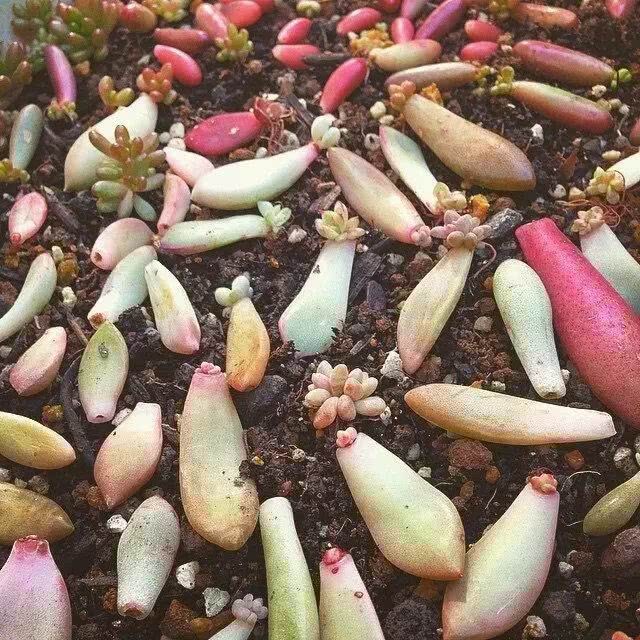
A propagation method for succulents, inserting succulent leaves into soil to regenerate a new succulent plant.
It can also be called stem cutting, cutting off the top part of the succulent for propagation. The base left at the bottom, after the wound heals on its own, will also grow new small heads.
Behead
ing
Division
Propagation
A propagation method in which small branches growing from the roots or stem base of a plant are cut away from the point where they connect to the mother plant, and then planted separately so that they grow into independent new plants.
Dormancy
It is a self-protection mechanism of plants. Different varieties will enter a dormant state under different temperature conditions. Just as plant leaves turn yellow and fall in autumn and sprout in spring, the only difference is that when succulents are dormant, their leaves do not all turn yellow and fall off. At this time, they stop growing. Caring for succulents during dormancy especially tests the grower's skill and experience.
Enclosed Growing
Enclosed growing is a care method popular in low-temperature seasons, usually for varieties such as Haworthia cooperi, Haworthia retusa, and Haworthia that like high humidity. Just place a cover with a diameter similar to the flower pot over the pot, or use film, plastic bags, and other methods. The main purpose is to create a small greenhouse for the succulent, increase the air humidity around the plant, and make the succulent plump and dewy.
Note:
1. Succulents being grown enclosed cannot receive direct sunlight, otherwise it is easy to cause excessively high temperatures and lead to the consequence of "cooking the succulent";
2. Do not immediately enclose a succulent just after watering. It is recommended to wait until the surface soil is dry but the lower soil still has moisture;
3. Do not keep it enclosed for a long time. It is recommended to remove the transparent cover when the nighttime temperature is lower, letting the plant breathe fresh air. This can also increase the day-night temperature difference, which is beneficial to succulent growth;
4. Not every succulent is suitable for enclosed growing. If adult plants of Crassulaceae and Aizoaceae are grown enclosed, it is instead unfavorable to their growth.
Etiolation
Due to insufficient light, the succulent grows only a long stem without growing plump. It loses its original short and sturdy shape, and the originally relatively closed rosette leaves become more spread out. Succulent enthusiasts vividly call this phenomenon "wearing a skirt" or "spreading a big pancake." Etiolated plants are not only unattractive in form and lose their vivid colors, but the powder and fuzz on the succulent surface also fade, making them highly prone to pests and disease. Once a plant has become etiolated, it is basically impossible for it to change back. You can wait for the spring and autumn growing season, cut off the top, let the wound dry, and then do stem cuttings. Be sure to remember to give it plenty of sun (except at noon in summer). If sufficient sunlight cannot be guaranteed, then control watering a little.
Water Rot
Excessive watering or certain diseases, low temperatures, frostbite, and other reasons cause the succulent's leaves or stems to gradually become transparent, and to soften, fall off, and eventually rot.