The Vain Succulent Rose - The Aeonium Series Beginner's Guide
Wonderful Ability Song
Chen Li's singles list
Chen Li
00:00/04:13
BGM: Chen Li - Wonderful Ability Song
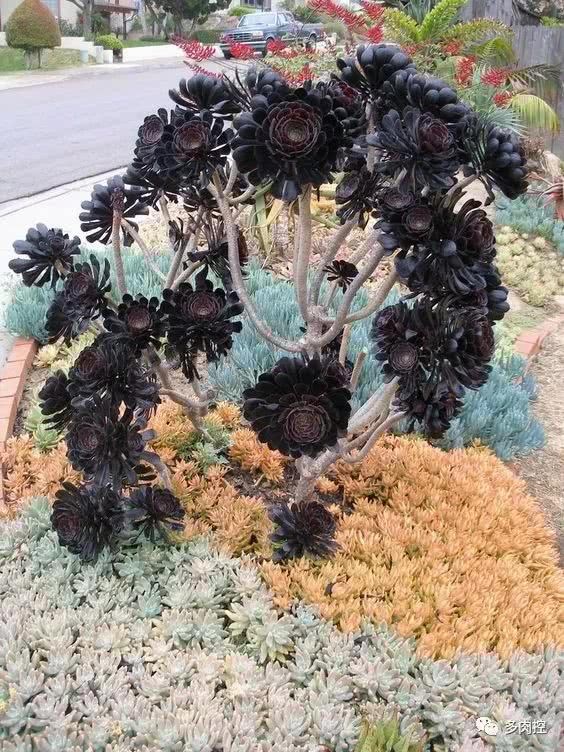
Aeoniums, succulents of the genus Aeonium, have become the white moonlight in the hearts of many succulent lovers thanks to their tall, slender posture and perfect lotus shape.
If you have a yard, you must have succulents. And the summer that has just passed was their most beautiful time, because aeoniums choose to go dormant to get through the high temperatures, and once autumn cools down, they will slowly bloom again.
So why do aeoniums choose to go dormant in summer? This has everything to do with the aeonium's homeland - the Canary Islands.
Canary Islands
- The Mystery of Aeonium Dormancy -
The Canary Islands are an island group in the waters northwest of Africa, with an area of 7,273 sq km. The eastern island group includes Lanzarote, Fuerteventura and 6 small islands; the western island group includes Tenerife, Gran Canaria, La Palma, La Gomera and El Hierro (also known as Ferro Island).
Speaking of El Hierro, everyone will surely think of a succulent: the pink El Hierro. Yes, the Canary Islands are the homeland of succulents of the genus Aeonium.
On these islands, more than 40 species of aeonium and over a dozen species of mountain roses were born.
And the common horticultural aeonium varieties now number more than 60.
First let us look at some of the aeoniums:
Large-leaf Coronarium
Purple Velvet
Starburst
Small-leaf Black Aeonium
Halloween
Shaoxiu
Plum Puddy
Black Copper Kettle
Red Copper Kettle
Mirror Lion
Green Velvet
The above images are from Amber Pine Cabin
Black Aeonium
Aeonium Variegata
Sunburst?
Ink Aeonium
Red Belly Wheel
Medio-variegated Aeonium
Lily Lily, yes, it is also an aeonium
Turning back to the Canary Islands, the region has a Mediterranean climate. The weather is warm, with little change across the four seasons. The average afternoon temperature in Las Palmas in August is 26°C, and in January it only drops to 21°C. Summer rainfall is scarce, while winter is abundant.
A bold guess: is the aeonium's dormancy related to the area's scant summer rain and high temperatures? And the reason aeoniums go dormant above 30°C is also probably related to the summer temperatures of their native habitat.
And,aeoniums are not cold-tolerant; they will suffer frost damage below minus 5°C, which is also inseparable from the local warm winter climate.
The fertile volcanic soil and mild climate of the islands are suitable for many kinds of vegetation, and the distribution of plants varies with the height of the terrain.
- Care -
Compared with other succulents that are especially picky about soil, aeoniums can be considered very easygoing.
Many succulent lovers who use garden soil also grow them perfectly well, and aeoniums are not recommended to be grown in pure grit, since tall ones eat a lot.
Aeoniums have other advantages too: they easily produce offsets, especially easily produce offsets. In the first year it is not very obvious, but after growing them for 2 or 3 years, they really do shoot up and quickly turn into a bouquet.
Soil: 7:3/5:5/6:4, with peat being the smaller portion. In the free-shipping area, considering the summer survival problem for the coming year, the grit proportion can be slightly higher.
Pot: Use a deep pot for tall ones; for short ones, first grow the roots, and once the roots are well grown, then switch to a deep pot, otherwise too much water sitting deep in the pot can easily drown the short one. It is recommended to put a layer of ceramic pellets at the bottom to help with drainage~
Growing environment: Ventilation, definitely ventilation. Keep them fully outdoors in spring, summer and winter, and provide appropriate shade in summer. Aeoniums still have a fairly high demand for light, so it is not very recommended to grow such large succulents indoors.
Beheading: After beheading, there is a saying that aeoniums very easily form clusters, especially single-headed aeoniums; it is not rare for one to burst into more than a dozen heads. But the timing of beheading must be chosen well - the lingering power of the autumn tiger is still there, and beheading is sending them to their death. Generally speaking, the suitable growing temperature for aeoniums is 15°C~25°C, so beheading within this range is fine.
Note that the wound should be left for a few days to heal before exposure to the sun. As for whether to apply carbendazim to the wound, it is better not to apply it; anyway, when the weather is cool, succulents have their own resistance.
Besides these, aeoniums also have other "advantages."
- Peculiar Aeoniums -
1. They are divided into large aeoniums, medium aeoniums and small aeoniums. Just how big is the difference? See the pictures for details~
2. Do they die once they bloom? Yes. Once an aeonium blooms, if you do not cut off the flower stalk, it will kick the bucket; and even if you cut the flower stalk, there is still a certain chance it will kick the bucket. They are really hard to please.
3. They have a smell: for example, Shaoxiu and Purple Velvet come with athlete's foot, and the more in condition they are, the stinkier they get. The beautiful Lily Lily, on the other hand, has a sweet honey scent.
Even though it is so peculiar, I still love it~ What about you?
·END·
—Welcometo submit articles, there are rewards, so contact us quickly—