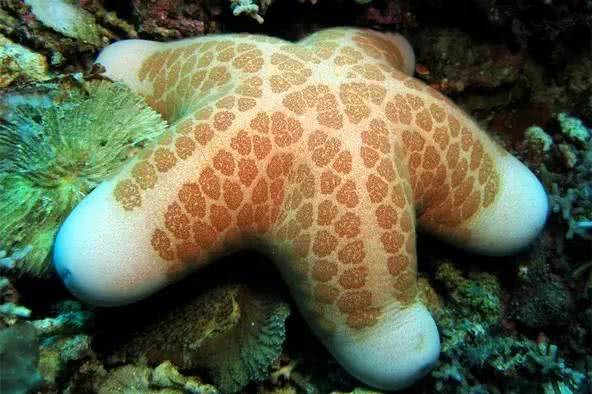
This star looks a bit strange. What on earth is it?
WeChat Official Accounts got a redesign, and everyone is giving their favorite accounts a "little star." Lots of friends said they gave Calendar Ma a star right away, yay! As a thank-you gift, today Calendar Ma is giving you this "star" she has kept at the bottom of her box.
Sea stars are widely distributed across all the world's oceans, and they come in a huge variety of species and shapes. The one Calendar Ma wants to give you is even moreunrestrained and casual in its looks, and it is thegranular sea star(Choriaster granulatus)。
Good heavens, look at those indescribable arms
Like all other sea stars, the granular sea star is also anechinoderm,It belongs to the order Valvatida and the family Oreasteridae. Its goofy figure can be seen in the Indian Ocean, the Pacific Ocean and the Red Sea. It usually lives in shallow coral reef waters of tropical seas, and its body diameter can reach about 20 cm. It is a medium-to-large sea star.
Granular sea star. Image: curiousokinawa.com
The body surface of the granular sea star is smooth, with no tubercles or spines.Slightly raised papulae covered with fine granules, which serve for respiration and excretion, and this is also the origin of its Chinese name.
The body of the granular sea star consists of a central disc and five radiating arms. Its build is sturdy and plump, looking both like a comfortable throw pillow and like a soft lump of dough, which is why it has the English common names "cushion seastar" and "doughboy star."
Dark papulae covered with fine granules. Image: fineartamerica.com
Granular sea starThose five indescribable armsare the essence of its appearance. Its arms are short and thick, the last quarter of the tip is not covered by papulae, the tip is rounded, and the ambulacral groove in the middle of the underside extends upward. From a human perspective, the grandeur of these five arms is like the Battle of the Five Armies, stirring the imagination, so it also has the Japanese colloquial name "five times a night guy" (heavy fog); as for the nicknames "Gu Juji" and "Jin Chengwu" jokingly used among fans, someone who doesn't follow celebrities seems not to know what they are talking about.
Those five indescribable arms. Image: basdiving.com
In the American animated series SpongeBob SquarePantsPatrick Star(Patrick Star) was very likely modeled on the granular sea star. The chubby pink sea star in the show is always inseparable from SpongeBob. He is scatterbrained and physically strong, often causing trouble for everyone, is a loyal fan of the Krusty Krab, and is SpongeBob's best friend. Boo-hoo, it seemsnow we finally know why SpongeBob is full of holes(covering face).
SpongeBob and Patrick Star. Image: SpongeBob SquarePants
The silent hunter on the seafloor
Sea stars rest quietly on the seafloor, and that silent appearance is in stark contrast to their usual image as greedy carnivores in the ocean. Like most sea stars, the granular sea star has relatively hard calcareous ossicles, and its arms can only bend slowly, so theirmovement mainly relies on the "water vascular system"。
Tube feet of the granular sea star. Image: curiousokinawa.com
There is a groove in the middle of the underside of their arms, usually bearing several rows of small tube feet with suckers. The tube feet are soft and elastic, able to swing back and forth and grasp and suck onto objects. At the base there are finger-like fluid sacs filled with liquid and connected throughout the body to form a water vascular system.
In short, sea stars can control local muscle contraction through the nervous system, thereby using these"hydraulic little tube feet"to support and move the body. The arms of a sea star are radiating, sothe body has no front or back,and any arm can act as the vanguard, moving in any direction at any time, at least 5 to 10 cm per minute.
The well-developed water vascular system of the granular sea star. Image: curiousokinawa.com
The granular sea star usually feeds on mollusks, coelenterates and corals. When hunting, it uses the tactile and olfactory functions of its tube feet to find prey. After discovering prey, it tightly embraces the prey with its stout arms, or uses the suckers of its tube feet to pry open the prey's shell, then spits out its cardiac stomach from its mouth to wrap around the fleshy part of the prey and begin digesting and absorbing it. Sometimes it can evenpush its stomach into the narrow gap between the tightly closed valves of a bivalve. This amazing trick allows sea stars to prey on animals much larger than themselves.
Holding on tightly. Image: wetwebmedia.com
Here comes the giant triton. Run!
The granular sea star encounters quite a few natural enemies in its life, such as seabirds, sea otters and so on. Of course, there is also a major nemesis from the seafloor, the famoustriton(Charonia tritonis)。
Triton (C. tritonis). Image: 123rf licensed image
The triton is a huge sea snail. Its shell can grow to nearly 60 cm at most. It is one of the largest mollusks in coral reef waters, and its favorite food is sea stars.
Like most sea stars, after the granular sea star encounters a natural enemy,in a moment of crisis it will detach the arm that has been grabbed, but their arms have a very strong regenerative ability, and before long a new one will grow back.
A triton preying on a sea star. Image: norbertwu.com
The triton also preys oncrown-of-thorns sea stars(Acanthaster planci). Compared with the granular sea star, the crown-of-thorns sea star is a major enemy of coral reefs. It can cling firmly to corals, turn its stomach inside out to cover the coral, and at the same time secrete large amounts of digestive fluid that penetrates into the pores of the coral's calcareous skeleton, turning the delicate coral polyps into a nutritious "delicious feast."Each crown-of-thorns sea star eats about 15 square meters of coral tissue every year.The crown-of-thorns sea star is covered with venomous spines all over its body, and the triton is almost its only natural enemy.
Granular sea star on a coral reef. Image: casc.it
A crown-of-thorns sea star preying on coral. Image: Michele Westmorland / Animals Animals
Unfortunately, today in many countries the triton is still traded as a beautiful ornament. Humans catch large numbers of tritons, makingthe number of natural enemies of the crown-of-thorns sea star smaller and smaller; in addition, overfishing of fishery resources has reduced some fish that prey on crown-of-thorns sea star larvae.
The crown-of-thorns sea star has very strong reproductive capacity, laying about more than 100,000 eggs at a time, and in less than two years it can mature and become capable of reproduction. An exploding population of crown-of-thorns sea stars can bring serious disaster to coral reefs,like a coral plague。
A triton just caught. Image: natgeocreative.com
This article is a 2017 article from Species Calendar, from Species Calendar author @Safish.
Soft and cute Calendar Ma, swapping stars online~
Do you all like this "star" from Calendar Ma?
Remember to leave your star before you go!
If you haven't yet, open the "…" button at the top right of the official account's main page, and choose "Set as starred" and that's it!