Pomelo's coldest Mid-Autumn Festival: middlemen slash prices in the chaos, auction prices fall below cost -- how to break the curse?
The coldest Mid-Autumn Festival for pomelo farmers! This year, due to weather factors, pomelo production rose 11% over last year. The Agriculture and Food Agency estimates this year's total production across Taiwan at 86,953 metric tons, yet it has run into sluggish demand. Farmers in the two major pomelo-growing areas -- Madou and Hualien -- are crying out in distress. In Madou, because each farmer's growing area is small, most go the direct-sales route, with direct-sale prices ranging from about 50 to 100 yuan per Taiwanese catty (600 g), but wholesale prices to middlemen fall between 18 and 35 yuan per Taiwanese catty, about 70% of past levels.
Hualien pomelos are mainly bought up by middlemen, and the prices have been brutal. In early September, the opening price was only 17 yuan per Taiwanese catty, then it slid all the way down, finally holding at around 12 yuan per catty. Farmers lament bitterly: "Some of the nastier middlemen use the atmosphere of pomelos being hard to sell to slash prices. I heard of 6 yuan per catty -- farmers are basically being slaughtered."
Weng Chen-hsin, chief secretary of the Agriculture and Food Agency, said that according to origin quotations, Douliu pomelos are 91 yuan per kilogram (54 yuan per Taiwanese catty), Madou 83 yuan (50 yuan per Taiwanese catty), Ruisui 61 yuan (38 yuan per Taiwanese catty), and Bali even sells for 100 yuan per kilogram. He pointed out that this year's production increased by 10%, and because the interval between White Dew and Mid-Autumn Festival shrank by ten days this year, the sales period is shorter, but the Council of Agriculture, along with various local governments and farmers' associations, actively promoted sales, and the sales situation is decent: over 95% of the Madou area has sold out, while the Hualien area is roughly estimated to have 300-500 metric tons left.
A farmer surnamed Kuo in Madou said the prices cited by the Agriculture and Food Agency are gift-box prices. "Of course origin gift boxes are high-priced. Our own gift-box cost is nearly 60 yuan. If we don't sell at 95 yuan per kilogram, we're losing money. That claim is ridiculous." Kuo stressed that in the auction market there are prices of 5 yuan per kilogram (3 yuan per Taiwanese catty) and 10 yuan (6 yuan per Taiwanese catty). Not only substandard goods -- even good goods are auctioned off in a total mess. Fruit farmers angrily criticized: "The Council of Agriculture issued a notice saying pomelos under 10 yuan per kilogram should not go to the auction market. So are these pomelos supposed to be left to rot? There are simply no supporting measures."
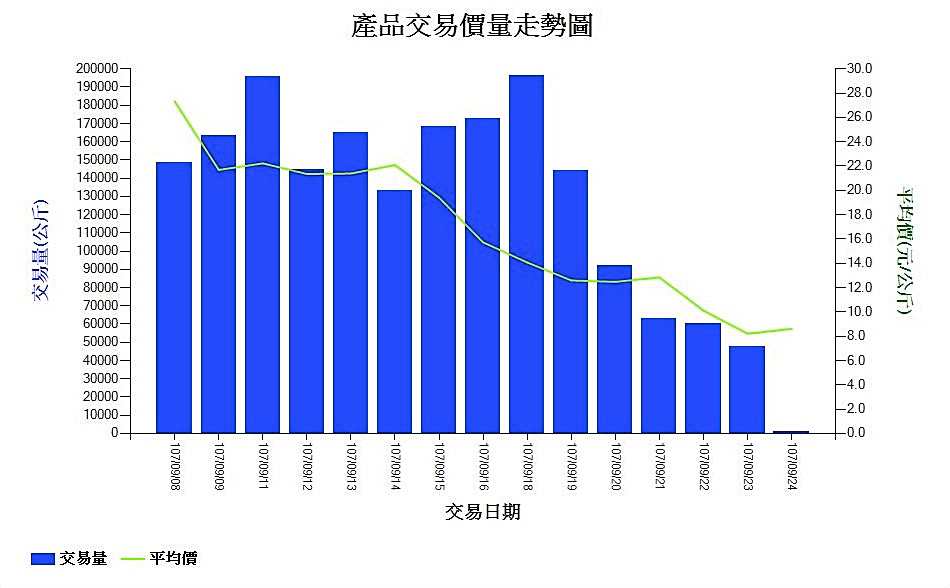
According to the Taipei Agricultural Products Marketing Corporation auction price scale, on September 8 (White Dew) the average price was 28 yuan per kilogram (16.8 yuan per Taiwanese catty), on September 9 it slid to 22 yuan per kilogram (13 yuan per Taiwanese catty), then fell all the way down, and two days before Mid-Autumn Festival (September 22) only 9 yuan per kilogram remained (5.4 yuan per Taiwanese catty).
Council of Agriculture notice: "Don't send anything under ten yuan to the auction market" -- farmers: are we supposed to let them rot?
Farmer Kuo estimates that about 60% of his pomelos were bought by wholesale outlets, 30% went to the auction market, and 10% were sold direct from the origin. "The amount I sell direct myself is at most ten or twenty thousand catties, but the total volume is 400,000 catties. The wholesale outlets can't absorb that much either, so some still has to go to the auction market."
"Once it goes to the auction market, whether the price is good or bad isn't up to you -- it's up to the auctioneer." Kuo said that in the week before Mid-Autumn Festival it was very obvious: the auctioneer told me that two truckloads come into the auction market from the east every day. "The auction price is 15 yuan per kilogram (9.3 yuan per Taiwanese catty), and those are pomelos from forty-year-old trees, and there are still freight and cardboard-box costs. But what can you do? There's nowhere to stuff them." Wholesale outlet purchase prices were over 70 yuan per kilogram at best, and 12.5 yuan per kilogram (7.5 yuan per Taiwanese catty) at worst. "Going into the auction market is basically trampling on us. This year the market is all pomelos, so it's hard to sell high, and consumers can hardly tell good pomelos from bad."
Kuo went further, pointing out that the Council of Agriculture sent an official document to farmers' associations saying that anything under 10 yuan should not be sent to the auction market. "But the Council of Agriculture didn't say what to do if it can't be sold. Are we supposed to let the pomelos rot? And if I don't go to auction, how would I know the price would be this low?" He believes the Council of Agriculture should have supporting measures. "Many people ask why not switch to processing, but do I have the money to buy equipment? We can't even sell the pomelos." Processing plants in the Madou area also only buy the volume they can handle. "There's simply no solution to this."
In response, Weng Chen-hsin said the Council of Agriculture did not issue an official document requiring farmers not to send pomelos under 10 yuan to the auction market. It should have been the four major farmers' groups doing joint marketing who, seeing poor-quality pomelos fetch only 5 yuan per kilogram at auction -- not even enough to cover cardboard boxes and freight -- hoped farmers would not send them to the auction market.
Madou Farmers' Association: after heavy rain, rumors spread that pomelos were flooded, causing demand to cool
"This year's demand situation is a real headache. Mainly after the August 23 heavy rain, many reports said Madou pomelos were flooded, which cooled demand." Sun Tzu-min, general secretary of the Madou Farmers' Association, pointed out that the main pomelo areas were not flooded, but once the news spread, no one came to buy Madou pomelos.
Madou's pomelo production this year is about 22,000 metric tons. Although demand is cool, Sun said Madou pomelos are mostly sold direct, so prices don't fluctuate much. The farmers' association sells in two grades, at 70 yuan per catty and 100 yuan per catty. There were many late dropped fruits, so total production is actually about the same as in past years.
As for new-tree or substandard pomelos with poor taste, Sun explained that this year the farmers' association also bought 100,000 pomelos from farmers for processing, combining pomelo peel with plums to make plum-pomelo slices. "Sales are good right now." In addition, pomelo peel can be made into pomelo peel candy, the flesh into jam, as well as shampoo, body wash and so on. The farmers' association hopes to increase the proportion of pomelo processing in the future.
Agriculture and Food Agency: origin quotes are 60-100 yuan per kilogram; farmers: that claim is ridiculous
Origins all say demand is cool this year, and farmers also point out that prices have fallen, but Weng Chen-hsin, chief secretary of the Agriculture and Food Agency, said that according to origin quotations, Douliu pomelos are 91 yuan per kilogram, Madou 83 yuan, Ruisui 61 yuan, and Bali even sells for 100 yuan per kilogram. He pointed out that this year's production increased by 10%, and with Mid-Autumn Festival ten days earlier, the Council of Agriculture, various local governments and farmers' associations actively promoted sales, and the sales situation is decent: over 95% of the Madou area has sold out, while the Hualien area is roughly estimated to have 300-500 metric tons left. "After Mid-Autumn Festival they can only be sold as ordinary fruit, and whatever can't be sold is used for processing."
Origin price means the sales price at the origin. Hung Jui-tse calculated in detail: Hualien mostly relies on middlemen buying up the crop, with wholesale outlets buying at 15 yuan per catty, including medium and large fruits. After sorting, medium fruits go to secondary wholesalers at 30 yuan, and the final retail price of 50 yuan per catty (83 yuan per kilogram) is not unreasonable. "But in reality the origin farmer only gets 15 yuan per catty." Farmers' costs generally fall at 10 yuan per catty.
Farmer Kuo said the Agriculture and Food Agency pointed out that the Madou origin price is 83 yuan per kilogram. "Of course origin gift boxes are high-priced. Our own gift-box cost is nearly sixty yuan. If we don't sell at 95 yuan, we're losing money. That claim is ridiculous." Kuo stressed that in the auction market, 5-yuan and 10-yuan prices are not just for substandard goods -- even good goods are auctioned off in a total mess. "Last year was already bad, this year is worse, and I dare not imagine next year."
Weng Chen-hsin pointed out that this year's production is estimated at 87,000 metric tons, with only 10% going to the auction market, of which the Taipei Agricultural Products Marketing Corporation accounts for 2,400 metric tons. Pomelos basically go through direct sales and wholesale outlets, and the wholesale outlets then sort them into different grades: the good ones are packed into gift boxes at various prices, and the bad ones still have to be sold -- sent to the auction market.
Taipei Agricultural Products Marketing Corporation auction prices are poor -- Weng Chen-hsin: sending them to auction means selling them as ordinary fruit
Regarding the poor auction market prices at the Taipei Agricultural Products Marketing Corporation, Weng Chen-hsin explained that pomelos are mainly sold at the origin as gifts, and sending them to the Taipei Agricultural Products Marketing Corporation amounts to selling them as ordinary fruit. "But there are still gift boxes with auction prices of over one hundred yuan per kilogram, while inferior goods go for five or eight yuan." And prices start falling five days before Mid-Autumn Festival. "After Mid-Autumn Festival it gets very realistic -- they become 10 yuan, 20 yuan."
Facing unsold Hualien pomelos, Weng also said the Ruisui Farmers' Association and the Hualien County Farmers' Association have begun buying up substandard pomelos at a purchase price of 4.3 yuan per Taiwanese catty, planning to buy 300 metric tons first and increasing to 600 metric tons if necessary.
Export-quality pomelos are all medium-to-low grade -- how to open up the market?
With pomelo overproduction, export and processing are both considered by farmers as possible ways out. Although pomelos are exported, Chang Wen-chao said exports are generally the best quality sent out, but export-quality pomelos are all medium-to-low grade. This is because domestically pomelos are regarded as gifts, and top-grade pomelo gift boxes are expensive, selling for four or five hundred yuan per catty. More than 90% of the export market is in mainland China, and traders, considering costs and selling prices, believe that good-tasting pomelos are expensive and yield no profit. Farmers also think that top-grade pomelos sell well at the origin, so why sell them to middlemen?
Chang said, "Taiwan should focus on domestic sales, with exports as a supplement." Direct sales of pomelos at the origin are profitable, and the return on investment in Madou and Douliu is high. "This year is a special situation -- demand has never been this cool, and two or three days before Mid-Autumn Festival they still weren't sold out."
Hung Jui-tse said bluntly, "The quality going out is too lousy. Seeing this stuff, I wouldn't want to eat it after two years." He pointed out that traders will definitely find cheap pomelos to export; as long as the appearance isn't ugly, there's profit in exporting. If the purchase price is too high, there's no profit to be made, which results in only B-grade pomelos being exported. "Good pomelos farmers want to keep and sell themselves -- they can sell for eighty or ninety yuan per catty. As a middleman, how am I supposed to buy from you? If I buy, how much do I have to sell them for later? Do pomelos really have that value?"
Hung suggested that production areas should be graded, with the government helping establish dedicated export zones, because the soil and fertilization management methods differ across Taiwan's production areas, and the government should help improve quality. Although there are agricultural research and extension stations across Taiwan, only the Tainan Agricultural Research and Extension Station truly understands pomelos, and other counties and cities have no spare researchers or energy to invest, so farmers can only figure things out on their own.
Weng Chen-hsin said last year's pomelo export volume was 2,400 metric tons. This year demand in mainland China is weak, and during the period before September 15 that is most suitable for export, orders were only 2,000 metric tons. However, as of Mid-Autumn Festival, cumulative pomelo exports reached 2,924 metric tons. Still, the volume absorbed by exports and joint marketing is limited, and the main sales channels remain direct sales at the origin and wholesale outlets.
How can pomelos escape the fate of being "Mid-Autumn Festival-only"?
Chang Wen-chao said farmers mainly sell fresh fruit, which can fetch a good price, and only turn to processing when there's truly no other way. Pomelo peel and flesh can be processed into different products: the outer peel can be made into pomelo peel candy, and the flesh into jam. However, Chang pointed out that pomelo processing is troublesome -- it must be peeled layer by layer, and peeling down to just the flesh is very labor-intensive and costly. To deal with unsold pomelos and substandard goods, farmers' associations in various places have also invested in pomelo processed products, developing plum-pomelo slices, pomelo peel candy, pomelo tea, pomelo jam, pomelo shampoo, pomelo body wash and other products.
Beyond exports and processing, how pomelos can escape being a Mid-Autumn Festival-only fruit is also a major challenge. Chang explained that pomelos are positioned as a Mid-Autumn seasonal fruit, with good quality and high prices, suitable for gifting. But in fact pomelos are highly nutritious and store well, and agricultural research and extension stations and farmers' associations have repeatedly promoted that after Mid-Autumn Festival, buying pomelos at the market is actually cheaper, hoping to encourage consumers to eat pomelos in daily life too. Hung Jui-tse also said that in fact pomelos taste even better after another month of storage, and can even serve as Double Tenth National Day gifts. Weng Chen-hsin said there should be more measures, such as adopting pomelo trees, so that pomelos are no longer only usable as Mid-Autumn gifts.