Eight adorable healing plants that easily fill their pots
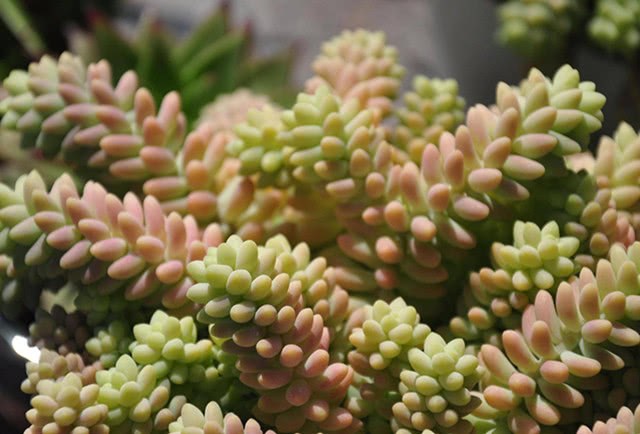
In nature there are many plants that love to trail and easily fill their pots, and of course they all belong to the healing category. In this slightly cool autumn, being able to warm you is the best thing of all! Today let us take a look at those adorable healing plants...
1. Burro's Tail (Sedum morganianum)
Burro's Tail likes warm, dry, sunny conditions, tolerates partial shade, is vigorous in habit, is fairly cold-tolerant, and has no obvious dormant period.
Cultivation tips: the optimal growing temperature is generally 18-25 degrees, and no lower than 5 degrees in winter; for water, just follow the principle of watering thoroughly once the soil has dried out completely, and growing it in special succulent soil is the most convenient; it loves light and can take full sun, though in summer it is usually given a little shade; apply light fertilizer frequently, and it can be applied along with watering.
2. String of Coins (Crassula perforata)
String of Coins, a sedum, gets its name because the plant closely resembles strings of ancient coins, and it is quite popular. Its plant form is peculiar, dainty and lovely, with pleasing colors; decorating a desk, windowsill or similar spot, it is fresh and elegant, full of charm.
It prefers a sunny, cool, dry environment, tolerates partial shade, fears waterlogging, and dislikes muggy, humid conditions. During the growing period it should be given plenty of sunlight.
3. Burrito (Sedum 'Burrito')
Burrito, a Sedum succulent, is native to Mexico. It hangs down like a string of beads, and looks very elegant trailing in a garden. Some scholars consider it a variety of Burro's Tail.
Generally speaking, apart from the intense midday sun of high summer, whether in partial sun or full sun, Burrito will grow vigorously as long as there is sunlight.
4. Rosary Vine (Ceropegia woodii)
Rosary Vine belongs to the genus Ceropegia in the family Apocynaceae, with heart-shaped, pale purplish-red leaves that hang down like a necklace.
Cultivation tips: in summer it grows rapidly under scattered light and likes a warm, airy environment. It cannot take harsh sun exposure; water as soon as the soil is dry, and if it is too dry the leaves will wrinkle. In winter it grows slowly, so water sparingly and give it more sunlight.
5. Purple Moon (Othonna capensis)
Purple Moon, also known as Purple String of Moon, is one of the trailing varieties, with very unusual leaves; under sufficient sunlight the stems turn from green to purplish-red. It bears small yellow flowers, which look very pretty against its own purplish-red color.
Cultivation tips: in summer, when temperatures are high, water less; wrinkled leaves indicate a lack of water, and the day after watering the leaves will plump up again. The optimal growing temperature is 15-28 degrees, and no lower than 10 degrees in winter.
6. Lemon Balm (Melissa officinalis)
Also called lemon balm or curly-leaf mint, it is a perennial herbaceous plant with overwintering roots; lemon balm is cold-tolerant, shade-tolerant and drought-tolerant, and also tolerates pruning.
Cultivation tips: in winter it can withstand low temperatures below 0°C; in summer, growth is limited at high temperatures above 30°C; the most suitable growing temperature is between 10-20°C.
7. String of Pearls (Senecio rowleyanus)
There are currently two common types of String of Pearls: one with round beads, often called "Buddha Beads" or "String of Pearls", and another shaped like teardrops, generally called "Lover's Tears"; there is also a variegated one with even prettier colors.
Cultivation tips: String of Pearls likes soil rich in organic matter, loose and fertile, and grows best in a warm environment with fairly high air humidity and strong scattered light. In summer, avoid high temperatures and high humidity, otherwise the stems rot very easily and the plant dies; the potted plant can be placed under rain protection and in shade for cultivation. After autumn arrives, the plant resumes growth and should be given more light.
8. Japanese Stonecrop (Sedum hispanicum)
Japanese Stonecrop is a small, elegant and wild-charming succulent. Because of its good drought tolerance, it can grow where there is little soil, and is especially suited to accenting rock penjing or to being planted directly on rocks. Its layers are rich, resembling either a miniature coniferous forest seen from afar or streams of green tumbling between peaks and ravines, displaying different charms and giving a feeling of abundant vitality; it can also be used as a surface-accent plant for stump penjing, filling the pot with emerald green and making it all the more elegantly pleasant.
Cultivation tips: Japanese Stonecrop is a crassulaceous plant that likes a warm, dry, sunny environment and has no obvious dormant period; the optimal growing temperature is generally 18-25 degrees, and no lower than 5 degrees in winter; for watering, just follow the principle of watering thoroughly once the soil has dried out completely (it is strongly drought-tolerant); it rather likes light and can take full sun, though in summer it is usually given a little shade.