Just how zen is the six flowers? Once you've seen them, you'll realize zen youths are nothing special
The term "zen" first originated from a Japanese magazine in 2014, which introduced the "zen man"; in December 2017, the entry "zen youth" flooded social media and took the internet by storm. As a cultural phenomenon, zen represents a state of being and an attitude toward life that sees through the mortal world and involves living according to one's own way of life.
Today, instead of talking about zen youths, let's talk about the plants in the zen tradition. According to Buddhist rules, places where offerings are made to the Buddha and Sakyamuni must be planted with Buddhism-related plants - the Five Trees and Six Flowers. Do you know which plants the Five Trees and Six Flowers refer to?
The Five Trees are the sacred fig (bodhi tree), the banyan, the talipot palm, the areca palm and the palmyra palm; the Six Flowers are the lotus, the miangui flower, the yellow ginger lily, the frangipani, the Chinese crinum lily and the Musella lasiocarpa. Today we will mainly learn about the six zen flowers.
1. Lotus
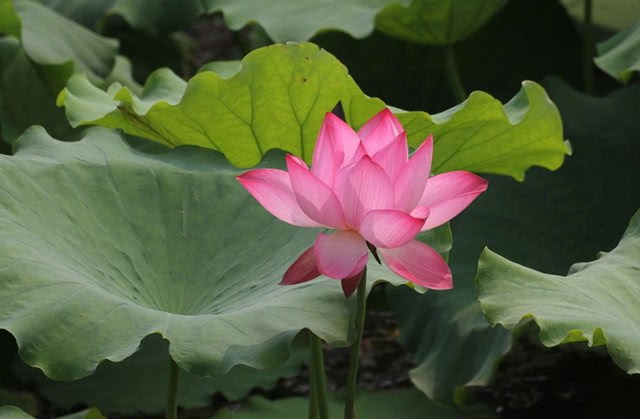
Belonging to the order Proteales, family Nelumbonaceae, it is the collective name for two species of the genus Nelumbo, also known as the lotus flower, water hibiscus, etc. It is a perennial aquatic herbaceous flower of the genus Nelumbo. The underground stem is long and thick, with long nodes; the leaves are peltate and round; the flowering period is from June to September; the flowers are solitary at the tip of the pedicel, with numerous petals embedded in the cavities of the receptacle, in colors such as red, pink, white and purple, or with colored patterns and borders. The nut is elliptical, and the seed is ovate.
The lotus is one of China's top ten famous flowers and is also the national flower of India. The lotus is a symbol of purity and, moreover, a symbol of Buddhist sacredness and cleanliness. After Zhou Dunyi of the Northern Song dynasty wrote the famous line in "On the Love of the Lotus" - "emerging from the mud yet unstained, washed in clear ripples yet not coquettish" - the lotus became the "flower of the gentleman."
2. Miangui flower
An evergreen tree, up to 17 m tall, with widely spreading branches forming a broad umbrella-shaped crown, and a diameter at breast height of 30 cm; the bark is gray; the crushed branches and leaves are fragrant; young branches and buds are densely covered with pale yellow-white fine pubescence, the hairs gradually falling off when old; the leaves are thinly leathery, oblong or lanceolate-elliptical, hairless above, sparsely covered with fine pubescence below, with the reticulate veins on both sides very obvious when dry. The flowers are white and extremely fragrant; the tepals number 10, lanceolate; the pistil has numerous carpels, and at maturity, as the receptacle extends, they form an aggregate fruit of sparsely arranged follicles; the follicles are bright red when ripe; the flowering period is from April to September, blooming in summer, and it usually does not set fruit.
The miangui flower is the white magnolia, a deciduous shrub of the family Magnoliaceae. Summer is its flowering period, and its fragrance is rich; its scent can be smelled even 30 or 40 m away from the tree. Some people even buy freshly picked white magnolias and place them at home to fill the house with fragrance. If the winter temperature is suitable, it will continue to bloom, though the fragrance is not as rich as that of summer flowers.
3. Yellow ginger lily
A perennial herbaceous aromatic flowering plant of the family Zingiberaceae, genus Hedychium. It blooms in autumn and winter, with a spike inflorescence, oblong, and oblong-elliptical bracts arranged in an imbricate pattern; each bract contains 3-5 flowers; the flowers are deep yellow, shaped like butterflies, with a pure and fragrant scent that refreshes the heart; the labellum is obcordate, yellow, with an orange patch in the center and a slightly concave tip; the lateral staminodes are short-petal-shaped; the flowers open sequentially from bottom to top, extremely beautiful. Under natural cultivation, each bract can produce 3-5 flowers, and the flowering period of each stem is about 30 days.
The yellow ginger lily is native to Tibet, Sichuan, Yunnan, Guizhou, Guangxi and India, growing in dense mountain forests. Its flowers are deep yellow, vivid and fragrant. The flowering period of the yellow ginger lily is from August to September, and the blooms have a faint fragrance, very charming. A mature yellow ginger lily is about 1 m 8 tall.
4. Frangipani
Also known as mianguizi, egg-yolk flower, Indian jasmine and dajihua, it is a deciduous shrub or small tree of the family Apocynaceae, genus Plumeria, with thick and fleshy branchlets. The leaves are large, thickly papery, mostly clustered at the top of the branches. The veins connect into a marginal vein near the leaf edge; several flowers cluster at the top of the branches; the corolla is tubular, about 5-6 cm in diameter, with 5 lobes, milky white outside and bright yellow in the center, extremely fragrant; the flowering period is from May to October. The frangipani blooms in summer, with an elegant delicate fragrance.
The frangipani is designated by Buddhist temples as one of the "Five Trees and Six Flowers" and is widely planted, hence it is also called the "temple tree" or "pagoda tree." Its tree form is attractive and oddly shaped, and the entire stem contains milky sap. When cultivated in a greenhouse, the frangipani will shed its leaves in winter, which shows its poor cold tolerance, but after the leaves fall, the bare curved trunk resembles a bonsai and also has strong ornamental value.
5. Chinese crinum lily
Also known as wenzhulan, shiba xueshi, cuiti flower, etc., it is a plant of the family Amaryllidaceae, genus Crinum. The name Chinese crinum lily may make people mistake this variety for an orchid, but in fact this variety is a perennial robust herbaceous plant of the family Amaryllidaceae; the flowering period is from June to August, and it emits fragrance in the evening; the tepal lobes are white and linear; the stamens are pale red; the anthers are linear with acuminate tips; the ovary is spindle-shaped; the fruit is nearly spherical and usually contains 1 seed.
The Chinese crinum lily is beautiful in both flower and leaf and has high ornamental value. It can be used as a decorative accent for green spaces in scenic areas, campuses and institutions, and on lawns in residential communities, as a courtyard decorative flower, and also as a hedge around houses.
6. Musella lasiocarpa
Native to Yunnan, China, it is a flower unique to China. The true small flowers are in the leaf axils of the pseudostem, with a delicate fragrance, tender and lovely, alternating yellow and green, adding a more exquisite beauty, and the flowering period lasts as long as half a year.
Musella lasiocarpa is designated by Buddhist temples as one of the "Five Trees and Six Flowers," and is also an embodiment of goodness and a symbol of punishing evil in Dai literature.