The bold orchid growing experiment succeeded. Since planting, the growth has been very good.
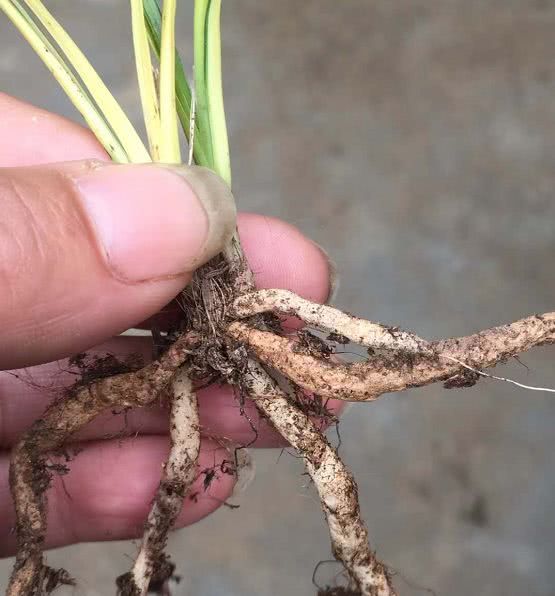
What to do? I had no choice but to temporarily find a 2.5-liter plastic Coca-Cola bottle, cut it in half, then use a hot iron tool to burn many holes in the upper half, and use this so-called "plastic orchid bottle" to plant another clump of orchids. However, because the bottle mouth faces downward, it is very inconvenient to place. I suddenly remembered that there was still an abandoned wooden flower pot at home that could be used. So I placed the orchid bottle inside the wooden flower pot, filling the bottom and surrounding areas with foam to secure it. Since planting until now, the orchids have grown very well, the orchid leaves are emerald green, the spring shoots have already become old seedlings, and the autumn shoots are already 5 gongfen tall. What is even more amazing is: once I slowly took the orchid bottle out of the wooden flower pot, and was surprised to find that the orchid roots had grown out of the bottle mouth! From this I have drawn several conclusions, and I respectfully ask fellow orchid growers to correct me.
1. Orchids by nature like ventilation and air permeability, and one should be good at creating a well-ventilated growing environment. Orchids have fleshy aerial roots, and orchid roots hate stuffiness and lack of air. Through my practice, I feel that planting orchids in an orchid bottle with granular potting medium does indeed create a basic growing environment for them, but merely burning holes all around the orchid bottle still leaves the air permeability somewhat insufficient, while placing the orchid bottle in a wooden flower pot filled with foam invisibly achieves the purpose of raising the orchid seedlings in an elevated way. The granular potting medium and the holes in the orchid bottle themselves already provide good air permeability, while the surrounding foam and the wooden flower pot provide an excellent growing environment for the respiration of the orchid roots.?
?
2. Orchids by nature like water to pass through and hate waterlogging, and one should be good at creating a potting medium space that is suitable in dryness and moisture and appropriately warm and moist. My method is to use a mix of coarse and fine granular potting medium in the orchid bottle, with the surface of the orchid bottle higher than the surface of the wooden flower pot (this can control watering), and to cover the wooden flower pot with a layer of sphagnum moss (remember: the orchid bottle must not be covered!). Each time when watering, the orchid bottle and the flower pot can be watered at the same time, or according to the actual situation, only the flower pot can be watered and not the orchid bottle, or only the orchid bottle can be watered and not the flower pot. The result is that not only can the moisture in the orchid bottle be effectively controlled, but the moisture in the wooden flower pot can also be controlled, complementing each other and artificially creating a suitably moist environment for the orchids.
3. The suitable temperature for orchid growth is between 15-30 degrees, and one should create a temperature suitable for orchid growth. This year Tianjin had high summer temperatures. My home is on the top floor, and the orchids are placed on the balcony. At noon the temperature was close to 40 degrees. I compared two clumps of orchids that were divided and planted at the same time, and found that the leaves of those planted in 2.5-cun black plastic orchid pots had black spots, and the new shoots were also weak, while those planted in orchid bottles remained calm and grew vigorously in the scorching summer. I analyzed that orchid roots are afraid of heat. High summer temperatures cause the 2.5-cun black plastic orchid pots to absorb heat, and the temperature inside the pots rises sharply, which is very unfavorable to orchid growth; those planted in orchid bottles, because the outer surroundings are protected by foam and a wooden flower pot, play a role in insulating temperature and preserving moisture, so no wonder the orchids can grow so vigorously.