Takashi Amano's Legendary Life Story (Part Two)
6. The Amazon River, Part Two: Cross-Cultural Exchange
Although we battled crocodiles in the Amazon River region, crocodiles were actually one of our food sources. We brought rice and generators from Japan, and procured the rest of our vegetables and fruits locally.
I even tried piranha (a South American freshwater fish) sashimi. It was incredibly delicious, truly top-grade sashimi! The taste was like flounder cured with salt, perfect as an accompaniment to alcohol! Here we ate fish almost every day. I think I could write a book called "The Great Amazon River Fish Cookbook"! During my time in the Amazon River region, I always carried green wasabi with me, ready to enjoy fine food. Takashi Amano said proudly.
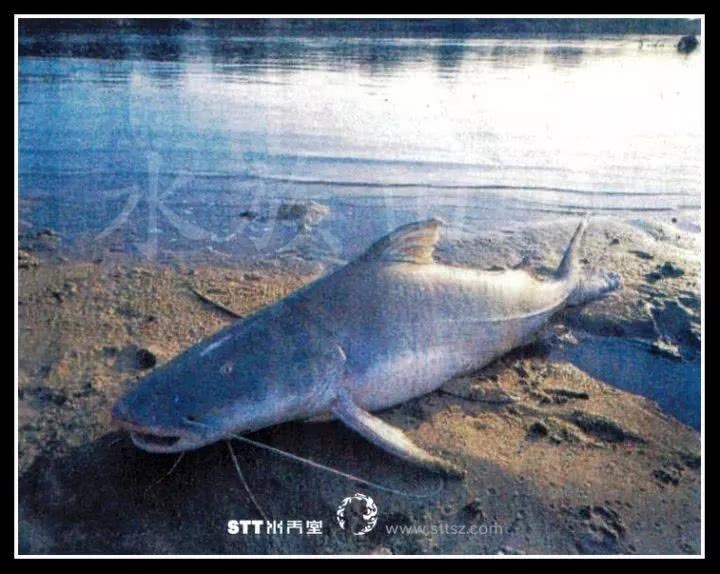
This is the large catfish that is a staple food in the Amazon River region. Catfish are carnivorous fish with a fresh, sweet taste. The catfish in the photo is 1.5 shaku long and weighs about 60 kilograms.
That said, there were still times of severe food shortage. For example, when visiting Gambia below the equator in Africa, Takashi Amano's team fell into a serious food shortage crisis.
Takashi Amano said: There was not much fish available locally, and the rice we brought kept dwindling. Some people in our team said that the native guides normally survived entirely on tree bark and fruits grown from trees, so we might as well save some of the food meant for them and keep it for ourselves. But I refused immediately! Since we were all sitting in the same boat, everyone was equal. How could we withhold what others deserved? Instead, we should distribute food to the local native guides first. He continued: This is the basic condition for mutual trust and mutual respect between people.
The local native guides also often gave us their tree fruits to eat. They were covered in dirt and looked strange, and everyone threw them away, but I ate them anyway. The temperature in Gambia was extremely hot, and sweat poured like a waterfall from morning to night. Every other member of our group was exhausted, but I did not feel tired at all. The reason was the tree fruits the locals ate!
You should know that the local natives walk more than 50 miles a day in the forest. It turns out that tree fruits are rich in vitamins and minerals, and are extremely effective for replenishing stamina! Takashi Amano said.
On this kind of journey, locals often give us food. Whether we accept or reject that food makes an entirely different impression on them. Accepting their food means accepting their way of life. Conversely, throwing away food they sincerely offer is a serious act of disrespect! These basic forms of respect are what I learned from traveling around the world.
From his twenties onward, Takashi Amano went overseas to gain experience, and by now he has visited more than 50 countries.
Takashi Amano continued: In the Borneo archipelago in Southeast Asia, which Indonesians call Kalimantan, the world's third-largest island, there is a place where dinosaurs might have lived, just like in the movie Jurassic Park. It is surrounded by a mountain about 3,000 meters high, roughly the same altitude as Mount Fuji. The terrain is steep and treacherous, and it is extremely difficult for ordinary people to climb in. But I carried my camera on my back and, using ropes and hooks from the top of the cliff, climbed and squeezed my way in step by step. Of course, I had to cover and protect the camera carefully. I am a person with intense curiosity. No matter how dangerous a place is, I want to go there once and take a look. Curiosity and the desire for knowledge overpowered everything. This personality trait even frightens me a little!
Taken below the cliffs of Borneo. Takashi Amano hired two locals as guides and put the camera away carefully so it would not be discovered. Photographed in November 1996.
Borneo photograph taken by Takashi Amano
West Africa photograph taken by Takashi Amano
7. The Giant Sheephead Fish
About seventeen years ago, I already knew that there was a very special fish around Sado Island called the sheephead fish (Cold porgy, also known as lumphead wrasse). At first, I happened to see it introduced in a diving magazine in a bookstore. Later, photos of this strange fish also appeared in diving advertisements about Sado Island, but the photos were very small and blurry......., Takashi Amano said.
Takashi Amano continued: To think that such a strange fish with such a unique appearance lived around Sado Island near my hometown. In that instant, I had the urge to go and photograph it immediately. So I went to learn diving, took courses and attended lectures, and before long I obtained my diving certification. Without delay, I set off for Sado Island at once!
The lumphead wrasse belongs to the wrasse family. It originally lives on rocky reefs near Aomori Prefecture in Japan. After the male grows up, a lump protrudes from its forehead like the head of the God of Longevity, so it is called the lumphead wrasse. Adult fish are about one meter long.
In order to capture the appearance of the lumphead wrasse, I dived into the waters off the northeastern side of Sado Island called Kitaoura, hoping as much as possible to swim within 5 to 10 cm of the fish to photograph it. Because at such close range, using an ultra-wide-angle lens produces the most striking photos, and the close distance also reduces the refraction of seawater, making the photos clearer and more vivid. Takashi Amano explained.
At first, Takashi Amano bought squid as bait and rented a small boat from the Kitaoura fishing boat association to go out to sea, but each boat rental cost 20,000 yen, which was extremely expensive. So Takashi Amano boldly haggled with the local fishermen.
Takashi Amano said: If I went out once in the morning and once in the afternoon, that would cost 40,000 yen a day!!
So I boldly told the local fishermen: The lumphead wrasse is a treasure of Sado Island. If you let me take close-up photos of it, I guarantee Sado Island will become famous throughout Japan, and tourists will flock to this island. Do you believe me?? Do you have the guts to make a bet with me??
In the end, what a Takashi Amano he was. He succeeded in persuading the fishermen to reduce the boat rental fee from 20,000 yen per trip to 2,000 yen, and for three trips they charged only 5,000 yen! But the local fishermen gave Takashi Amano one condition: he had to make the name of Kitaoura known and put it on the map.
Takashi Amano dived into the sea many times to scatter bait. On the seabed of Kitaoura, there were abundant natural resources such as kelp and seaweed.
Almost every day I dived into the sea to feed them. For more than two full years, the large fish here gradually shed their innate defensive instincts and became familiar with me, swimming close to me without any fear. The lumphead wrasse is a very intelligent fish with rich facial expressions, showing joy, anger, sorrow and happiness. I never imagined fish could differ so much in their gaze. It is truly hard to believe!! Takashi Amano recalled.
Finally, after more than two years, Takashi Amano photographed the giant lumphead wrasse. With this photo, he entered the 1992 Fuji Film Photography Contest, stood out among more than 50,000 entries, and won the championship. Afterwards, the rest of the photos taken on the seabed of Kitaoura were published in diving magazines. The place Kitaoura immediately became widely known and turned into a hotspot for diving enthusiasts, and a diving center soon developed there. To this day, Kitaoura remains one of the top diving hotspots in all of Japan.
Takashi Amano said earnestly: I finally fulfilled my promise and made Kitaoura widely known. The local fishermen held a local festival and invited me to attend. When I went to their village, from twelve noon onward they went from house to house to toast and clink glasses. It was very lively, and by the time the banquet ended it was already late at night. In fact, while I was happy in my heart, I also felt a great weight lifted from my mind!!
Besides making the fishing port of Kitaoura famous, Takashi Amano also made a name for himself.
8. The Giant Cedars of Sado
From his twenties onward, he had an unfulfilled wish: to take photographs with nature as the subject. He finally completed it in the Amazon River region of South America. Unfortunately, in the past five or six years, the Amazon River has also suffered severe environmental destruction. Virgin forest has been converted into farmland, and huge numbers of trees have been cut down and burned. The ashes pollute the river, the natural ecology has been damaged, and it is no longer what it once was!!
Because of the environmental changes, his interest in the Amazon River region of South America greatly diminished. He suddenly thought of Sado Island, where he had photographed the lumphead wrasse. During that photography period he had entered the mountains many times, and the natural scenery there was beautiful, with reds and purples setting off the natural beauty of the landscape. So three or four years ago, after a gap of ten years, he set foot on Sado Island again.
Unfortunately, after entering the mountains, those naturally beautiful wild grasses and trees had been extensively dug up and stolen by people, and he felt a slight melancholy. Takashi Amano sighed.
Unable to find a subject to photograph, he ran around different mountains and trees. Just when he was disappointed, he saw a photo of a giant cedar in the photo album of the owner of the guesthouse where he was staying. His spirits immediately lifted. That feeling was like being electrified, just as he had been drawn to the lumphead wrasse of Sado in the beginning. Takashi Amano said excitedly. He had thought he knew every plant and tree on Sado Island inside out, yet unexpectedly there was still such a natural ecological place he did not know about. It was almost like being slapped in the face, but he was also very excited!! After making careful inquiries, it turned out the location was within the training forest of Niigata University. So he again asked the university for permission and, carrying a large-format camera, ran into the primeval forest in early summer!! Takashi Amano said proudly.
Takashi Amano walking into the primeval forest of Sado Island, photographing a thousand-year-old giant cedar. Photographed in 2007.
Takashi Amano then said formally: We climbed a peak over 900 meters above sea level and saw that giant cedar. Its trunk was close to 7 to 9 meters in diameter, and its age was probably at least over 1,000 years. That awe-inspiring presence took one's breath away. It was like a landscape from ancient times, truly incredible!!
The roots of the giant cedars of Sado Island have a unique form, twisting and turning, very springy, wrapping around the giant cedar like ropes. You could see that the giant cedar had weathered many hardships, just like the ups and downs of life. I immediately took out my large-format camera and recorded her form, her soul and essence one by one, and even thoroughly photographed the surrounding plants, mosses and so on.
From the underwater world more than 40 meters deep to the primeval forest more than 1,000 meters above sea level, Takashi Amano clearly photographed every fragment of natural ecological landscape. From April 2007 to March 2008, over the course of one year, a "Takashi Amano Solo Photography Tour Exhibition" was held at three exhibition venues in Tokyo Metropolis, Niigata City and Sado City. The two exhibitions in Sado City attracted about 15,000 visitors in total. For Sado City, with a population of only just over 60,000, that meant one out of every four people had appreciated his exhibition.
Giant cedars growing in clusters around a marsh. The work is titled "Forest of a Thousand-Handed Cedars." This photo was one of the works later exhibited at a seminar held at Lake Toya in Hokkaido. Photographed in 2006. The climate of Sado Island is mild, with distinct summers and winters, and it is also very suitable for producing fruits such as apples and mandarin oranges. There are few places like this left in the world. Throughout the four seasons, the scenery is beautiful at any time. To record it all one by one like a computer scanner, how could a few dozen visits ever be enough!!
In my mind, the natural heritage of Sado Island is priceless and something to be proud of. What is regrettable is that outsiders keep collecting wild plants and destroying the environment here!! Takashi Amano lamented.
Takashi Amano continued: Therefore, the photography exhibitions I hold are meant to awaken the locals and everyone else, to tell them of the pristine beauty of Sado Island, and to let the local people cherish the priceless natural heritage that belongs to them. Nowadays many people are beginning to talk about environmental protection, but I personally believe that environmental protection must start with the natural ecology around oneself, and that people should pay more attention to and care about the scenery around them!!
Takashi Amano photographing the Kongo Cedar on Sado Island
Sado Island scenery photographed by Takashi Amano
Satoyama scenery
Yakushima scenery
To be continued...
There is still a surprise here