How to Make and Care for a Pear Bonsai
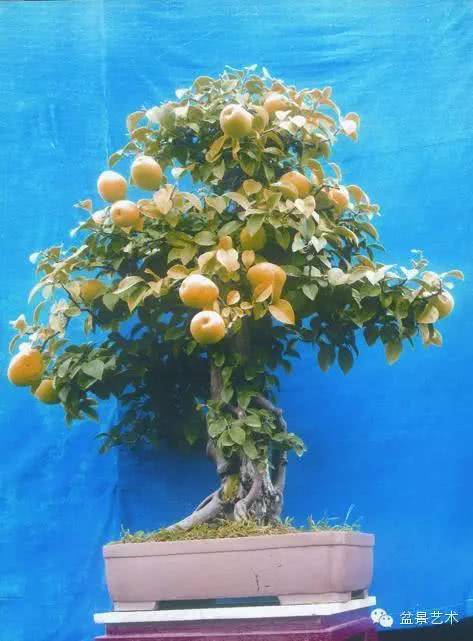
The pear tree is a deciduous tree in the Rosaceae family and the genus Pyrus, growing about 6 m tall, with stout, purplish-brown branchlets. The leaves have long stalks and are ovate or elliptic-ovate, 5 to 12 cm long and 3.5 to 8 cm wide, with a gradually pointed or long-tailed tip, and sharp serrated leaf margins. The inflorescence is an umbel-like raceme with 7 to 12 white flowers, blooming in April. The fruit is ovoid or nearly spherical, varying greatly in size and shape depending on the cultivar, ripening in August to September in yellow or yellowish-white to brown, with some cultivars showing a red blush. The pear tree is a traditional Chinese plant grown both for eating and for its flowers and fruit, and many excellent cultivars have been developed over its long history of cultivation. Made into a bonsai, it offers a handsome tree form, deep green foliage, flowers to enjoy in spring, and fruit to admire in summer and autumn.
For propagation of the pear tree, Pyrus ussuriensis, Pyrus calleryana, Pyrus betulifolia or Pyrus calleryana can be used as rootstock, with vigorous, high-quality, easily fruiting pear cultivars used as the scion, grafted by bud grafting or branch grafting. The rootstock can either be propagated artificially, or old pear trees culled from orchards can be used, or old stumps of short, strangely shaped, low-branching, quaint and vigorous wild pears and similar cultivars can be collected from the mountains and fields; after "growing out the stock" to restore vigor, they produce new branches, which are then grafted. The stumps are generally dug up and transplanted after leaf fall in autumn or before sprouting in spring, first planted in the ground or in a larger clay pot. Before planting, shape the plant, cutting away overly long main roots while keeping as many lateral roots and fibrous roots as possible, and also remove surplus branches. After planting, water thoroughly and keep it in a wind-sheltered, sunny spot to ensure survival.
The pear tree is suitable for making many different styles of bonsai, such as formal upright, slanting, curved trunk, double trunk, clump, cascade, and semi-cascade. Because the leaves are fairly large, the canopy is mostly trained in a natural shape rather than wired into pads. Since the pear tree grows vigorously with a large annual growth increment and strongly developing apical branches, no matter what style of bonsai it is, the methods of pinching back and tip pruning must be used to control the growth of vigorous branches, so that it forms a short, compact, naturally beautiful canopy and is encouraged to change from vegetative growth to reproductive growth, which favors flower bud formation. The large fruit of the pear tree is the main ornamental feature of its bonsai, so when developing the canopy, the size, quantity and distribution of the fruit should be determined according to the plant's form and nutrient reserves, so that there is some variation. Also, by methods such as bending branches, twisting branches, curving and heading back, adjust the direction of the branches, increase the number of main branches, control vigorous branches, and encourage short spurs, so as to develop strong fruiting branches and give the bonsai full foliage and a moderate fruit set. The pear tree has a well-developed root system, and the roots can be raised as needed to enhance the bonsai's sense of age and antiquity.
The pear tree likes a warm, humid environment with plenty of sunlight, and is highly adaptable, tolerating cold and also high temperatures. During the growing season it can be kept in a spot with good air circulation and full sun; if light is insufficient, the branches will grow poorly and the flower buds will not form well. In winter it can be kept in a cold room or outdoors in a wind-sheltered, sunny spot to overwinter; as long as the potting soil does not freeze, it will overwinter safely.
Because the leaves of the pear tree are quite sensitive to water supply, if water is insufficient the leaves often wilt, and after a little too long they dry up and drop. This is especially true before and after flowering, and during the rapid fruit growth period: without an adequate water supply, it can directly affect the fruit set rate as well as the growth of young fruit and the later weight gain of the fruit. Therefore, in cultivation, water as soon as the soil dries, avoiding soil that is too dry, and in hot, dry summer weather spray water on the leaves as appropriate. The middle to late ten days of June is its flower bud differentiation period, and a short period of drought treatment can be carried out to inhibit new shoot growth, increase the proportion of medium and short branches, and promote flower bud differentiation; the method is wilt-water-wilt-water, and about 20 days of this treatment is enough. In the first to middle ten days of June, ringing or scoring the trunk or main branches can also be done to raise the proportion of medium and short fruiting branches. In autumn, watering should be appropriately controlled, and in winter the potting soil moisture should be checked often and replenished in time to avoid dry freezing.
The pear tree has a fairly high fertilizer requirement, so apply plenty of base fertilizer when potting, and during the growing season apply a well-rotted organic liquid fertilizer once every 15 to 20 days. During the bud break period, flower bud differentiation period and fruit swelling period, when fertilizer demand is greater, in addition to normal fertilization, the amount of phosphorus and potassium fertilizer used should also be increased, by spraying the leaves 2 to 3 times with a 0.2 to 0.3 monopotassium phosphate solution, to meet the nutritional needs of flowering and fruiting.
Once the tree shape is basically stable, attention should be paid to maintaining vigorous tree growth so that it fruits year after year, and, along with pruning and shaping, remove water sprouts, crossing branches, overlapping branches and dead branches, and head back vigorous branches to encourage lower buds to develop into branches, so as to develop compact fruiting branch groups. Also make the bonsai's layers clear and its density well balanced, achieving a naturally beautiful artistic effect. Because nutrition within the pot is limited, the fruit kept should not be too many; generally keep 1 to 2 fruits per inflorescence, and the entire inflorescence can even be removed. Repot once every 1 to 2 years in spring, with a loose, fertile, well-drained neutral sandy soil being best; a pH between 5.8 and 8.5 is acceptable.