The plant keeps drying up even though I mist it every day after bringing it home - what should I do?
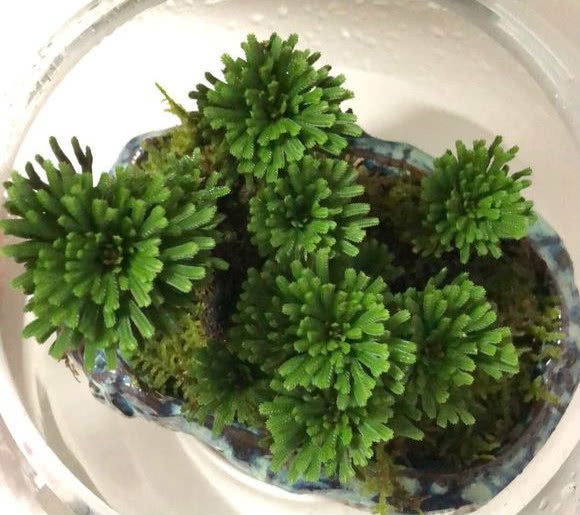
The legendary resurrection plant: wild ones are tough in the wild, but can't enjoy the good life at home. I mist it every day, yet it still stays dried up - all for nothing! Its name is well earned; it has been curled up from beginning to end and has never opened. How on earth do you care for it?
Why has my Selaginella never unfurled?
When you first get a Selaginella, be sure to check whether it has grown new roots. Only when it has new roots and is planted in a pot will it stop keeping its leaves curled. If there are no new roots and it relies only on its leaves to absorb water, the leaves will easily curl. Whether a Selaginella is potted or not, always check the root system. Moisture retention, ventilation and indirect light are the three key elements for growing Selaginella well.
The most common problem with Selaginella is curling leaves. At this point, either moisture retention or the soil is the issue. The best solution is to soak the whole plant: submerge it, leaves and all, below the water surface for 5-10 minutes. Remember not to soak it too long, otherwise once the leaves open they will turn yellow and black.
Once the leaves have unfurled, consider whether moisture retention is the problem. In spring, summer and autumn, mist the leaves once in the morning and once in the evening. In winter, mist in the same way but use warm water. If the relative air humidity is below 40%, you can add one more misting.
If moisture retention is not the problem, then only the soil remains. Coarse sand is the right answer: 1 part humus soil to 3 parts coarse sand, plus a top dressing of sphagnum moss. The pot you plant it in must be a shallow one.
Don't fear that Selaginella will die of drought; fear that waterlogged soil will drown it.
Do you remember how you first came to know Selaginella?
At first, Selaginella actually entered the public eye in this embarrassing way - the conversation between flower lovers below is proof enough!
Flower lover A: My dad bought back a pile of Selaginella, at least seven or eight of them. The flower seller said this one blooms with an especially fragrant flower and comes in every color. I'm also asking here what it is... When bought, it was dry. (Photo below)
Flower lover B: Your dad was cheated. It doesn't bloom in colorful flowers. When I was little, people at the market always sold this to cheat others. I bought some too, sigh!
Flower lover C: I thought this scam had long been lost to the world...
Flower lover D: We've all been initiated by it; we paid the tuition long ago...
Flower lover E: It's just that Selaginella won't bloom in those colorful flowers like in the photoshopped pictures.
I believe many people have encountered this: only after buying it do you realize it's not like that at all! And it's not at all like the peddler said, that it comes back to life just by soaking in water. Instead, it dries out in soil and rots in water - you simply can't figure it out!
Is Selaginella really a cypress? Why doesn't it look like a tree?
Selaginella, commonly known among the people as the nine-death resurrection plant, reproduces by spores and is a lycophyte, so it can never become a tree, let alone produce flowers. Selaginella is a resurrection plant: when dry, its leaves turn yellow and curl into a ball, looking dead, and when it encounters a moist environment, the leaves absorb water again, turn green and revive.
Cacti turn their leaves into spines to reduce water evaporation, and tamarisk has an extensive root system reaching over ten meters underground to find water, while Selaginella takes the tough-guy approach: with no water, it simply endures. Typically, woody plants have a water content of about 40%-50%, and herbaceous Do you remember how you first came to know Selaginella? plants have a water content of about 70%-80%, while Selaginella can survive with a water content of only 5%.
The survival strategies of resurrection plants are wonderfully ingenious!
Members of the resurrection plants, like Selaginella, are a class of plants that can endure severe drought stress. These plants adopt a strategy of going with the flow rather than confronting drought head-on; instead, they choose to dehydrate quickly and completely. After losing 95% of their water, they enter a dormant-like state, in which physiological metabolic activity is reduced, maintaining cell viability at low cost to get through the drought period. When water becomes abundant, they quickly absorb it and return to their former unfurled state.
During dormancy, resurrection plants all change their appearance: when dry, the leaves curl, harden and lose their green color, and when rehydrated this reverses, becoming unfurled, soft and fresh green again, just as if they had come back from the dead. That is why people call this kind of plant resurrection plants.
Welcome to follow Plant Enthusiast; Squirrel Jun chats about flowers and plants with you!