Characteristics and Cultivation Techniques of Yellowhorn (Xanthoceras sorbifolium)
Characteristics and Cultivation Techniques of Yellowhorn
Yellowhorn, also known as cliff papaya, civil official fruit, and civil lantern fruit, and known in Mongolian as "Sengdeng Maodao," belongs botanically to the genus Xanthoceras in the family Sapindaceae. It is the sole species in its genus and is a woody oil tree species unique to northern China. Under good site conditions with adequate soil water and nutrients, it generally grows as a tree with a height of 7-10 m; in poor site conditions with barren soil, it generally grows as a small tree; in extremely poor site conditions, or when the main trunk dies or is damaged, it mostly grows as a clump-forming shrub. Yellowhorn is relatively easy to cultivate and can be grown from seedlings or sown directly for afforestation. To alleviate the shortage of seed sources and maintain the traits of superior individual plants, root cuttings and grafting can also be used to propagate seedlings. According to experimental survey data from scientific and technical personnel of the Laiwu Municipal Forestry and Urban-Rural Greening Bureau in the Laiwu area over recent years, yellowhorn has the characteristics of early fruiting and long lifespan, beginning to bear fruit in the 2nd year after planting. The yield per 5-year-old plant can reach 5 kg, and the yield per 10-year-old plant can reach 8 kg, with seed yield increasing year by year as the tree ages. Its performance in the Laiwu area is summarized as follows.
1 Morphological Characteristics and Biological Characteristics of Yellowhorn
1.1 Bark
Old bark is grayish-brown to blackish-gray, splitting in flakes.
1.2 Branches
Young branches have short fine hairs. Old branches are grayish-brown, new shoots are brownish-purple, with some grayish-green ones bearing gray short fine hairs. New branches mostly divide into two or three forks, with some dividing into four or five forks. Branches are thick, sturdy, and upright. Young plants, under good water and nutrient conditions, can produce new growth three times a year in spring, summer, and autumn.
1.3 Buds
New buds form in the previous year, are ovate, purple-brown, and covered on the outside by numerous bud scales, most of which have white fine hairs. Flower buds are terminal or lateral, relatively plump; leaf buds are lateral, smaller, with sharper tips; there are also mixed buds. Terminal buds are mostly flower buds; lateral buds generally have mixed buds in the upper part and leaf buds in the lower part. Buds break in early April in the Laiwu area.
1.4 Leaves
Leaves are odd-pinnately compound, alternate, up to 20-25 cm long. Leaflets number 9-19, sessile, mostly opposite, oblong-elliptic to lanceolate, 2-6 cm long, with sharply serrate margins, dark green on the upper surface, generally smooth and hairless, with some having silvery-gray short fine hairs on the underside. Yellowhorn either leafs out before flowering or flowers and leafs out simultaneously.
1.5 Flowers
Racemose inflorescence, generally 15-25 cm long, up to 30 cm at maximum. Pedicels are slender and upright. Flowers are yellow-white gradually turning to pale purple, with a few having red-purple bases. There are two types: fertile flowers and sterile flowers. Fertile flowers have a pistil 6-7 mm long, with a three-lobed stigma; 8 stamens extend from the base of the ovary, reaching only half the length of the ovary, with anthers that do not dehisce or shed pollen; the ovary is spherical and swollen, developing normally and capable of bearing fruit. Fertile flowers mostly occur in the middle and upper parts of terminal inflorescences, with a few on lateral inflorescences. Sterile flowers have an underdeveloped pistil and shrunken ovary; stamens are 6.5-8.0 mm long, robust and well-developed, with pollen sacs that dehisce early, serving a male function. Sterile flowers mostly occur in the lower part of terminal inflorescences and on lateral inflorescences. Flowering begins in late April and ends in late May, with a flowering period of up to 4 weeks. Lateral inflorescences generally open 1-2 d earlier than terminal inflorescences.
1.6 Fruit
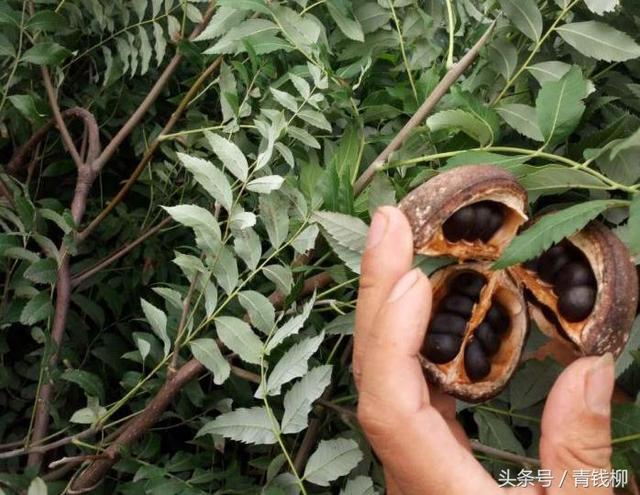
It is a loculicidal capsule, varying by type in shape: round, conical, spindle-shaped, obovate, etc., green or dark green. Most are composed of three carpels forming three locules; a few are composed of two to five carpels forming two to five locules accordingly, with thick walls. Fruits vary in size, with a diameter of 4-9 cm and a length of 4-10 cm, averaging 20-45 g per fruit, with a few weighing 50-60 g. Each fruit contains 7-24 seeds, with some having more than 30. When the fruit matures, the pericarp changes from green to yellow-green, and the surface changes from smooth to rough; the pericarp is thick and suberized. The maturation period is August to September.
1.7 Seeds
Flat-round or spherical, with a diameter of 1-1.6 cm. Immature seeds are white, gradually turning pink and reddish-brown; mature seeds are blackish-brown or black and glossy. After air-drying, seeds become blackish-brown and dark brown, and the gloss disappears. The hilum is prominent and white. The average 1000-seed weight is 400-1,175 g.
1.8 Kernel
The outside has a brown coating; after removing the coating, the kernel is milky white and accounts for about half the weight of the seed, with irregular dicotyledons. When the seed germinates and emerges from the soil, the cotyledons remain within the seed coat and remain together in the soil layer.
2 Seedling Propagation Techniques for Yellowhorn
2.1 Sowing and Seedling Propagation
Select plants with vigorous growth, strong high-yield characteristics, and high seed oil content as mother trees for seed collection. In August to September, when the pericarp changes from green to yellow-brown and the seeds change from reddish-brown to black, they can be harvested. For sowing immediately after harvest, the seeds require no treatment; if sowing in spring the following year, germination should be promoted before sowing. Germination promotion methods include stratification with sand and soaking in warm water. Sow when two-thirds of the seeds have cracked and shown white, or successively select cracked seeds and sow them in stages for seedling propagation. The sowing rate is 30-40 kg per mu. After thinning, maintain a seedling spacing of 10 cm. One-year-old seedlings can reach 60 cm in height, with 15,000-20,000 seedlings produced per mu. Both 1- to 2-year-old seedlings can be lifted for afforestation.
Table 1 Results of Different Treatments for Cutting Propagation
2.2 Cutting Propagation
2.2.1 Comparison of Cuttings from Different Materials. The survival rates of different treatments for root cuttings, hardwood cuttings, and softwood cuttings are shown in Table 1. As seen in the table, root cutting propagation has a fast multiplication rate, with a survival rate as high as over 93.6%, higher than hardwood cuttings and softwood cuttings.
2.2.2 Root Cutting Propagation Techniques. The nursery site should be chosen on high ground, sheltered from wind and facing the sun, and a cold frame should be dug, 1.2 m wide and 0.5 m deep. The soil substrate should use soil and sand in layers: spread a 5 cm thick layer of clean river sand on the bottom of the cold frame, then spread 5 cm of soil. If peat soil and vermiculite are used as the substrate, the survival rate is even higher. Select vigorous young trees or robust 1- to 2-year-old seedlings as mother plants for root collection, and dig roots 0.5 m from the main trunk. Roots collected in autumn can be cut in autumn or in spring the following year; autumn root cuttings are generally carried out in mid-to-late November. Root segments for spring cuttings must undergo overwintering sand storage treatment. Root segments are cut to a length of 10-15 cm, with the thick end 0.5-2.0 cm in diameter, with a flat cut at the upper end and a slanted cut at the lower end to facilitate cutting. When cutting, the cut surface must be smooth and must not split. Treating with hormones before cutting can greatly increase the survival rate of cuttings. Experiments show that treating the base of root cuttings with 250 mg/L NAA or 250 mg/L ABT for 30 s before cutting gives the best results, with a rooting rate of over 93.6%. Cuttings are inserted at a spacing of 5 cm x 15 cm. To prevent the cuttings from rotting before rooting, a 0.05% thiophanate-methyl solution can be used to irrigate the cutting furrows. When inserting, vertical insertion is best, with the upper end level with the ground, and a small mound of live soil covering the upper cut. According to measurements, the suitable soil moisture content for cutting rooting is 60%-80%. After root cutting is completed, spray the cold frame thoroughly with water at a rate of 15-20 kg/sq m and cover with plastic film. During the overwintering period, supplement with 1-2 light waterings to maintain appropriate moisture content until March of the following spring. In early March, increase the frequency of watering, spraying once every 7-10 d; in early April, when seedlings reach over 15 cm in height and do not terminate growth, it indicates that the root system has formed, and the film can be opened for hardening. At this time, increase watering frequency to 1-2 times/d, and during the hardening period, rain protection is also needed. After entering the transplanting stage, spray thoroughly half a day before transplanting so that seedlings can be removed from the frame with soil. Transplanting can be done after 7-10 d of full-light hardening when stems and leaves have become sturdy; early April is the best transplanting period for root cuttings, and transplanting can be done all day, continuing until early May, but it is best to transplant on cloudy days or after 16:00 each day. When seedlings are about 20 cm tall, keep one vigorous, strongest-growing new shoot and remove all others to promote the growth of the retained shoot. Other management measures are the same as for seedling propagation from seed.
3 Planting Techniques for Yellowhorn
3.1 Reasonable Close Planting
Different cultivation measures are adopted for yellowhorn depending on the purpose. As a soil and water conservation forest, the main purpose is to close the ground surface, so high-density planting should be adopted, with a spacing of 1 m x 1.5 m. As a field ridge shelterbelt, it has the effect of reinforcing embankments, preventing collapse, and reducing soil erosion; plant at a spacing of 2 m x 2 m, and a certain economic yield can also be obtained. Appropriate close planting can increase early yield and improve benefits. The specific density should be determined according to site conditions. Plots with fertile soil and irrigation conditions should be sparser; plots with barren soil and no irrigation conditions should be denser. Under dryland conditions, plant at a spacing of 2 m x 2 m, with about 170 plants per mu; a design spacing of 3 m x 2 m can also be used, with about 110 plants per mu. Plots with irrigation conditions can be designed at a spacing of 3 m x 3 m, with 70-80 plants per mu.
3.2 Timely Field Planting
Yellowhorn can be planted in autumn or transplanted and planted in spring. In the Laiwu area, planting in autumn at leaf fall (mid-to-late October) is best. Especially in mountainous and hilly areas with large-scale development and no watering conditions, autumn planting can achieve a survival rate of over 90% without watering. Early spring planting is also a key technique for improving the survival rate; planting can be done when the soil thaw depth reaches 30 cm. Yellowhorn has an extremely high planting survival rate, 37% higher than poplar, 18.5% higher than black locust, and 49% higher than Siberian apricot (see Table 2); in spring, under conditions of no rain for two consecutive months, the planting survival rate reached 86%, the highest among all tree species.
Table 2 Comparison of Planting Survival of Various Tree Species Under the Same Site Conditions
3.3 Training and Pruning
After young trees are planted, train the trunk in a timely manner, with a trunk height of about 40 cm; on fertile and irrigated land, appropriately higher. Do not train the trunk if seedling height is less than 40 cm. In mid-June of the same year, carry out summer training, selecting and retaining 3-4 main branches and one central leader, and shortening the remaining branches, leaving 5-10 cm fruiting stubs. In early July of the same year, promptly remove root suckers and sprouts below the selected main branches, so that nutrients are concentrated in supplying the selected branches and promote their growth. The retained main branches should be evenly distributed, with wide angles, and staggered in an orderly manner. Winter training and pruning in the same year should only serve as an auxiliary measure and must not involve heavy pruning. As long as the selected main branches are at the same height, they should be left unpruned to promote growth; if there are overly vigorous branches, appropriately cut them back so that their height is basically consistent with the other main branches. Branches shortened during summer pruning are specially retained to promote earlier fruiting and should continue to be left unpruned to promote growth and development, striving for early flowering. Yellowhorn is a tree species that flowers and fruits on terminal buds, so in pruning one must not cut whenever a tip is seen; this is the most basic principle. Whether small trees or large trees, the terminal buds that should be retained must be fully retained. The pruning task in the second year is to develop branch groups, adjust tree shape, and promote flowering. Summer pruning generally begins in mid-June. The central leader should be left unpruned to allow it to grow fully upward. Main branches can generally be pinched to promote lateral branches. Other branch groups are generally not treated, to promote flower bud formation. If branches are too dense, they can be moderately removed to prevent competition. A second summer pruning is carried out in mid-July; if upright branches or vertically growing branches are found on main branches, they are generally removed. Other branches should not be tipped too much, to promote their development. For three-year-old trees, the task at this time is to control lateral growth, prevent canopy closure, retain good second-tier main branches, develop an excellent tree shape, and increase yield as early as possible. The distance between the second-tier main branches and the first tier is about 40 cm; select and retain 2-3. Branches on the central leader between tiers can be cut back by half and trained into fruiting branch groups, then cut back or thinned when they become too crowded. The first-tier main branches should continue to be tipped to promote branching. At crowded points, appropriately thin or cut back. Subsequent pruning should follow the principle of "shaping according to the tree, promoting high yield." Trees four or five years old and older can form large numbers of flower buds every year and bloom profusely in spring, but flower and fruit drop is very serious. At this time, appropriately remove some flower buds to concentrate nutrients and improve fruit set rate.
3.4 Spraying Growth Regulators
Yellowhorn has serious flower and fruit drop, hence the saying "a thousand flowers, one fruit." The key to preventing fruit drop is: strengthen management, apply sufficient base fertilizer, topdress in a timely manner, control diseases, insects, and rodent damage, and enhance tree vigor. Spraying 50 mg/L sodium naphthaleneacetate plus 0.3%-0.5% urea at full bloom can effectively improve the fruit set rate. Improving the fruit set rate is an important means of increasing income. Solving the problem of flower and fruit drop has a clear effect on improving fruit set rate and increasing yield. According to experiments, it can increase the fruit set rate by 10.2 times.
3.5 Timely Harvesting
For fresh fruit, it can be harvested and sold when the kernel contents become cloudy and have become semi-milky; once the kernel begins to taste astringent, it can no longer be harvested. For oil use, harvesting must wait until the pericarp turns yellow, the seed coat turns black, and the seeds are fully mature. After harvesting, sun-dry until the fruits split open; when moisture drops below 13%, store for sale. Sun-drying of seeds should be done on the ground or on mats, not on concrete or stone slabs, to prevent affecting seed vitality.