Managing succulents this way after leaf cuttings sprout makes growing roots a breeze
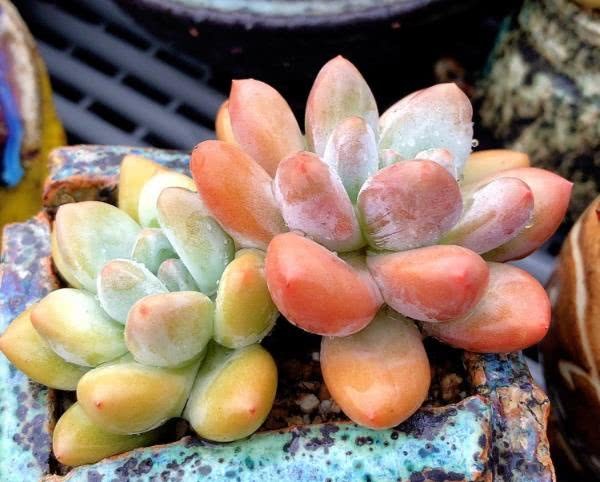
First, prepare succulent soil. Note that it can be moist soil, but it must be placed in a ventilated and breathable spot. Then place the collected succulent leaves neatly face-up on the soil, preferably with some space between each pair of leaves, and put them in a ventilated place, but please note that during this period you must not water them at all. After some time, perhaps around half a month, check the leaves again, and you will be amazed to find that roots and new buds have begun to emerge from the base of the succulent leaves. This is the beginning of successful succulent leaf propagation.
After succulent leaf cuttings sprout, never put them together with other mature succulents under direct sunlight to bake. Instead, treat them like Haworthia cooperi and just place them in a bright spot. In addition, note that you must not water frequently; wait until the soil has dried out completely before watering. Succulent leaf cuttings can be repotted at any time, whether they are in a rooted state or an unrooted state. Being unrooted is equivalent to just changing the leaf cutting to a new location.
For small seedlings with roots, be very careful not to damage the roots; you can transplant them with roots and soil attached. For succulent leaf-cutting seedlings, there is absolutely no need to consider root trimming. Compared with when succulent leaf cuttings can be repotted, what matters more is where to move them. For succulent leaf-cutting seedlings, a bright, ventilated spot without direct light is a good choice. Once the leaf-cutting seedlings are slightly larger, you can consider giving them a small amount of direct light and gradually increase the light. If the repotting location suddenly has overly strong light, it can easily cause the mother leaf to turn to water or be consumed, and the leaf-cutting seedlings may also fall into a state of slow growth.
In fact, it is also very common for succulent leaf cuttings to only grow roots and not buds. There is no need to worry; it is equivalent to about 80% success. As long as the mother leaf does not die, give it some patience and let the little seedling slowly grow, and it will grow roots. I have heard of a method that directly pinches off the roots. I think it is too simple and rough, and this process also consumes nutrients from the succulent leaf. The leaf's nutrients are limited to begin with, so how could it withstand such torment?
You only need to bury the roots into the soil and give appropriate light and water. After the succulent leaf takes root, it can absorb nutrients from the soil and become self-sufficient. After a period of time, the originally somewhat shriveled leaf will also plump up. As long as the leaf can form a complete living system, then budding is just a matter of time! Only rooting, no budding. You can wait a little while. If it still does not bud, gently pull out the leaf, gently break off the roots, and place it back on the soil to let it slowly bud. After breaking them off several times in a row, it will still eventually root and bud.
Leaf propagation is one of the fastest ways to propagate succulents. You only need to check whether the leaf's growth point is still there. The growth point is where the leaf connects to the stem. If it is still intact, then even if the leaf is damaged, it can still successfully "continue the family line"! Care before budding and rooting: place it in a spot without direct sunlight, or with weak sunlight, and do not water before budding and rooting.
This is a gathering place for succulent plant enthusiasts, sharing succulent care tips. You are welcome to follow and exchange ideas.