How do you glue rocks for penjing landscapes? These clever tips are very practical
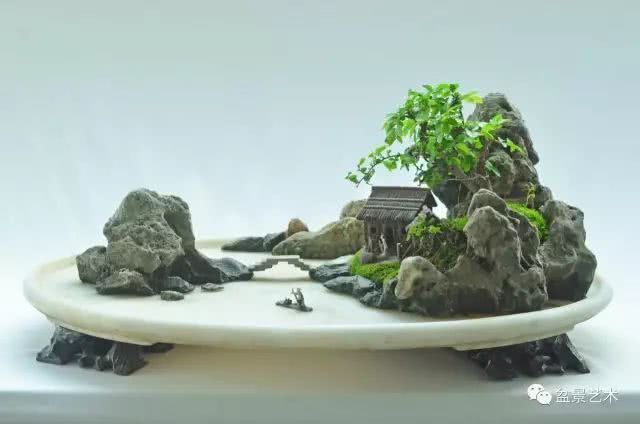
In the process of making a landscape penjing, because of the requirements of the landscape's rock layout and the volume of the rocks, it is often necessary to properly glue several, a dozen, or even dozens of smaller stones together to form an integrated single peak and layered mountain ranges.
Generally speaking, the gluing of rocks can be divided into two types. One is gluing several smaller stones with poor shapes together vertically, or a small number of them left and right, to form the main peak and secondary peaks in a landscape penjing; this type is mostly used in landscape penjing with close-range scenery. The other is gluing multiple stones with a certain landscape quality together on the same horizontal plane to form a group of distant mountains; this type is mostly related to the layout of the rocks and the expression of distant scenery.
The adhesives for gluing rocks include cement (gray and white), epoxy resin, and No. 307-1 unsaturated polyester resin. Considering low cost and ease of use, cement is mostly used in penjing production, and the higher the cement grade, the better. For example, some people use industrial waste coal cinder to make miniature penjing, and gray cement can be used as the adhesive. In order to make the joints close to natural, pigments of the same color as the stones should be mixed into the adhesive, such as iron oxide red, iron oxide yellow, chromium oxide, vanadium oxide, ink, etc. Never use glue-based dyes, such as advertising dyes and the like.
Before gluing the rocks, first match and arrange the stones according to the landscape to be formed, brush the gluing areas of the stones clean, wet them with water, and then glue them with the prepared adhesive. Generally speaking, the more concealed the glued seam lines, the better. In order to be close to natural, when the glued mud is not yet dry, stone chips of the same rock material can be applied and scattered at the seams. After gluing, first give support with other supporting objects. The glue can solidify and harden in 24 hours; cement can be moved after half a day in summer and 1-2 days in winter. 3-4 hours after cement gluing, a small knife or saw blade can be used to gently scrape off excess cement or cement that has stained the stone body, and pull out texture at the seams similar to that of the stones.
Interested flower lovers might as well get started right away and make a landscape penjing they like, adding a bit more color to life.
Reading and review