How do you make a cascade bonsai? A detailed guide to the method
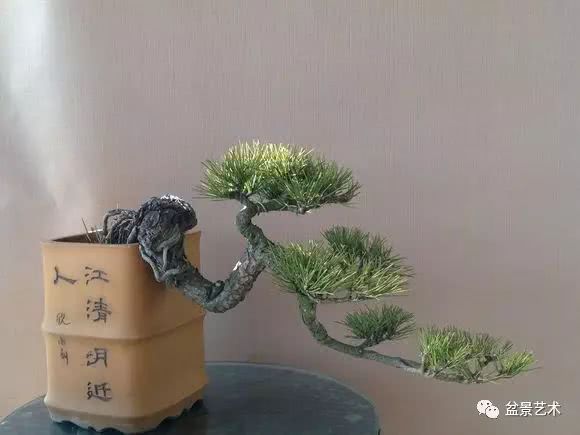
Cascade: when the trunk of a bonsai tree trails down beyond the bottom of the pot, it is called a large cascade-style bonsai. The large cascade style is the most difficult creative form in bonsai shaping. First, selecting the material is hard. Apart from meeting all the conditions for creating a cascade form, a large cascade trunk has several specific factors: 1. After the stump rises above the pot surface, the sharply bending and drooping section must have a branch pad serving as the key branch of the crown. 2. The bending, drooping trunk must have rises and falls, an obvious rhythm, and strong three-dimensional spatial variation; avoid soft bends, large arcs, and snake-like movement. 3. It must have sufficient trailing length. 4. The branch pads must be reasonably distributed and not shade one another. Large cascade-style shaping focuses on the shaping of the first and second branch pads at the section that curls and droops after the stump rises, requiring the main vein of the thick branch to follow roughly the same direction as the drooping trunk, playing a following role. The secondary veins may reverse direction in between to seek change and enhance the sense of movement. The curvature changes of the newly cultivated trunk and the original trunk should preferably not be on the same vertical plane, but should vary in three-dimensional space in the front, back, left, right, upper, and lower directions, so as to achieve reasonable distribution among the branch pads and space for light. The ending of a large cascade bonsai is flexible and varied. Because of the plant's phototropism, when the trailing tip droops to a certain length, it must turn upward to conform to the laws of growth, and at the same time it strengthens the change in rigidity and softness of the drooping trunk. To increase the weightiness of the trailing tip, a double-branch ending may also be used, one main and one secondary, one strong and one weak, each with its own appeal. After the work is formed, the trailing tip is generally pruned little, to strengthen the tree energy of the drooping tip, while the branch pads in the middle of the head must be reasonably suppressed to avoid excessive tree vigor and to achieve balance with the trailing tip. The large cascade form has a majestic, lively tree appearance, with powerful changes in the trunk, full of rhythmic beauty and the beauty of strength. When shaping, one must grasp the overall trend and consider the whole picture. The competing and yielding relationships among branch pads must be handled reasonably, without favoring one over another. The author's subjective efforts must be fully brought into play, with pursuit and individuality, gradually cultivating and forming the tree according to the established plan.
Figure 1 is a large cascade-style shaping of a mountain pine.
'The trunk shaping combines rigidity and softness, with soft bends combined with hard angles; the two consecutive acute angles of the trailing tip are the essence of the shaping of the entire trunk, and this can be achieved by cutting off the main bud and using a side bud instead. The top pad and the trailing tip are the key points of the shaping of the whole tree; the top pad should mainly be pruned, striving for twists and turns, while the trailing tip should mainly be wired, with a long rhythmic transition, so that they can be consistent in the time needed to take shape.
Figure 2 is a large cascade shape with a double-branch ending. Through the mutual interweaving of the main and secondary veins of the trailing tip, the bonsai makes the trailing tip weighty and turns it into the focus of appreciation; relatively speaking, the top pad and the other side pads are all appropriately relaxed. This makes the tightness of the tree reasonable and the focus prominent.
Figure 3 is the original stump form of a mountain orange. The trailing length is 12 o cm, and the largest trunk diameter is 8 cm. This stump is a top-grade choice for a large cascade bonsai. The trunk rolls and twists with strong spatial variation and natural transitions, the trailing length is sufficient, the utilization rate of the original pads is high, and the roots are vigorous. All of this is enough to make it a rare and excellent piece of material.
Figure 4 shows the stump after cutting, planned as a large cascade shape by rotating it 90' according to the characteristics of a large cascade.
Figure 5 is the shaping design drawing. The feature of this shaping design is that the trailing tip is used, going straight up and then extending horizontally as the main vein of the ending tip. Two right-angle sharp bends are newly cultivated, forming a linked 7-shaped branch form, contrasting with the rolling curves of the trunk, seeking contrast and distinctive character within the perilous in the shaping.
Reading and sorting