Keep one little trick in mind when growing Buddhist pine (Podocarpus macrophyllus) and it will grow with lush branches and leaves, a straight and upright trunk, and glossy green foliage all year round.
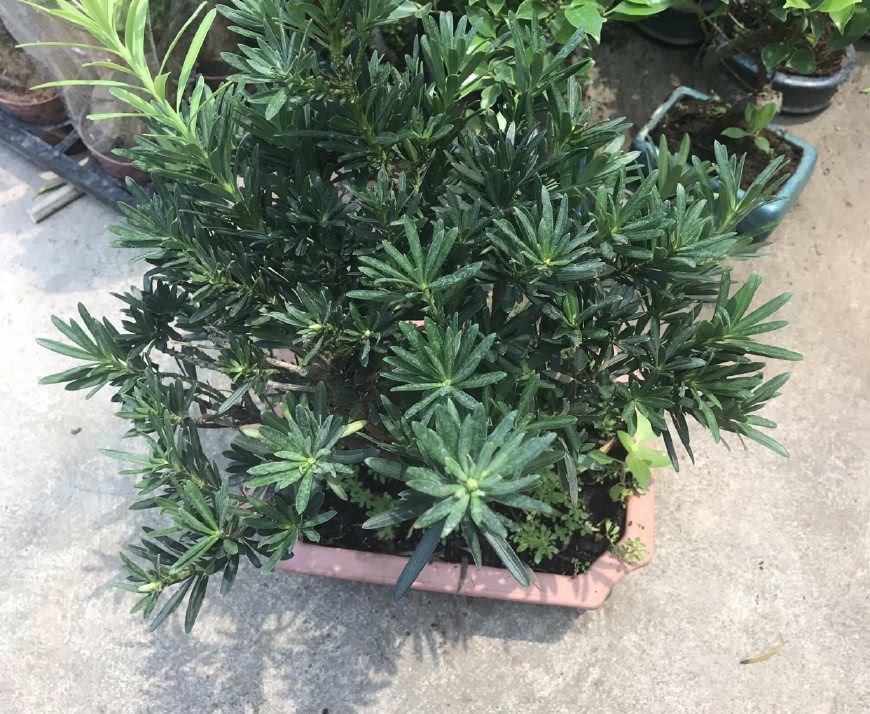
Buddhist pine is an evergreen tree with particularly dense branches and leaves, an elegant form, and evergreen foliage all year round. Grown outdoors it can reach over ten meters, and it gives a feeling of thriving vitality, making it very suitable for pot cultivation and appreciation. However, growing Buddhist pine requires attention to a few little tricks, because some growers end up with Buddhist pines that either have yellow leaves or drop leaves, or grow slowly. How can you make Buddhist pine grow vigorously, constantly push out new leaves, and have lush branches and leaves?
Grow potted Buddhist pine this way, with not a single yellow leaf, new leaves constantly sprouting, and lush branches and leaves!
When growing Buddhist pine yourself on a balcony or at home, it is best not to use a porcelain pot, because porcelain pots are not very breathable; it is best to use a ceramic pot or a purple clay pot. The soil for growing Buddhist pine must not be too compacted or too thin. You can use leaf mold, peat soil, and add garden soil and sand; this kind of soil is fertile, loose and well-draining.
Buddhist pine likes to bask in the sun. If the light is too poor, it easily makes the branches and leaves grow leggy. Although it can also grow in semi-shaded environments, during the growing season, more sun in spring and autumn will make the branches and trunk grow stronger and more luxuriant.
During the growing season, you must fertilize two or three times, each time using fermented cake fertilizer, or organic fertilizer water such as manure and urine, or potassium fertilizer, fertilizing once a month. After dilution, pour it into the pot, and it must be in a thin state. After the Start of Autumn, there is no need to fertilize anymore; otherwise, if new leaves grow, they are prone to freezing damage in winter.
When watering Buddhist pine, you must control it well, because it is relatively drought-tolerant. The amount of water at one time must not be too much, otherwise if water accumulates, it easily causes root rot and leaf drop. Just keep the soil slightly moist. In summer, you can spray a little water around the pot. In winter, as long as the soil has a bit of moisture, there is no need to water.
Repot once every two or three years, and for old trees repot once every four years, carried out in spring in March or April. For overwintering, it must not be placed in a place that is too cold; it is not very cold-hardy, so it can be placed in a warm, sunny spot on the balcony. As long as the temperature is not below 5 degrees, it can overwinter safely.
In spring and after the Mid-Autumn Festival, when the sunlight is not too strong, you can place the potted Buddhist pine outdoors on a terrace for care. In early autumn and in summer, when the light is strong, it should be placed in a semi-shaded place.
During the growing season, if there are leggy branches, cut them short or cut them off in time. After Buddhist pine blooms, if you do not want to keep seeds, remove the flowers to avoid nutrient consumption that affects growth.
Pay attention to these little details, and you too can grow a Buddhist pine with lush branches and leaves and glossy green foliage all year round!