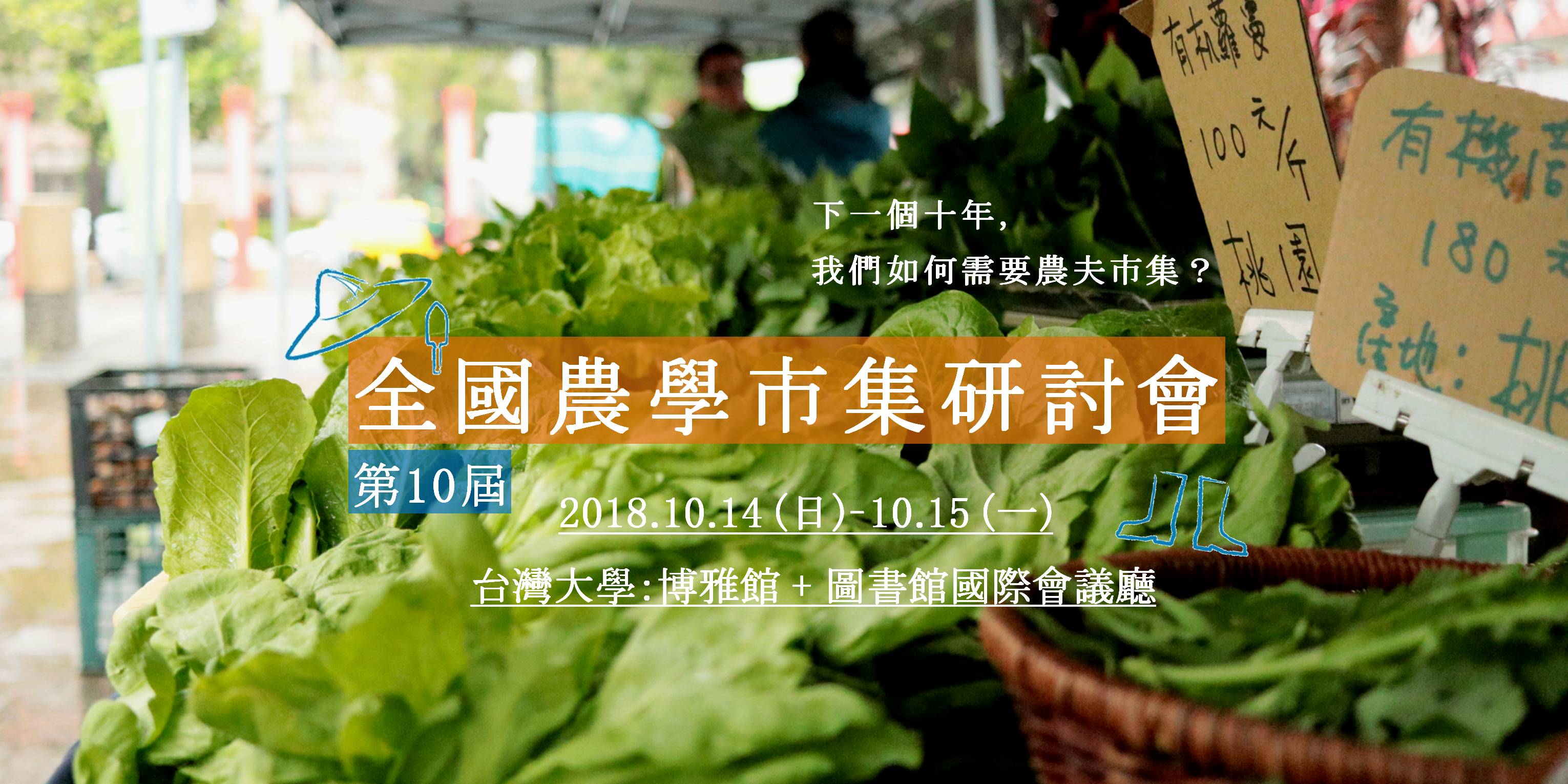
Explanation of the 10th National Farmers' Market Symposium: "We want to find out why, we want to know the truth, so we listen."
Dear market partners, and friends who care about small farmers in Taiwan, China:
This year's symposium is a little different, because this is the year with the fewest market managers taking the stage in all these years. Over the past 10 years, the markets have gone from green to mature, and discussions have mostly been about market regulations and operations, and about building mutual trust and bonds through this kind of market gathering.
But as we enter the 10th year, society is changing, people's consumption habits are changing, and the challenges facing the markets are changing too.
In recent years, the climate has been abnormally hot, with summer lasting almost half the year. Under such intense heat, along with a decline in the novelty of the markets, the number of people coming to the markets has also slowly declined; at the same time, many retail channels have begun offering organic ingredients for sale, and more and more e-commerce platforms focused on the concept of organic and eco-friendly are appearing.
Recently, because of the symposium, I have come into contact with quite a few markets, and apart from a small number of them, farmer-centered markets have suffered severe blows to their sales to varying degrees.
"We want to find out why, we want to know the truth, so we listen."
We want to hear how consumers view the markets, what they expect from them, why they come, and why they no longer come. So we invited Gu Biling, Fan Honghua, and Yan Defen, several consumers with a professional eye, to talk. And so came the theme hosted by Xiaofei: [The Era of Visiting Markets, When Consumers Meet Farmers].
Recently, with the floods in the south, under extreme climate, and under the crisis of multinational corporations continuously acquiring seed companies in an effort to monopolize and commodify seeds, on the afternoon of the first day of the symposium, in addition to opening the lectures free of charge, under the hosting and guidance of Teacher Guo Huaren, together with units including Zhulian, Xiuming, Permaculture, the seed farm, the Crop Germplasm Center, and Cixin, we held the first National Seed Exchange. Through an occasion like this, seed preservation and seed saving are actually not far from the public, and this kind of exchange and advocacy is especially important under today's dramatic climate change.
On the second day of the symposium, we also invited Carrefour spokesperson He Mozhen, Lefei Supermarket General Manager Pu Shengming, and SuperBuy General Manager Liu Caiyuan to talk about the markets. The host Shengyou, who has long been in contact with the markets and tried to open up new prospects for civil agriculture, also tried to draw out, from the perspective of a highly competitive retail operator, whether farmers' markets really are that uncompetitive? And what advantages can retail channels never replace? Could channels and markets even possibly cooperate to spark new business opportunities?
In response, should all the markets just sit and wait for death? So we invited Breeze to talk about how they cooperated with the Kaohsiung City Government on green eco-friendly restaurants, as well as the recent Green Refrigerator project, and also Sanxia's Food Communication and agricultural product development, Xiaosen's direct-sales outlet system planning, and Water Garden's green dining guide. These market cases show that markets are no longer just about buying and selling within the market; no one dares say they will definitely succeed, and some are even losing money while feeling their way forward, but it is precisely this fearless pioneering spirit that is so moving.
After talking about consumers, channel operators, and market innovation, we are honored to also have invited Director-General Hu Zhongyi of the Agriculture and Food Agency, Legislator Cai Peihui, and Deputy Minister Zeng Xuzheng of the National Development Council. With host Jieting serving as a bridge for communication among markets, small farmers, and the government, let us have a good talk about what the government actually plans to do, and what the markets expect from the public sector. And whether the private sector and the government always talk beautifully but in practice are forever two parallel lines. In a market centered on small farmers or even micro-farmers, is there a chance to join hands to open up the sales chain for small farmers?
There is much to be learned from others' experience. The finale is Brother Mengkai representing Taiwan's markets in a dialogue with Seoul's Marche_Market, Beijing's Organic Farmers' Market, and Nanning's Urban Farm Market. We are very interested in the huge membership organization Seoul has developed starting from its market, and we also want to understand how Beijing and Nanning have managed to survive without any resources. Under such extreme hardship, what paths have they each taken?
Yes, this year's market symposium is not typical. We have no market hugging and mutual-comforting activities, no banquet, only vegetarian boxed lunches, and we do not even go by number tags, letting all the market managers take the stage to introduce their own markets.
I think, 10 years... the markets are familiar enough with each other.
So this year we shut our mouths, and listen and discuss from the audience, listening to these valuable, real, and even nakedly cruel suggestions and criticisms from different fields. These will all become nourishment for all our markets, and we will absorb this nourishment and these suggestions. I deeply believe that there will surely be people of aspiration who will respond in the coming years of market operations.
This time we start from the future, and look back at what we should do now.
Secretary-General of Water Garden Organic Farmers' Market, Huang Juncheng
 https://pse.is/ADEC6 (Accupass Event Platform)
-- The 10th National Farmers' Market Symposium --
Time | October 14 (Sun), October 15 (Mon), 2018
Location | National Taiwan University (Boy ya Hall + Library International Conference Hall)
Guiding Units | Agriculture and Food Agency, Council of Agriculture, Executive Yuan; Department of Economic Development, Taipei City Government
Organizers | Water Garden Organic Farmers' Market (Taipei Cultural Exploration Association), Haoshiji Agricultural Food Integration Co., Ltd.
Co-organizers | Bamboo Dragonfly Green Market, NTU Agricultural Development Center