The uncle who grows bonsai stumps has a quirky habit: he gets up in the middle of the night to scratch the tree stump. Auntie asks whether he is sleepwalking or playing tricks on her.
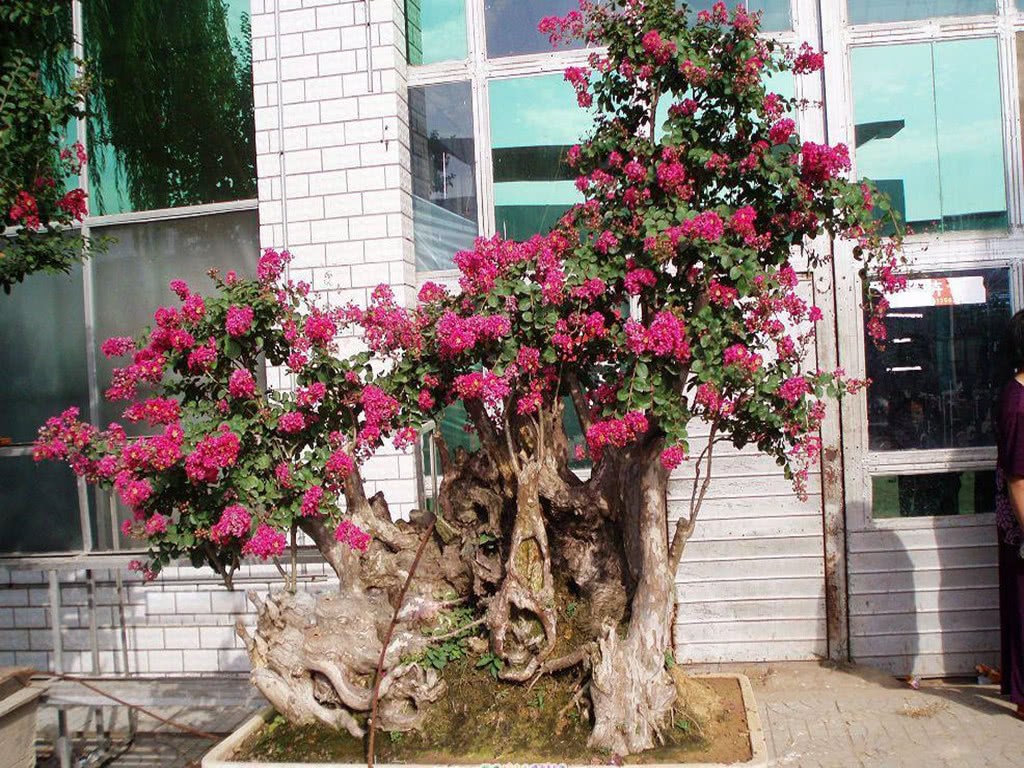
Uncle has developed a quirky habit from growing stumps: he gets up in the middle of the night to scratch the tree stump. Auntie says: Are you sleepwalking or deliberately playing tricks on me?
Uncle is a hardworking rural man who is quite good at what he does. He lives only about 500 m from my house. I often drop by his home to listen to his stump-growing experience, so that the tree stumps I care for can grow healthily, and so that I can avoid some detours in stump care.
Uncle is especially fond of growing wild-collected crape myrtle (Lagerstroemia indica) stumps. The several pots of wild-collected crape myrtle stumps he grows can be called expert-level, whether judged by their appearance or by studying the details of their care and management. Anyone who grows crape myrtle stumps is familiar with this: crape myrtle is a deciduous shrub or small tree, with smooth gray or grayish-brown bark; the branches and trunk are mostly twisted, and the twigs are slender. The leaves are alternate or sometimes opposite, papery, elliptical, broadly oblong, or obovate, green to yellow when young, and extremely vivid.
Not only that, the crape myrtle's form is even more graceful, with a smooth, clean trunk and brilliantly colored flowers; it blooms right in the summer and autumn season when few other flowers are around, and its flowering period is long, so it is called "the hundred-day red." There is also the praise: "In midsummer when green shades the eyes, this flower reddens the whole hall." It is an excellent material for bonsai enjoyed for its flowers, trunk, and roots; its roots, bark, leaves, and flowers can all be used as medicine. Moreover, the bark of the crape myrtle changes color twice throughout the four seasons. This is also why Uncle rather likes and appreciates this kind of tree.
But recently, Auntie has often been grumbling: Uncle frequently gets up in the middle of the night (around 12 o'clock) to look at his crape myrtle stumps. This caught Auntie's attention. For several days in a row, Auntie followed behind him. At first she thought he was sleepwalking and did not dare go up and disturb him. Later she found that he would first go to the living room to drink some tea before going out, and then he would go scratch the tree roots and watch them carefully. By rights, there is no need to shape a stump only at night. This really is a bit odd.
It was not until last night that I heard Auntie and the others arguing. Listening carefully, it was all about this matter. Auntie shouted: You stay up half the night every night without sleeping. I thought you were sleepwalking. Little did I know you were tending your rotten tree stumps. Are you deliberately playing tricks on me? Tomorrow I am going to chop up your tree stumps for firewood. At this point, only after our persuasion did things gradually calm down. After we questioned him carefully, Uncle finally told the truth. He said: I recently saw news online saying that the kind of tree I grow is also called the "tickle tree." As long as you gently scratch its roots with your hand, it will act shy and its branches will sway. At night the wind is light and calm, so I wanted to verify whether it is true. Before there was any result, your auntie put a stop to it, and we even ended up in a fight.
As for crape myrtle stumps, I just think their texture is hard and they easily form burls, making them very pleasant to grow as potted plants. They are not as magical as Uncle described. I wonder, if you also like growing crape myrtle stumps, have you made any new discoveries? Do you agree with this claim?