Bare flower pots look unattractive? These cover plants for pots can help you solve that
Many gardening enthusiasts know that if the flower pots at home are bare, they look very monotonous. In fact, you can choose to plant the following types of cover plants for pots.
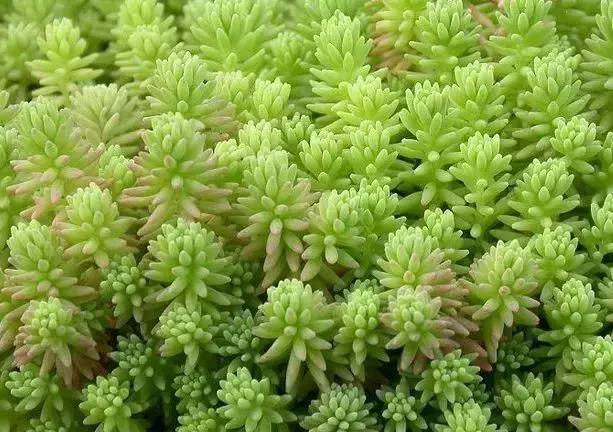
Sedum hispanicum var. minus
Sedum hispanicum var. minus is a perennial herbaceous plant of the Crassulaceae family. Its roots are fibrous, it has a creeping habit, and its leaves are club-shaped and very densely packed.
It likes to grow in environments with plenty of light, and either full sun or partial sun will do. It has fairly strong drought tolerance, fears heat, but is very cold-hardy.
Sedum japonicum 'Tokyo Sun'
Sedum japonicum 'Tokyo Sun' is a plant of the Crassulaceae family. Its leaves are golden yellow under sufficient light, very beautiful, and it is very suitable for accenting the edges of flower pots.
Plenty of light is what Sedum japonicum 'Tokyo Sun' likes most. During its growing period, it needs to be given sufficient light so that its color will be even more beautiful.
Sedum makinoi
Sedum makinoi is a succulent plant of the genus Sedum. Its entire plant looks very small and delicate, and its stems also grow in a creeping manner.
Normally when it is growing, it needs to be given sufficient light and cultivated in loose, breathable soil. It is the kind of plant that grows better the more harshly it is treated.
Sedum lineare
Sedum lineare is a perennial herbaceous plant of the Crassulaceae family. Its leaves are linear, its inflorescence is umbel-shaped, and its calyx is linear-lanceolate, very beautiful.
It has very strong adaptability to the environment, very strong cold and drought tolerance, and no particular requirements for soil, so it is very easy to keep alive.
Sedum spurium 'Dragon's Blood'
Sedum spurium 'Dragon's Blood' is a plant of the Crassulaceae family. It also has another name, Dragon's Blood Sedum. The shape of the plant is very attractive, and it is very suitable as a cover plant for pots or a ground cover plant.
Normally, it is green, but if you increase its light and increase the temperature difference, its color will turn blood red. Normally it should be given sufficient light and water.
Although these can all serve as cover plants for pots, you still need to be careful not to let them take over the potting soil, and pay attention to routine care and pruning. Among these cover plants for pots, which ones do you like?