Tiger-stripe orchid fakes are getting more sophisticated - a veteran orchid grower teaches you how to tell real from fake
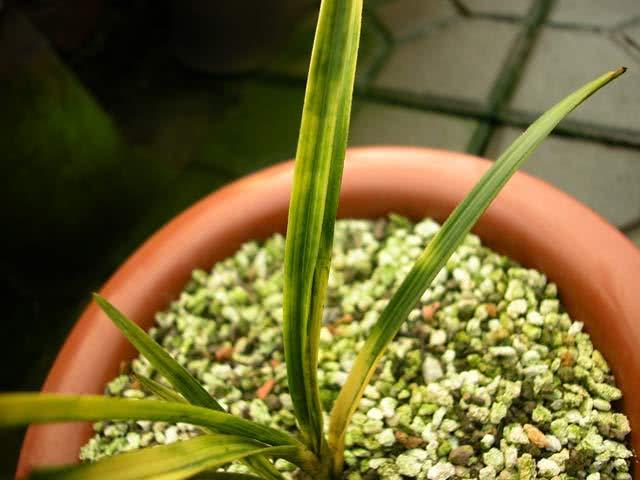
There really are quite a few fake tiger-stripe orchids on the market, and the forgery techniques are getting better and better. The tiger-stripe orchids you spend a lot of money on often, after a year or so of growing, have old growths that fade and lose their variegation, while the new growths show no variegation at all, so you lose interest and set them aside. Judging by the characteristics of tiger-stripe variegation, most are late-developing tiger stripes, and late-developing tiger stripes have better variegation quality than early-developing ones. Even a real tiger-stripe orchid, without proper light, will produce green leaves or indistinct markings. So don't casually throw away the tiger-stripe orchids you already have; just because fakes exist, it would be a real pity to be afraid to keep real ones or to discard them. It's better to observe for a year or two before deciding what to do.
Fake tiger stripes are made by spraying some kind of herbicide, combined with the forger's cleverness, but a fake is still a fake after all, and careful observation can still identify it. First, fake tiger stripes are usually one large patch; it is very rare for a single leaf to have two or three segments of patches, and it is impossible for a whole growth or whole plant to show two or three segments of patches.
This is a technical problem the forgers have to overcome. Perhaps the cost of forgery is too high. Second, the variegation color of fake tiger stripes is yellow-green or pure white, and most importantly, the boundaries are blurred. Online there are also some shameless characters hawking fake tiger stripes, saying: tiger stripes for florist use. Because they know perfectly well that what they produce is not up to standard, so they might as well sell it as a disposable potted flower.
Third, looking at the whole plant, fake tiger stripes often have many and large pseudobulbs, few growths, mostly new growths, with old growths absent or cut short; even if old growths are present, they have no variegation. Ask them why, and the answer is: the cow ate them. I have heard the saying: an old cow eats tender grass - but why do theirs only eat old grass and not tender grass?
Also, the main production area of fake tiger stripes is the Henan area, and the characteristics of the plants differ from those of Jiangsu and Zhejiang plants. And because they have been home-grown and sprayed with herbicide, their growth is
stunted; growths with fake tiger stripes generally grow poorly, with short, thick leaves, though taller than those treated with growth retardants. In short, plants with no old growths and only new growths bearing variegation, with blurred boundaries, and with only large-patch variegation, are highly likely to be fake. And vice versa.
Sometimes you come across dragon-root seedlings or weak seedlings with variegation, which can generally be trusted, because forgers usually will not choose dragon-root seedlings or weak seedlings, which carry greater growing risk and cannot fetch a high price, but this is not an absolute guarantee. Because the herbicide's effect only shows on new growths, forgers also choose robust growths; from this you can infer - new growths with large pseudobulbs bearing patches are more likely to be fake tiger stripes.