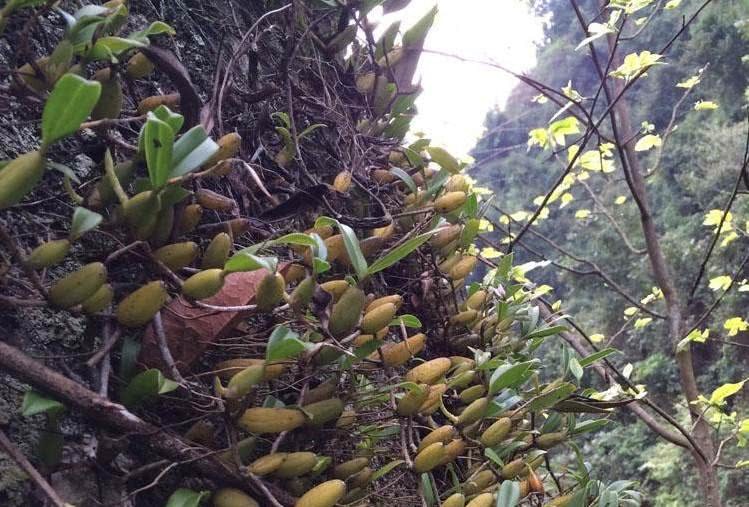
The shimi that grows on rocks is very famous and extremely valuable; don't miss it if you see it.
For friends in rural areas, there is always a special feeling for wild vegetables and wild foods, especially for our grandmothers' generation, who can name every wild vegetable growing along the edges of fields and paths as if counting family treasures. Some wild vegetables can still be seen often today, but others, because of their high requirements for the growing environment, are now rarely seen. Today I will introduce a wild vegetable that I ate in the countryside as a child. It is both a vegetable and a medicinal herb, and it is very well known in the Guangdong area; people there cannot do without it for making soup all year round.
This wild vegetable is called shimi, and its scientific name is shi ganlan (rock orchid). It always grows deep in the mountains, and moreover it grows by clinging to cliff faces, with extremely tenacious vitality. The fruit of shimi looks like an enlarged grain of rice, except that its color is green. Under this special growing environment, shimi has remarkable effects. In rural areas, farmers always call shimi "fairy peach," because farmer friends always treat shimi as a kind of health-care medicinal food. When I was a child, we were very poor, and farmers simply had no extra money to buy nutritional supplements. The old people in the countryside all said shimi was very good, so farmers would go deep into the mountains to look for shimi, and in this way they could eat this natural nutritional supplement without spending money.
In fact, shimi really does have very good effects and high edible value. The rich minerals and vitamins in shimi can promptly supplement the elements lacking in the human body. Especially when shimi is stewed with some meats such as pork ribs or free-range chicken, the nutrients of shimi can be effectively preserved. Even now, many people are still looking for wild shimi to make soup or stew meat, and its nutritional effect is beyond that of many other foods. Moreover, when making stewed soup, all of shimi's roots, stems, leaves, and fruits are kept, so its nutrients can be preserved to the greatest extent.
Besides its nutritional value, shimi also has medicinal value. It has the effects of moistening the lungs, promoting body fluid production, and reducing internal heat, and it also has a certain effect on treating toothache and stomach problems. In our country, folk tradition believes in the role of food therapy, so shimi is regarded as a very good material for both medicine and food. According to traditional Chinese medicine, shimi has a sweet and cooling nature, and when used in the hot and humid regions of the south it can clear heat and nourish yin, so many people like to use shimi to make soup. Shimi is used in two ways: fresh and dried. The price of the fresh product is not expensive, about 10 yuan per jin, while the dried product is more expensive, roughly 4-5 times that of fresh shimi.
In the past, shimi was all wild; you just had to go pick it, and it did not cost any money. Now, because of people's demand, shimi has also begun to increase in value. If you see shimi on rocks in the wild, don't miss it! Its nutritional value and medicinal value are both extremely high, and it would be a pity to miss it. Have you ever seen shimi?