Tips for caring for a Caladium potted plant: pay attention to light and soil to easily grow large leaves
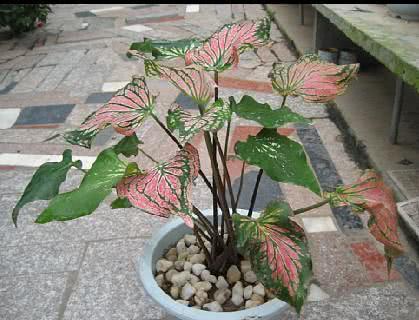
Caladium is also known as Caladium bicolor; its leaves are oval or nearly heart-shaped and quite brightly colored, usually with a bright red center and green outer edges, so people often call it "two-color taro"; in addition, the leaves have various spots, and the undersides are mostly powdery green. As the seasons change, the leaf color gradually deepens, so it is suitable for growing indoors or in corridors and courtyard corners for ornamental viewing, with very good ornamental value.
I. Cultivation of Caladium
People often use division propagation to cultivate Caladium because this method has a high success rate and is suitable for cultivation all year round, but for home potted Caladium, the cutting method is more recommended. Spring and autumn each year are more suitable for growing Caladium by cuttings. You need to take relatively tender green branches and leaves from a well-growing Caladium plant, with a length of about 10 cm being appropriate, but during this process you need to take certain protective measures, such as wearing gloves, because the leaves of some Caladium varieties have an irritating effect on the skin, so extra care is needed.
Then spray an appropriate amount of disinfectant on the wound of the branch and wait for it to heal; this process generally takes one to two days. Before this, most of the leaves on the branch should also be cut off, leaving only a few leaves at the top. When taking cuttings, also pay attention to protecting your hands. After watering an appropriate amount of water, you can quietly wait for the branch to take root. Generally after three weeks, the branch can be seen to have taken root, and after about another week of cultivation, the seedling can grow a small number of leaves, at which point the potted plant can enter normal management.
II. Care of Caladium
1. Light conditions
Potted Caladium is more suitable for growing in a semi-shaded place, but it needs to receive appropriate diffused light to ensure good plant growth; at the same time, the placement of the potted plant is quite particular. Generally, from early morning to noon, the whole potted plant can receive sunlight, while the afternoon sun is more intense and appropriate shading is needed, especially at noon in summer, otherwise the plant's branches may be burned by the sun, affecting its ornamental value. According to changes in temperature, the time it receives light can be appropriately changed. If it is spring and autumn, the sunlight at this time is relatively warm and suitable for the growth of Caladium, so the plant should receive more light, while the practice in summer is exactly the opposite.
2. Soil conditions
Because Caladium often grows poorly in poor soil, the choice of potting soil is especially important. Generally, relatively fertile and well-loosened humus soil or sandy soil is chosen, so that the plant can smoothly pass through the seedling growth period, which also has a relatively large impact on the plant's ornamental value.
3. Watering requirements
Caladium is especially not tolerant of waterlogging, but the potting soil must still be kept in a somewhat moist state, so the watering requirements are relatively strict. Usually, whether to water should be judged according to the soil and leaf color. If the soil is relatively dry and the leaf color is relatively dull, it often indicates that the plant is in a state of water deficiency. At this time, an appropriate amount of water should be poured in, preferably watering about once every three days.
On the other hand, according to changes in weather or air humidity, watering also needs to be adjusted. For example, when the rainy season comes, the air humidity will increase significantly over a period of time. If you water as usual, it may cause water accumulation in the potted plant, so special attention is needed.