How to grow a Dennis bromeliad bonsai? Diverse shapes with a fresh, pleasant flower color
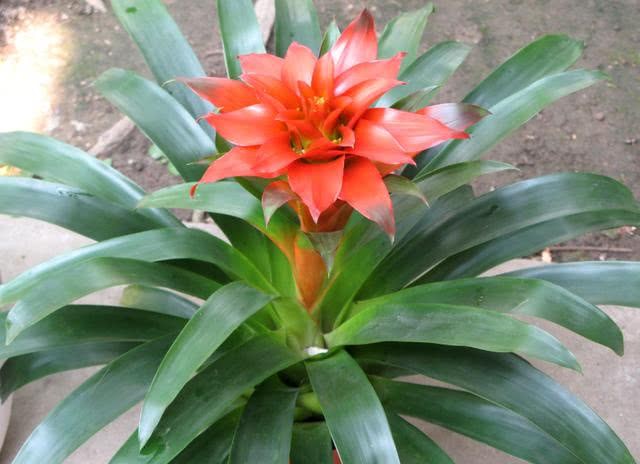
The Dennis bromeliad is also known by the alias Dennis Star. Its leaves are emerald green, its shape smooth and translucent, with no particular stripes on the leaf surface, giving an overall extremely clean and simple impression; while the flower spike and flower stalk are red, surrounded by several red bracts, and usually a small number of seeds are produced inside the flower stalk. A small potted Dennis bromeliad is suitable for placing in the home, appearing very elegant in a brightly lit spot, and its delicate, gorgeous flower color gives people a refreshing feeling.
I. Cultivation of the Dennis bromeliad
The Dennis bromeliad is generally propagated by seed cultivation and division, but the division method is rather troublesome, and the growth cycle usually takes several years before it blooms, so seeding is commonly used to cultivate the Dennis bromeliad. New seeds can be collected from the Dennis bromeliad every year in April-May and July-August, and can also be purchased from flower markets. Before sowing, the seed coat and impurities must be thoroughly cleaned, otherwise sowing may fail.
After rinsing clean, the seeds generally still need to be soaked in warm water for one to two days, and placed in a cool place to dry before sowing. Usually 4-8 seeds are broadcast per pot, and care should be taken to spread them evenly over the soil; normally after three weeks the seeds will germinate properly, and once the seedlings have grown several true leaves, routine management of the pot can begin.
II. Care of the Dennis bromeliad
1. Soil requirements
Since the Dennis bromeliad adapts well to its environment, those without special conditions can use ordinary sandy soil or humus soil, as long as the soil has good looseness and drainage; in addition, to allow the plant to absorb more nutrients, a piece of cake fertilizer or manure fertilizer can be added to the bottom of the soil.
2. Light requirements
A potted Dennis bromeliad needs to grow in a place with good light, but it should not be exposed to direct light for long periods; growing under diffused light is most suitable. Therefore, when the summer sun is rather intense, the pot usually needs some shading, otherwise the plant's branches and leaves may become dry. In addition, try to avoid growing the plant in too dark a place, as this can very easily cause the leaves to turn yellow, and in severe cases even cause them to drop, and the death of the plant is not impossible either.
3. Water requirements
During the growth of the Dennis bromeliad, its water needs are actually not too great. Every year, spring and autumn are the periods of rather vigorous growth for the Dennis bromeliad, and watering once every three to four days or so is appropriate; be sure not to overwater, otherwise water accumulation can easily occur in the plant's root and stem area. During high-temperature periods, it is best to spray water mist on the plant's leaves to prevent the air from being too dry and causing the leaves to dry out; while in winter, add as little water as possible.
4. Fertilizer requirements
The plant's nutrient needs are average, and too much phosphorus fertilizer should not be added to the fertilizer applied, otherwise the plant's growth will be greatly affected; instead, apply a compound fertilizer mainly of nitrogen fertilizer and potassium fertilizer, and generally fertilizing once or twice a month is sufficient. In the one to two months near the plant's flowering period, a few extra applications of fertilizer can be given as appropriate.