Characteristics and High-Quality, High-Yield Cultivation Techniques of 'Manicure Finger' Grape in Zhuji City
Characteristics and High-Quality, High-Yield Cultivation Techniques of 'Manicure Finger' Grape in Zhuji City
Manicure Finger (マニキュラフィンカ) is a Vitis vinifera grape variety originating in Japan. In 1988, it was bred by the Japan Uehara Grape Research Institute by crossing Unicom with Baladi No. 2. This variety has strong bud-break ability, vigorous growth, extremely large clusters, a high fruit-setting rate, and good coloration, but its canes ripen noticeably late. Under improper cultivation management, this variety differentiates few flower buds and its yield is unstable. After more than ten years of cultivation research and experimental demonstration, Zhuji City has now achieved success.
1 Variety Characteristics
1.1 Botanical Characteristics
The main shoot has very strong upright growth and relatively long internodes. The young shoot is yellow-green with a purplish-red tinge and glossy. The leaves are relatively small, palm-shaped, and medium-sized when mature. They are shallowly lobed or moderately five-lobed, with heart-shaped serrated margins. Both the upper and lower leaf surfaces are smooth and hairless. The petiole sinus is arch-shaped. Flowers are bisexual.
1.2 Cluster Characteristics
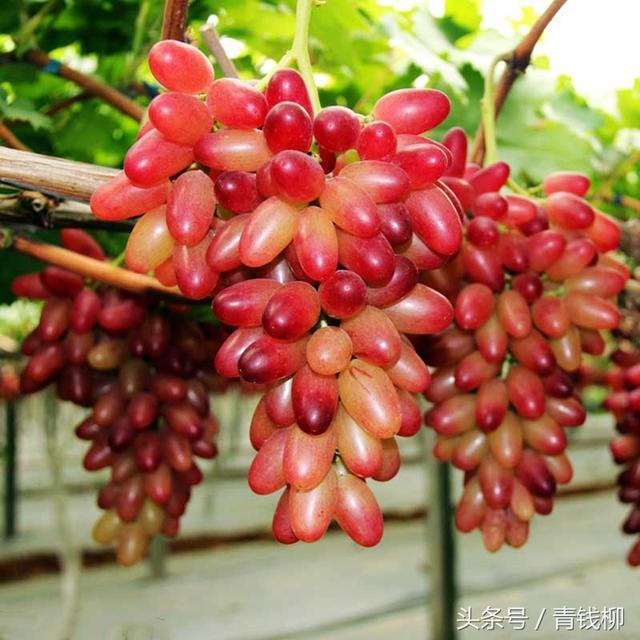
This variety has medium-to-large clusters with no secondary clusters. The average cluster weight is 450-600 g, and the largest cluster weight is 1,750 g. The berries are large and slender, with an average berry weight of 10-12 g and a maximum berry weight of 20 g. The front end of the berry is bright red, while the base of the berry is slightly lighter in color, exactly like the finger of a beauty with red nail polish, and its appearance is extremely gorgeous, hence the name. The bloom is relatively thick, and the skin is thin but has good toughness and is not prone to cracking. The flesh is firm and crisp and can be cut into slices with a knife without dripping juice. The fruit is semi-translucent, high in sweetness, and has no sourness. The soluble solids content reaches 16%-19%. When cultivated properly in the south, it has a rich fresh flavor, and the taste is sweet, fresh, crisp, and refreshing, with the typical flavor of a Vitis vinifera grape. This variety combines appearance, eating quality, and nutrition, and its quality is excellent.
1.3 Tree Vigor Characteristics
This variety has strong and vigorous tree vigor. A one-year-old large seedling can grow to more than 5 m by late autumn, and the basal thickness can exceed 3 cm. The ripening period is relatively late. In this city, buds break in early April, and it takes about 135 d for the fruit to fully ripen. In ordinary years, coloration begins in early August, and the fruit ripens from late August to early September. The ripening period requires a certain amount of accumulated temperature. Disease resistance is relatively weak, and it is susceptible to white rot. The cane ripening period is rather late, flower bud differentiation is relatively difficult, differentiation is better on the middle and upper parts of the canes, and winter buds are prone to sprouting in autumn.
1.4 Flower Bud Differentiation and Yield Performance
Manicure Finger is relatively difficult in flower bud differentiation, and early-differentiated flower buds are also prone to degeneration. With improper fertilizer and water management, winter buds are prone to sprouting in autumn, and the yield is relatively low. Under ordinary cultivation, the yield per mu is only about 300 kg. In response to the characteristics of Manicure Finger and the cultivation requirements for pollution-free commercial fruit, Zhuji City, through technical research, overcame the difficulties of flower bud differentiation and the control of major diseases and pests in Manicure Finger cultivation, and summarized a set of "pollution-free, standardized supporting cultivation techniques that, through one year of cultivation management, achieve two-year-old tree vigor and high yield in the second year." According to this set of techniques, the yield per mu can reach more than 1,000 kg in the second year, and from the third year onward the yield per mu stabilizes at about 1,500 kg.
2 Main Cultivation Techniques
To achieve significant economic benefits in planting Manicure Finger, the main cultivation strategy should accomplish the following two points: first, in response to the botanical characteristics and cultivation traits of Manicure Finger, focus on controlling tree vigor and promoting flower bud differentiation to lay the foundation for high yield; second, focus on producing pollution-free fresh fruit and carry out integrated control of major diseases and pests well, so as to achieve high quality and high yield.
2.1 Application of Protected Cultivation
In order to control diseases and produce pollution-free table grapes, protected cultivation must be advocated. Protected cultivation has two forms: single-ridge small arched rain-shelter facilities and double-ridge large greenhouse rain-shelter facilities. The materials used in protected cultivation generally include galvanized steel pipes and moso bamboo.
The ridge width is suitably 2.5-3.0 m. For cultivation with a ridge width of 2.5 m, when using galvanized steel pipes as the material, the spacing along the ridge direction is 4 m; when using moso bamboo as the material, the spacing along the ridge direction is 3.6 m. The single-ridge small arched rain-shelter facility has a top height of 2.3 m and an arm height of 1.8 m. The double-ridge large greenhouse facility has a top height of 3.0 m and an arm height of 1.7 m. Note that the shed should be built firmly to prevent typhoons.
2.2 Selection of a Suitable Trellis System
Manicure Finger has vigorous growth, so a trellis system that moderates growth vigor should be selected. A pergola trellis or a high-wide-drooping trellis system may be used. According to local experience in Zhuji City, it is suitable to use an improved "double-cross V-shaped trellis" for cultivation. This trellis system can both moderate growth vigor and ensure high yield in the second year. The specific requirement is that, on the basis of the original "double-cross V-shaped trellis," the width of the "V shape" should be increased. At 1.7 m above the ground, the V-shape width should be between 1.25-1.75 m depending on the ridge width; at 1.4 m above the ground, the V-shape width should be about 1.0 m; and at 1.0 m above the ground, the V-shape width should be 0.3 m.
2.3 Reasonable Planting Density
For grape varieties with moderate vigor, using the "double-cross V-shaped trellis," the general planting density in the south is 185-250 plants per mu. Because Manicure Finger has strong and vigorous growth, it is generally suitable to plant 120-150 plants per mu. With a ridge width of 2.7 m, it is suitable to plant 1 plant in the middle of each ridge, with a spacing of 1.5-2.0 m between plants.
2.4 Planting Requirements
It is advocated to plant after leaf fall in winter or in February in early spring. For planting in paddy fields, it is better to plant shallowly rather than deeply. On the basis of root trimming and root disinfection, plant with the root system spread out in an umbrella shape. After planting, water the roots with water mixed with Aiduoshou, and then install drip irrigation on the ridge. Then cover with agricultural film to promote growth. By June, after the plants have grown larger, replace it with black-and-white plastic film to increase light exposure, and it can also retain moisture and inhibit weed growth.
2.5 Temperature and Humidity Regulation in Forcing-Cultivation Greenhouses
From after film covering to before bud break, keep the greenhouse door tightly closed day and night to raise the greenhouse temperature and soil temperature. The temperature is generally controlled at about 30°C, with a maximum not exceeding 35°C. When the greenhouse temperature reaches 30°C, open the greenhouse door in time for ventilation and temperature control, and keep the soil moist. From after bud break to one week before flowering, prevent low-temperature chilling injury, and the minimum temperature in the greenhouse should not be lower than 5°C. Around the flowering period, control the daytime temperature at 25°C-30°C, and the minimum temperature should be above 14°C. Lay double-color reflective film on the bed surface to control temperature and reduce humidity.
2.6 Control Nitrogen Fertilizer and Increase Phosphorus and Potassium
Strictly control the application amount of nitrogen fertilizer. In principle, the application amount of nitrogen fertilizer only needs to be about half that for Kyoho grape, and increase the proportion of phosphorus and potassium fertilizer by more than 30%, applying nitrogen, phosphorus, and potassium in a reasonable combination. The application time of nitrogen fertilizer should be earlier rather than later. It is advocated to apply winter fertilizer in autumn and to apply less bud-promoting fertilizer. Pay attention to foliar topdressing, generally 1-2 times per month, using foliar fertilizers such as Greenfinwei and Aiduoshou.
2.7 Bud Thinning and Shoot Training
The number of canes retained should be relatively sparse. Taking the improved "double-cross V-shaped trellis" as an example, generally retain 1 cane about every 25 cm to keep the trellis surface ventilated and light-transmitting. When the current-year seedling grows to 0.9 m, pinch the tip. When the leaves on the fruiting shoot grow to 8-9 leaves, begin pinching the tip, and tie it promptly. Afterward, leave 3 leaves and repeatedly pinch the tip continuously. Shoot pruning and leaf number for fruiting trees: prune shoots according to the "7+4+4" leaf pattern, and the first shoot pruning should be carried out 15-18 d before flowering. One main shoot has 15 leaves. Treatment of secondary shoots: after the first shoot pruning, completely remove the secondary shoots below the inflorescence in batches 7 d later; retain 4 secondary shoots above the inflorescence, pinch the tips after 2-3 leaves, and completely remove the other secondary shoots in batches. One main shoot has 8-12 secondary shoot leaves, and the total number of leaves retained on the main shoot is 23-27. Repeatedly pinch the new shoots at the top to promote flower bud differentiation, prevent flower bud degeneration, and accelerate cane ripening. During winter pruning, retain canes with short internodes and plump buds, and appropriately retain more fruiting mother canes, carrying out medium and long cane pruning.
2.8 Integrated Control of Diseases and Pests
Disease and pest control adopts the policy of "prevention first, integrated control," with agricultural control as the foundation and killing pathogens as the focus. Comprehensive control measures are adopted, combining careful winter orchard cleaning, eradicating pathogens at the bud-swelling stage, timely bagging after fruit set, and targeted spraying during the growing period. The main diseases include black pox, gray mold, white rot, anthracnose, downy mildew, etc. Pests include clearwing moth, longhorn beetle, scarab beetle, aphid, etc. Select pollution-free pesticides such as Daconil, DuPont Fuxing, Sumilex, Shijiale, DuPont Wanxing, Thiophanate, imidacloprid, cypermethrin, and Yashijing. Pesticides should follow the principles of alternating use and reasonable mixing.