What flowers to plant in the autumn courtyard? These 15 flowers are suitable for planting
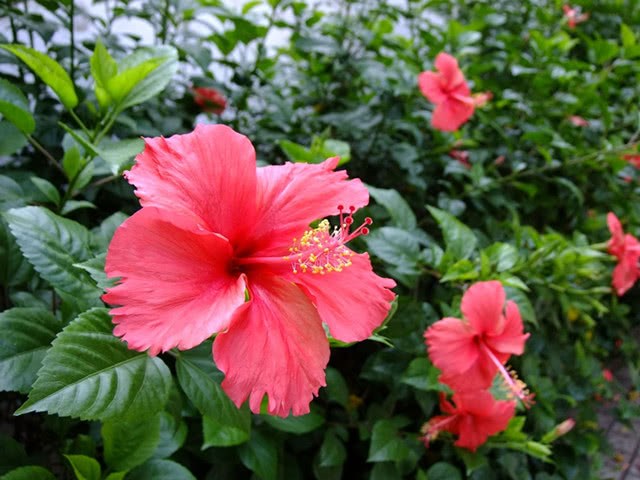
The weather has turned cool recently, and the pleasant, cool autumn has arrived. Autumn is the time when many flowers grow luxuriantly, and those with courtyards should get moving too. Today, the editor recommends 15 flowers suitable for planting in the courtyard in autumn.
1. Hibiscus
Hibiscus flowers are bright in color, and keeping them at home makes everything look colorful and varied. Hibiscus likes to grow in warm and humid environments, but attention must be paid to ventilation, so that hibiscus is less likely to develop diseases and pests.
2. Bougainvillea
The flowers of this plant are triangular. A single one does not look like much, but when many bougainvillea gather together, it is a feast of flowers. Moreover, this plant has strong adaptability; whether in a dry environment or a hot and humid one, it can grow. If we want to extend the flowering period of bougainvillea, we should pay attention to cold protection measures in winter, move it indoors in time, keep it away from windowsills, and let it get more sun at noon, and that will do. In particular, bougainvillea propagation can be done by cuttings. Isn't it simple?
3. Chrysanthemum
Autumn chrysanthemum is the most common flower in autumn. Autumn chrysanthemums have many petals and diverse colors, and can be grown not only in pots but also in the ground. Chrysanthemums are easy to care for; normally, regular light and watering are enough. They only need to be placed in a ventilated spot, so bacteria are less likely to breed, which is very good for the plant's growth.
4. Osmanthus
Osmanthus holds a very important place in our country. As one of China's ten traditional famous flowers, its ornamental value goes without saying. Imagine a cool autumn evening, osmanthus blooming silently, placing a bamboo chair under the tree, savoring a pot of aged wine, chatting freely with friends about a relaxed life, and as a breeze passes by, stirring up waves of floral fragrance that linger around the nose, as if entering a fairyland. Wouldn't that be wonderful?
5. Rose of Sharon
Rose of Sharon has many uses. Besides garden ornamentation, it can also be used for food and medicine. It is an important flowering shrub for summer and autumn. Its flower color is elegant and fresh, and its flower shape is bell-like, dotted among the verdant green leaves, indescribably delicate, truly charming in both flower and color.
6. Cotton rose
The flower color of cotton rose is what people praise most. For most flowers, a single plant has only one flower color, but the flower color of cotton rose changes. When it first blooms, it is deep red, gradually turning pink, then white, so during the viewing process, there may be a situation of three colors on one tree. Isn't that amazing?
7. Snapdragon
Snapdragon is a perennial herb, often cultivated as an annual or biennial flower. The plant height is 20-70 cm, and the leaves are oblong-lanceolate. The flowers come in colors such as white, pale red, deep red, flesh color, deep yellow, light yellow, and yellow-orange. It is named snapdragon because its flowers resemble goldfish, symbolizing abundance of gold and surplus, prosperity, and liveliness. It is an auspicious flower. South of the Yangtze River, it can be sown in autumn, preferably from September to October. It sprouts in about 7 days. Absolutely avoid exposure to strong sunlight. After germination, the seedling growth temperature is 10°C, and the seedlings can be transplanted 6 weeks after emergence.
8. Pansy
Pansy is a perennial flower, often cultivated as a biennial. It is relatively cold-tolerant and likes cool conditions, developing well under conditions of a daytime temperature of 15-25°C and a nighttime temperature of 3-5°C. Each flower usually has three colors: purple, white, and yellow, hence the name pansy. In South China, autumn and winter are the suitable sowing periods. The suitable temperature for seed germination is about 15-20°C, and germination takes about 10-15 days.
9. Lisianthus
Lisianthus belongs to the Gentianaceae family as a perennial plant, native to the limestone areas between the southern United States and Mexico, with a plant height of 30-100 cm. Lisianthus has a light and graceful posture, elegant and bright flower colors, and unique and lovely flower shapes. It is currently one of the very popular types of potted flowers and cut flowers internationally. Sow in autumn or early winter, mainly by indoor pot sowing in September-October or January-February, and cultivate in fertile loam rich in organic matter. Lisianthus has light-loving seeds; after sowing, do not cover with soil, just press lightly. It germinates 10-14 days after sowing, and thinning is done once 10 days after germination.
10. Freesia
Perennial herb. The corm is conical. The leaves are linear, alternately arranged in two rows, the spiral-shell-like inflorescence is tilted, and the flowers are narrowly funnel-shaped. The main varieties include the light purple "Blue Lady", the bright yellow "Cream Cup", the red "Quick Red", the white "Elegance", and the orange "Spring Day", among others. Freesia's flower color is pure white like snow, and its floral fragrance is delicate like an orchid, hence the name freesia. For indoor potting, the corms are usually planted in early September, with 5 to 7 corms per pot. From planting the corms to flowering takes 40 to 50 days. Freesia stems are slender and weak and prone to lodging, so supports need to be set up when potted.
11. Nasturtium
Nasturtium, also known as golden lotus and nasturtium, is a perennial succulent herbaceous flower of the Tropaeolaceae family. The leaves are plump and the flowers are beautiful. The flower colors include purple-red, orange-red, cream yellow, and others. The golden lotus has twining vine stems, and its leaf shape resembles bowl lotus. When the cream-yellow flowers are in full bloom, they look like a swarm of butterflies dancing. It is an important ornamental flower. It likes warmth and humidity, avoids summer heat and intense heat, is not waterlogging-tolerant, and is very easy to cultivate. Sow in a greenhouse from August to October, seedlings emerge in 7-10 days, and they are planted in pots in May of the following year.
12. Citrus
Spring brings flowers and autumn brings fruit. Autumn is the season when fruits ripen. Placing a pot of fruit-bearing ornamental plants at home can greatly reduce bacteria and microorganisms in the air. If you are used to bright flowers, those round little fruits also have a unique charm. Autumn is the best time to place a pot of citrus at home. The bright colors of the fruit make people feel happy. Not only that, the delicate fragrance given off by potted citrus can purify the environment and play a certain sterilizing role.
13. Phlox
The natural flowering period of phlox is from late spring to late summer. Flowering requires a growth period of 14-16 weeks. Generally, sowing is carried out between October and November. Spread the seeds evenly in the soil, cover with soil, and then shade with black covering. Control the temperature at 13-18°C, and they will germinate after 2 weeks.
14. Crabapple
Crabapple is relatively easy to plant and can survive by ordinary cuttings. Placing several pots of crabapple side by side, with the flowers blooming into a large mass, is very spectacular and beautiful. Among crabapples, four-season crabapple and begonia both bloom very brilliantly in autumn, very festive. They can be placed in an environment with sufficient light and good ventilation. Before Frost's Descent, the potted plants should be moved indoors for care to prevent frost damage.
15. Verbena
Verbena has a short and sturdy diameter, and the plant often grows in a creeping form. It likes sunlight and is not tolerant of shade. It is relatively cold-tolerant, poor in shade tolerance, and not drought-tolerant. In loose, fertile, and relatively moist neutral soil, it can take root at each node. Verbena comes in diverse colors, with small and dense flowers, generally planted in masses. Its flower language is staying together and a harmonious family.