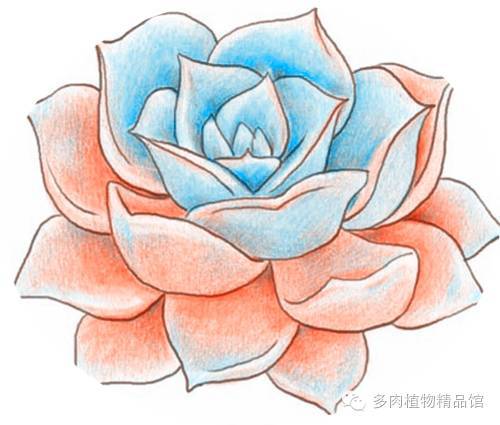
The succulent 'Shen Tong' (Crassula cv. Spring Time) is a variety in the genus Crassula of the family Crassulaceae
Main text
Images: Internet
Shen Tong, a succulent plant in the genus Crassula of the family Crassulaceae, is a horticultural hybrid of Crassula Rupestris. The leaves of Shen Tong are pale grayish-green to dark green, with a triangular tip at the front of the leaf, growing densely opposite each other in pairs. It blooms in spring, with flower clusters borne at the top, pink in color, with abundant flowers and a fragrance.
Care methods:
1. Sunlight
Generally in spring and summer, when it is growing at its best, we can give it a full day of light at this time, letting it enjoy more sunlight to promote its growth. But generally in summer it will slightly enter dormancy, so if we want it to bloom, we should let it get more sun at this time, so that it can bloom faster. In winter, the light is relatively weak, so at this time we can choose a spot that faces the sun as much as possible and let it receive all-day sunlight.
2. Watering
When watering it, we must pay attention: if it has not been watered for a long time and has dried out completely, then at this time we must remember to water it thoroughly as well, so that it can satisfy the amount of water its roots need. But if it is not dry, then we do not need to water it at this time; just keep its potting soil moist, but it must not be too wet. In the growing season, water about 1-2 times a week. When watering in summer, pay attention to the amount of water when the temperature is high in summer. Generally, watering it 3 to 4 times a month is enough, and also give a small amount of water around the edge of its pot. This depends on the size of your own pot and the local weather conditions. In this way, the root system can be maintained and will not dry out because it is too dry. In winter, if the temperature is below 5°C, then you should begin to gradually cut off the water, and if it is below 3°C, then you should keep the potting soil dry. Only in this way can it safely pass the winter.
3. Soil
When choosing soil, we must choose those with relatively good air permeability. Generally, using peat soil mixed with a little cinder is enough. This can well isolate its plant from the soil surface, making air permeability even better. Of course, when choosing soil, we should also choose those with a bit better drainage to prevent the existence of standing water.
4. Propagation
There are three methods for propagating Shen Tong: sowing, cuttings, and division. For large-scale cultivation of Shen Tong succulents, the sowing propagation method can be used. Sow the seeds of Shen Tong on a prepared seedbed, then cover with a thin layer of soil to keep warm and moist. Keep the temperature at around 21°C, and the seeds of Shen Tong will germinate in about a week. For cutting propagation, there are many methods. One is leaf cutting, that is, using the leaves of Shen Tong succulent for cuttings; this method is relatively convenient, but the survival rate is relatively low. The second is root cutting: cut off a small section of the root stem of Shen Tong succulent with buds, bury it in the soil, and the bud points on the roots will grow into new plants. The third is beheading cutting: cut off the upper part of Shen Tong succulent, leaving the root stem to continue growing, and use the cut-off part for cutting propagation. As for division propagation, it means that after Shen Tong succulent grows to a certain stage, it will produce some small plants in clusters. These small plants with root systems can be taken out of the soil, and then moved to new potting soil for planting. Because root systems are present, they will generally adapt and grow in about a week.
Ps: The difference between Shen Tong and Bride's Bouquet
Shen Tong (Crassula cv. Spring Time) and Bride's Bouquet (Crassula Bride's Bouquet) look almost exactly the same, but Bride's Bouquet has smaller, slightly narrower leaves, smoother leaves, and lighter-colored flowers.
The article was compiled by the Succulent Plant Boutique Gallery, and the copyright belongs to the original author. The sources of some articles cannot be identified and are marked as from the Internet. If there is any infringement, please contact us immediately, and we will handle it promptly.