Recommended Succulent Varieties: 9 Beautiful Succulents in Different Colors
There are many beautiful succulent varieties, but it is hard to define which is the most beautiful. After all, everyone likes different succulent shapes and colors. So here, Huayu Jun recommends 9 beautiful succulents in different colors. Come and see whether these succulents meet your standard for the most beautiful succulent varieties?
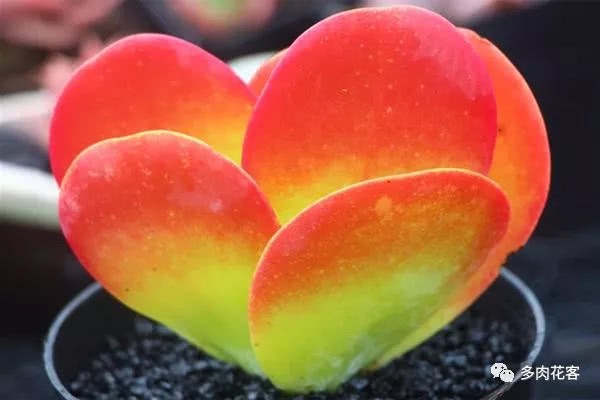
Red Succulent: Tang Yin (Kalanchoe thyrsiflora)
Tang Yin is a succulent in the Crassulaceae family, Kalanchoe genus. It has broad and relatively thin leaves (thin here is relative to other succulents). The leaves are inverted teardrop-shaped and are usually light green. In autumn, they begin to color up and enter their prime state, turning red, covered with a thin layer of powder, very beautiful. A Tang Yin in prime state is true red, like the large, vivid dance skirt on a dancer spreading freely as she moves. The glossy sheen in the sunlight makes it even more outstanding, impossible to ignore.
Pink Succulent: Allen (Sedum rubrotinctum 'Aurora')
Allen is a succulent in the Crassulaceae family, Sedum genus, and looks as similar to the peach egg succulent as a twin. It is an introduced succulent from Korea. Its leaves are also ovate and slightly pointed at the tip, a bit flatter than the peach egg succulent. When the temperature difference is large in autumn, it begins to enter its prime state, and the whole plant turns pink. What is special is that sometimes this pink also shows a slight hint of orange, which gives its pink a jelly-like translucent quality. The fine layer of white powder covering the leaf surface adds a soft feel. Allen very easily fills a pot and forms clusters. When grown into an old stem, it looks like an old peach tree bearing peach blossoms that never fade, full of artistic flavor.
Yellow Succulent: Mingyue (Sedum adolphi)
Mingyue is a succulent in the Crassulaceae family, Sedum genus. Its leaves are long spoon-shaped with pointed tips, arranged neatly around the stem like a rosette. The biggest feature of Mingyue is that it shows different shades of yellow depending on the duration of light. Under sufficient light, it becomes golden yellow with a bit of orange along the leaf edges. If exposed to strong light, the whole plant turns orange-yellow or even orange with a red tint.
Green Succulent: Deer Antler Begonia (Mitrophyllum dissitum)
Deer Antler Begonia is a succulent in the Aizoaceae family, Mitrophyllum genus. Its leaves are thick, short, three-sided prisms. The opposite leaves look from a distance like pairs of newly sprouted little deer antlers, very cute. The evergreen bean-green Deer Antler Begonia, when it has many branches, will sprawl along the ground, and when it fills a pot it easily covers the entire flowerpot. Its flowers are also very beautiful, with rich colors, like little chrysanthemums. This is a common feature of flowers in the Aizoaceae family.
Blue Succulent: Blue Stone Lotus (Echeveria glauca)
Blue Stone Lotus is a succulent in the Crassulaceae family, Echeveria genus. Its leaves are blue, and because the surface is covered with white powder, it presents a charming scene of blue showing through the powder. Blue Stone Lotus is just like its name: the whole plant is like a blue lotus blooming on stony ground. Blue Stone Lotus also easily produces side shoots and forms clusters. When it fills a pot, it is like blue lotuses blooming one after another, a feast for the eyes. If the light is suitable, you can even grow a Blue Stone Lotus with red edges!
Purple Succulent: Purple Rice Grains (Portulacaria)
Purple Rice Grains is a succulent in the Portulacaceae family, Portulaca genus. Its leaves are ovate, round and cute like little pearls. Generally, with sufficient sunlight they are purplish-red, and with stronger light they present a very deep purple, looking very appetizing. Under light they also have a translucent feel, very much like the berries we often eat. I wonder if anyone has eaten them? The flowers look like sunflowers. Compared with the leaves, the flowers are much larger and also very vivid. You can enjoy not only the leaves but also the flowers.
White Succulent: Guanghan Palace (Echeveria 'Guanghan Palace')
Guanghan Palace is a succulent in the Crassulaceae family, Echeveria genus. Its leaves are thin and large. The leaves are actually blue-green, but the surface is covered with a thick layer of white powder, so the overall appearance is white, with faint hints of blue and green showing through. When the light is sufficient, red edges appear along the leaf margins. Just from its name and appearance, you can feel that it is a very ethereal succulent!
Black Succulent: Black Prince (Echeveria 'Black Prince')
When it comes to the most common and also most beautiful black succulent, it must be Black Prince. Actually, it is not pure black, but deep chocolate color. Black Prince is a succulent in the Crassulaceae family, Echeveria genus, with the most common lotus-type arranged leaves. The whole succulent plant is lotus-shaped. It is well known that black plants are not easy to grow because they lack chlorophyll and find photosynthesis relatively difficult. But none of this troubles Black Prince. Even with its all-black appearance, it can still claim a place in nature, showing extremely strong resilience and ability to grow. Flower lovers who like dark-themed succulents can grow it, because although Black Prince has a cool, aloof appearance, it also has a very ordinary price, super friendly.
Variegated Succulent: Variegated Sunflower (Portulaca variegata)
Variegated Sunflower is a succulent in the Portulacaceae family, Portulaca genus. That's right, the ordinary-looking sunflower that we usually admire for its flowers, who would have thought its leaves could be so beautiful when variegated? This kind of variegated state can probably only be grown in a cheat-mode area like Yunnan. The green leaves, because of the variegation, begin to take on purplish-red from the leaf margins, gradually spreading across the entire leaf. This variegated state is truly unmatched. Even without flowers, simply admiring the leaves is beautiful enough for quite a while. The downside is that this state is hard to maintain. Once the growing climate conditions begin to change, it may revert to its original form.