Timing for planting autumn yardlong beans must be grasped well; the sowing window has now passed.
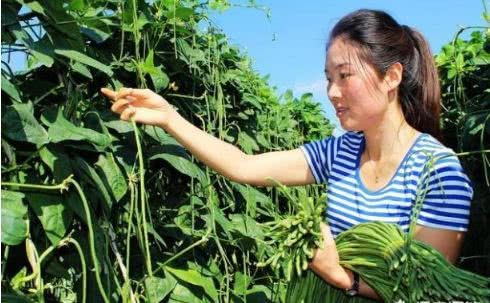
Judging from the current timing for planting autumn yardlong beans, it is already somewhat late in the northern regions. We are about to enter the Autumn Equinox period, the weather is getting colder and colder, and there are fewer and fewer vegetables that can be grown outdoors in the northern regions. At present, autumn yardlong beans can only be grown outdoors in some areas.
The most suitable planting time for autumn yardlong beans.
Personally, I think the taste of autumn yardlong beans is somewhat better than that of summer yardlong beans, and if they are grown at home, autumn yardlong beans have far fewer pests than summer yardlong beans. As a common household vegetable, yardlong beans are actually very easy to grow because they are highly adaptable, so apart from winter, when they cannot be grown outdoors, they can be planted in all three other seasons of the year.
Next, let us look at the growing habits of yardlong beans. Yardlong beans tolerate heat very well; generally, when the temperature is around 25°C to 35°C, they germinate best. During normal growth, the most suitable temperature for yardlong beans is around 25°C.
Generally speaking, the most suitable planting time for autumn yardlong beans is from early August to early September each year. However, because there are many varieties of yardlong beans and China has a wide range of growing regions, there will still be some differences in planting times. For example, because the Northeast region cools down relatively early, yardlong beans there are generally only planted in spring.
In the Southwest region, autumn yardlong beans are best planted in early August; in the South China region, the planting time is relatively flexible, and they can generally be planted from late August to early October. In North China and Central China, they are generally planted from July to August. In addition to considering the growing region, what also needs to be considered is the variety of yardlong bean; different yardlong beans have different growth and maturity times, so growers also need to understand this.
Finally, let us talk about the issues that need attention during the process of growing autumn yardlong beans.
The issue of planting density: a suitable planting density can promote better growth of yardlong beans. A reasonable density should be chosen according to the fertility of the local planting soil and the variety of yardlong bean.
Generally, yardlong beans are divided into greenhouse-grown and open-field-grown. Greenhouse growing is generally mostly carried out in winter, while open-field yardlong beans are generally summer yardlong beans. Summer yardlong beans have relatively sufficient light conditions, so the planting density is somewhat greater than that of greenhouse growing. The density for open-field-grown yardlong beans is about 6,000 plants per mu. Greenhouse growing generally uses about 4,000 to 5,000 yardlong bean plants per mu.
Another thing that needs to be considered is the issue of yardlong bean variety. At present, the main yardlong beans grown are climbing yardlong beans and dwarf yardlong beans. Because dwarf yardlong beans do not need trellises to grow upward, their plant spacing when planted should be somewhat larger than that of climbing yardlong beans, at around 25 to 30 cm, with row spacing at around 50 to 60 cm. Climbing yardlong beans require growers to set up trellises in time, and the row spacing should be increased somewhat, generally at around 65 to 70 cm, with plant spacing at around 20 to 25 cm. (Part Three)
This is Science Xingnong; you are welcome to follow us and grow your knowledge with us. The copyright of the original article belongs to the Science Xingnong account, and infringement will be pursued.