Succulents: White Dew season is the right time for pest control and sterilization
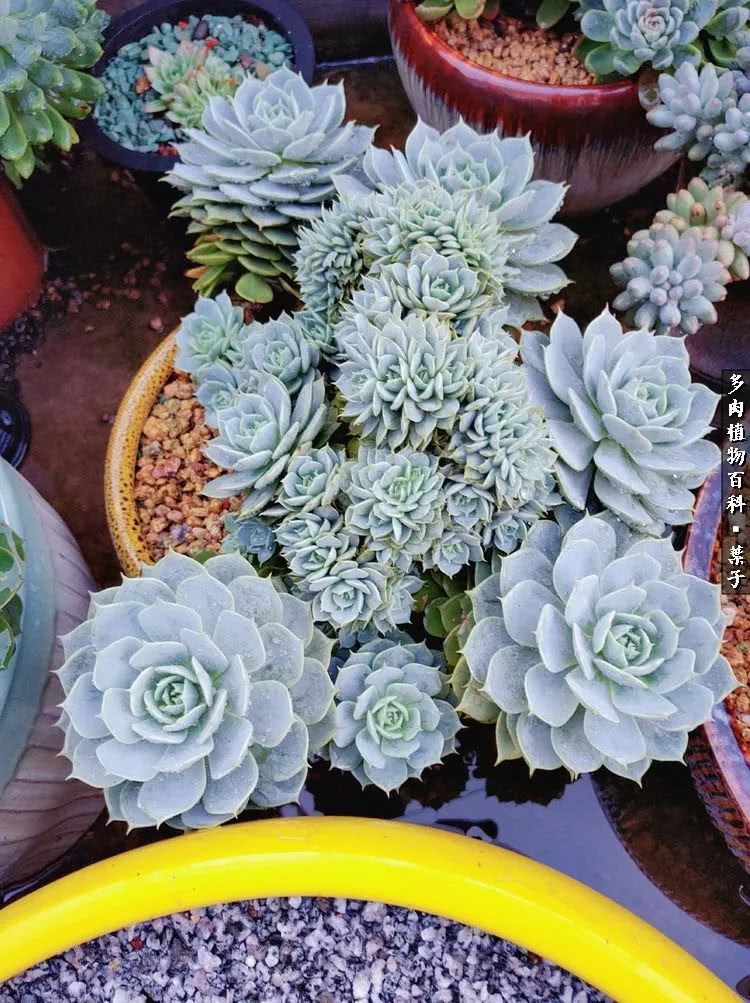
Preface
Follow the Encyclopedia · Meet Beauty (WeChat ID: duoroubaike)
Main text begins:
Thanks to the author [Ye Zi] for theoriginal contributionsharing
Edited and compiled by: Encyclopedia Jun
Location: Chuxiong Prefecture, Yunnan Province
White Dew and Autumn Equinox nights, each night cooler than the last, heavy dew at night, scorching sun the next day. Dry fog and dew mean overcast, wet fog and dew mean clear.
With the arrival of White Dew on September 8, it signals that the weather is starting to turn cool, and the refreshing autumn has already arrived!
After the baptism of a summer! I wonder how many empty pots my fellow succulent lovers have harvested? Don't be discouraged! Autumn is here! We will welcome the most beautiful season for succulents! And in this late summer and early autumn time, let's smooth over the wounds for our succulents, fade their scars, and show off their graceful figures!
In early autumn, you should give the succulents that have been ravaged by scale insects all summer a thorough sterilization and pest elimination!
Here I'd like to correct a viewpoint for everyone: 90% of the reason your succulents get scale insects is because the succulents you bought had scale insects or insect eggs on their branches, leaves, roots, or in the soil, you just didn't notice at the time, and only saw them after they broke out on a large scale. Roots, soil, and even occasionally some insects or eggs remaining on the succulent itself.
Scale insects generally lay eggs in two locations, one is in the gaps between the branches of the succulent, and the other is in the soil at the roots. Their eggs are extremely small, and from egg hatching to adult takes as fast as two to three months, and as slow as three to four months. The long time span may give you the illusion that my succulent didn't have scale insects back then, so is it that they only got insects after I started growing them outdoors.
In this article, I will summarize the latest, most complete, and most effective full guide to scale insects, bar none!
1. Jie Bi Zhi
Let me clarify one issue here! I found that there are two versions of Jie Bi Zhi on the market. The old packaging has an effective concentration of 20%, and the new packaging has an effective concentration of 40%. The bottle I used before was the old packaging, so the recommended dilution was 3000 times! The new packaging's effective concentration has doubled (I don't know if scale insects have developed resistance or for other reasons), so in terms of concentration: the new packaging's recommended dilution is 5000-6000 times.
Many friends have caused succulent burns from using Jie Bi Zhi, which should be because the new version's concentration has increased, while the dilution ratio is still the old packaging's ratio. Whether it's the old version or the new version, Jie Bi Zhi has always been the most ideal in terms of effectiveness in my experience!
Recommendation rating: ☆☆☆☆☆
Recommended for: Intermediate growers, those with some experience, veteran growers.
Usage tips: Use once in spring and once in autumn each year, one application can basically control for half a year. Small dosage, fast-acting, strong fumigation effect when used at high temperatures, kills insects and eggs.
Note: Be sure to follow the dilution ratio, test on a small area first. If the concentration is too high and you have already sprayed, immediately rinse the leaves with plenty of running water.
2. Sulfoxaflor
Recommendation: ☆☆☆☆☆
This pesticide specifically targets piercing-sucking mouthpart pests (scale insects, aphids)
I won't explain the pharmacology! You guys won't read it anyway. This pesticide is recommended from Dow Chemical USA, with Chinese names Kelishi and Tefuli. Good effectiveness, long duration, wide penetration. Sprayed on leaves, it can penetrate to the underside. Recommended dilution ratio 5000-6000 times.
Disadvantages: Expensive! Cannot be used repeatedly, must be rotated with other pesticides, strictly control concentration, use at your own risk! Recommend first use on a small area at 6000 times.
Advantages: Safe and efficient, even if it rains two hours after spraying, no need to re-spray! Can be rotated with carbamates, organophosphates, pyrethroids, abamectin, pymetrozine, etc.
3. Movento
From Bayer Germany, the active ingredient is spirotetramat, a highly efficient systemic insecticide with two-way translocation!
Recommendation rating: ☆☆☆☆☆
Advantages:
1: Highly efficient and broad-spectrum, against various piercing-sucking mouthpart pests (aphids, fungus gnats, scale insects, root mealybugs);
2. Systemic, two-way translocation, can protect new growth and roots (strongly recommended for lazy or careless people, meaning if you spray on the leaves, it can be absorbed by the plant and translocated to the roots, killing root mealybugs, equivalent to a liquid form of Xiaobai Yao);
3. Long residual effect, long-term protection of crops from pest damage (up to two months);
4. Selective against beneficial insects
5. This unique systemic property can protect new stems, leaves, and roots, preventing the growth of pest eggs and larvae.
6: Comes in independent small packaging, similar to the plastic packaging of Diquat
Recommended usage: 4000-6000 times, there is phytotoxicity! For succulents, recommend 5000-6000 times.
Disadvantages:
1. Expensive! Expensive! Expensive! A 10 ml bottle of Movento costs me about 10 yuan locally.
2. Short application interval, generally needs re-spraying about every 3 months.
3. Cannot be used alone long-term, scale insects will develop resistance.
This pesticide has another particularly impressive feature, which is an adjuvant called Hasuteng! Based on personal testing, it should be a kind of surfactant similar to laundry detergent or dish soap that makes spirotetramat adhere better to plant surfaces, making it more efficient and long-lasting!
Recommended usage ratio: Movento and Hasuteng mixed at 1:1. First prepare the mother solution, then add Hasuteng, finally add water.
Disadvantage: It will damage the powdery coating on the surface of succulents, very ugly. Recommend not using the adjuvant on succulents with powdery coating, just use Movento alone.
4. Wen Te
Bayer Germany launched an upgraded version of spirotetramat four years later: Wen Te, which is a compound formulation of spirotetramat plus thiacloprid. It was probably developed because scale insects have extremely high resistance in the Chinese market and the sustained effect against whiteflies was not ideal.
Advantages: Compound formulation effect is higher than single formulation, long duration, it is said that 2 weeks after spraying it can still maintain 60% insecticidal efficiency.
Let me clarify one issue here: why Movento is more expensive than Wen Te is because of the difference in spirotetramat content. One is 22.4% and the other is 11%. Actually the results in use are about the same. Wen Te also simultaneously kills other pests.
Those who are able can directly choose Wen Te.
5. Fen Jie Bi Zhi
This pesticide is a biological insecticide, recommendation rating ☆☆. Simply put, the pharmacology is to starve the pests to death.
This pesticide acts slowly, taking about 2-3 days after the pest feeds to take effect. The effective period is about 1 day, and it is only effective against young larvae. That is to say: after you spray, the insects are still alive for a day or two, and after a few days the ones still alive are all the old tough ones! Not recommended for use!
Answering three questions:
1. Are whiteflies scale insects?
Answer: No (both are white but not the same insect)
2. Is powdery mildew caused by whitefly bites?
Answer: No
3. Does nitenpyram kill scale insects?
Answer: It is another new product developed after imidacloprid and acetamiprid. It has some effect on mouthpart types, but it is not the main pesticide for killing scale insects. For aphid outbreaks, 25% nitenpyram bifenthrin (also known as Yingfengdao) can be recommended.
Here let me also summarize some common scale insect control pesticides on the market, understand the pros and cons for yourselves.
Buprofezin, also known as Pufuiling, highly toxic, heavy residue, and the most effective Zhengxianda Supusha has been discontinued. Has been replaced by Movento.
Thiamethoxam, has stomach poison, contact, and systemic activity, works okay against aphids, mediocre against scale insects.
Fenpropathrin, an old pesticide, effectiveness against mites is already very poor
Carbamates (metolcarb, aldicarb, carbofuran, fenobucarb, pirimicarb) their usage has surpassed organophosphorus pesticides, with sales second only to pyrethroid pesticides ranking second.
Here let me specifically mention carbofuran. Everyone is unfamiliar with the name, but when it comes to Xiao Zi Yao, everyone is familiar with it, right? Those interested can look it up, is carbofuran 3% furadan, Chongmanwei. Here I tell you, it is carcinogenic!
Those who don't believe it can go online and look up the issues with carbamate use in pesticides.
Is Xiao Zi Yao furadan? Is furadan carbofuran? Is carbofuran a carbamate? Are carbamates carcinogenic? You don't believe what I say? Baidu it yourself (carbamate pesticides) and it will be clear at a glance.
Here let me also mention Xiao Lu Yao (Bayer organophosphorus pesticide containing disulfoton and disyston components)
Xiao Bai Yao (acephate [highly toxic])
Xiao Zi Yao mentioned above.
In short, these pesticides can all be used, but don't grab and scatter them with bare hands. Also don't frequently touch plants with your hands, and most importantly, don't use succulents that have been treated with pesticides to stir-fry and eat! (#^.^#)
Finally, let me mention SK mineral oil (Korean Green Ying) which has become popular again recently. I didn't introduce this pesticide before because its disadvantages outweigh its advantages when used on succulents.
First: Its effective concentration is extremely high, 50-100 times, and the effectiveness is related to the degree of oil agitation during spraying. Most importantly, try spraying a layer of oil on your succulents? See if the powdery coating comes off? But there are still advantages: because mineral oil uses physical sealing to kill insects, pests cannot develop resistance to Jiemanling. It has been used abroad for over 100 years and still no resistance has been found. Through physical suffocation, it is equally effective against pests and mite individuals that have developed resistance to organophosphates and pyrethroids, making it a pesticide suitable for long-term use.
Suggestion: Buy name-brand mineral oil, use it on succulents without powdery coating, such as: Agave titanota! Aeonium! Senecio rowleyanus! It can even make them shiny! Not bad at all!
Last but not least, let me emphasize the relationship between ants and scale insect transmission that I introduced before! If you find that scale insects in your home keep recurring and there are ants, then first kill the ants. Careful friends will notice that scale insects have a secretion like honeydew, which ants particularly like, indirectly helping scale insects spread.
For specific killing methods, see my previous post. Alright! I know you're lazy! I recommend you use Bayer's ant bait, or Mie Yi Qing.
Black rot begins
After treatment it begins to grow, no beheading, no uprooting!
Black rot begins!
2 months after treatment!
3 months after treatment!
I have already successfully treated a batch of succulents with black rot. As for the specific method, if you want to see it you can leave a comment, and I'll share it next time! (#^.^#)
Let me show off my succulents grown outdoors year-round! Taken in the middle of summer, no wind protection, no rain protection! Not even hail protection!
Photos taken with a phone, because I'm poor, the phone quality isn't high! Just bear with it! If some big brother or sister would gift me a DSLR that would be great! Haha!!
Encyclopedia Jun's ramblings:Thanks to the author for sharing. Regarding the pesticide issue for scale insects, I want to say that actually veteran succulent growers each have their own tips, because when growing succulents it's hard to avoid dealing with scale insects. Scale insects belong toHomopterapests. There are many known pesticides on the market for killing scale insects, and many unknown ones too. Some may not be specifically for killing scale insects, but as long as they can killHomopterapests, they can eliminate scale insects. There are imported ones, domestic ones, at all price points, so the range of choices is very wide. But before using, be sure to follow the dilution ratio and test on a small area first, to be safe.
Personally, I think everyone should not just focus on pesticide effectiveness, but also choose pesticides based on their own growing environment. Because the author's growing environment is well-ventilated on all sides with no environmental restrictions, the range of choices is also wide. But if it's a home balcony, you might not need a sledgehammer to crack a nut. I suggest everyone chooselow-toxicity, high-efficiencyinsecticides as much as possible, so I personally think something like "thiamethoxam" this type of low-toxicity (unless accidentally ingested, generally won't cause poisoning accidents) neonicotinoid insecticide is also a good choice. If you don't have many succulents, small packaging is better, so that you won't have leftover pesticide that becomes ineffective or gets taken by children to play with and cause risks. This way, at least while killing insects, you also consider the safety of family members.
Appreciate the author
If you like this article, besides sharing it to your Moments, you are also welcome to long-press and recognize the WeChat payment code on the left to tip the author of this article! Even one cent is love, any amount counts as affection!
This article has beenexclusively authorizedby the author to WeChat public account: Succulent Plant Encyclopedia (ID: duoroubaike). The article content does not represent the views and stance of the public account! The Encyclopedia has signed with a third-party internet copyright enforcement company, opening network-wide rights protection. Unauthorized reproduction by other platforms is strictly prohibited! If piracy is discovered, infringement liability will be pursued! Netizens are welcome to report!
Advertisement ADVERTISEMENT
Brought together by succulents, grateful for your nightly waiting and reading! The culture of succulents needs you and me to promote! Remember to share good articles so more people fall in love with succulents! Use the power of plants to influence and heal the people around us, heart!!!