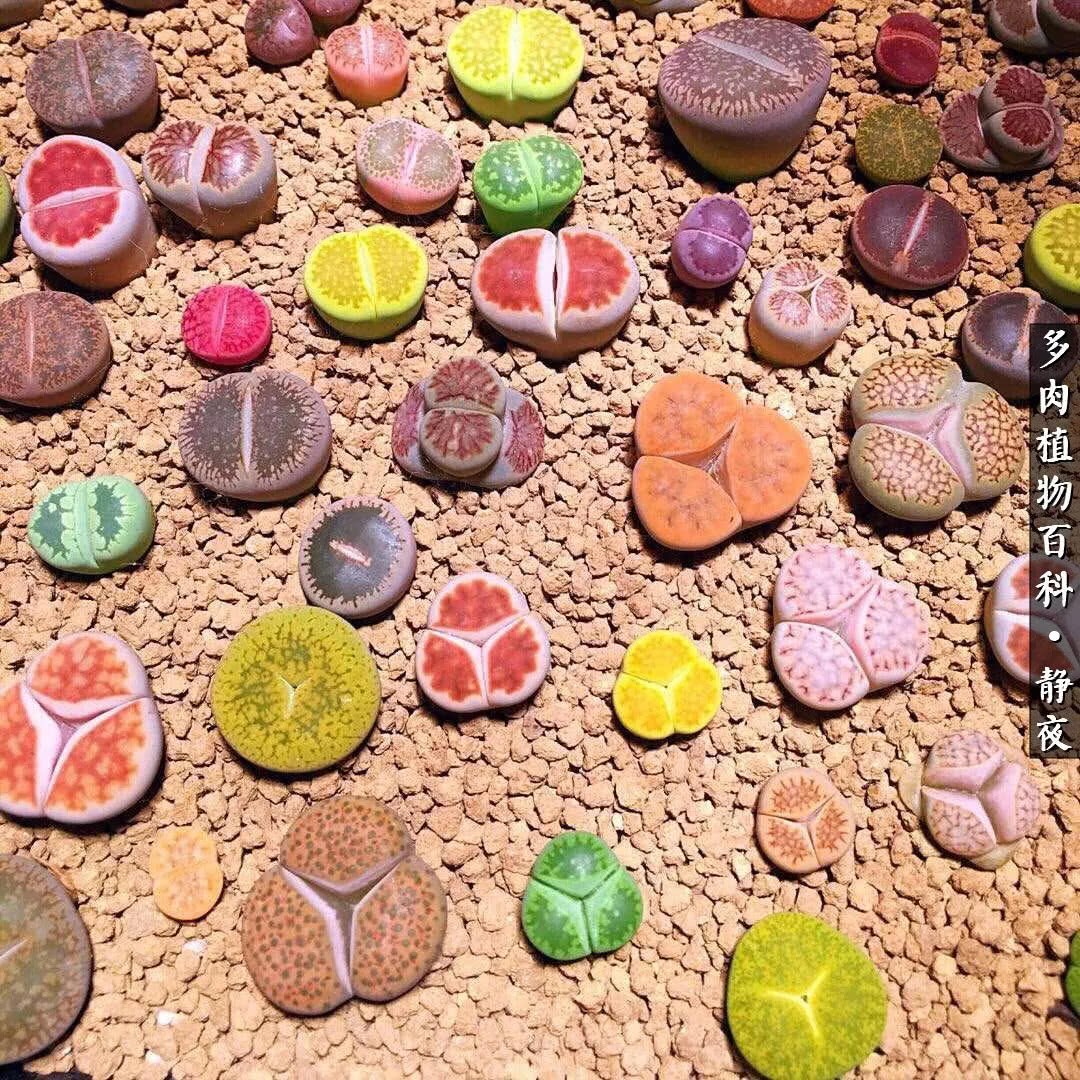
Lithops are the dazzling gems among succulents
Foreword
Follow the encyclopedia, meet beauty (WeChat ID: duoroubaike)
Main text begins:
Thanks to the author [Jingye] for theoriginal submissionsharing
Edited and compiled by: Encyclopedia Jun
Location: Dalian City, Liaoning Province
Once upon a time, Aizoaceae succulents suddenly became popular all across the country, not only because of their various adorable looks, but also because of their endlessly changing shapes, colors, textures, and surfaces.
If you are a woman who loves both succulents and gemstones, then I recommend you grow the gem among succulents: Lithops!
Lithops seem like creatures from an alien planet, and also the most beautiful spirits given to people by God. Each one radiates infinite magical charm, so it is not at all an exaggeration to call them the gems among succulents.
The beauty of Lithops is absolutely no less than that of gemstones. I even think that living stones are much cuter than cold, lifeless gemstones.
Perhaps the reason most people fall into the Lithops rabbit hole is still their vivid colors!
Anyway, if I had been asked at the beginning to appreciate the brain-like patterns of Lithops pseudotruncatella and the blood-dotted 'Chao Gong', I would not have appreciated them... Of course, now I really like all kinds of brain patterns, lightning patterns, and blood dots.
If you are used to the various gorgeous colors of Sedum when they color up, you will first appreciate Lithops with a Sedum eye. What first catches your attention must be the vivid colors! Especially red and purple.
I officially entered the Lithops rabbit hole in the spring of this year. What first attracted me was Purple Topaz. These were the first 2 Purple Topaz I picked, with black speckles on their purplish-red window surfaces. I just thought they were very, very beautiful.
Purple Topaz, to be exact, should be purplish-red. Of course, I have not been in the hobby long and my knowledge is limited. I am just using my own perspective to appreciate the beauty of Lithops with everyone, and to share the sweetness and bitterness of growing them. If there is anything off, I hope the knowledgeable experts will not laugh at me, haha. If I accidentally drag a few friends into the Lithops rabbit hole, that cannot be blamed on me. It is because Lithops are too magical, and you just have an eye connection with them.
First, let us talk about the strictly purple series. Any purple Lithops is not exactly cheap! The most typical one first is Purple Lithops salicola.
Its whole body is a noble purple, with glossy window surfaces, and it is one of the classic Lithops varieties. No matter how many I have, I would not find it too many! Its advantage is its long legs and tall stature.
New varieties hybridized from Purple Lithops salicola and other Lithops generally inherit its noble and elegant purple! Of course, the tall-stature genes are inherited too.
Purple 'Fulai': a hybrid of Purple Lithops salicola and Lithops 'Fulai', with the patterns of Fulai and the body color of Purple Lithops salicola.
It is the purple one in this mixed-color group! Unfortunately, when I had just started growing them and did not know how, I let it die.
Purple Chrysanthemum, a hybrid of Purple Lithops salicola and Lithops 'Julii', with the patterns of Julii and still the body color of Purple Lithops salicola.
Next is the purplish-red series. Red Dianthus is actually purplish-red. Although it counts as a common variety, planting a pot of it still looks very stylish! Paired with one plant in a mixed tray, it also stands out beautifully.
However, Red Dianthus is truly hard to grow. Not only does it easily rot, it also keeps shedding its skin endlessly. I do not know how Red Dianthus was bred into a common variety!
Red Olive is my favorite! From the pictures, Red Olive and Red Dianthus seem similar, but actually they are very different! First of all, the price is different, haha. Olive means the window surface looks like an olive, with a bit of rose red, and the texture is especially good! Red Dianthus, by contrast, feels softer when squeezed, and its color is not bright either.
Red 'Jushui', the purplish-red one below. It generally has a shape with two separated lobes, very special! Anyway, I really like purple; it just looks classy!
Then there are the patterned purple series, including the Purple Pomegranate mentioned at the beginning. I have several of them; the small ones are planted in mixed trays.
The large ones are planted separately.
This pot with the double-headed little feet is my favorite!
Purple-bodied 'Naolinyu', not very common. Looking at the window surfaces, they really look like pieces of agate!
Purple 'Biliuli', I have seen it for sale, but it does not quite appeal to me, though the price is definitely not cheap.
Purple 'Dajinhui', the legendary Lithops, I have never seen it for sale. See, without realizing it, I have become a variety collector! Anything I have not seen, I want to know about.
Purple 'Diyu': Diyu is the king of Lithops, and purple especially shows off a kingly demeanor!
If purple is noble and elegant, then red is rich and grand! To prove how rich and grand it is, I must show off my awesome Chrysanthemum.
I pestered a seller to get these. It was because he loved showing off tempting plants, and I got envious. These 9 brothers are a pot of carefully selected, elite mother plants of Chrysanthemum, not sold separately, so there was no choice but to cut into my budget and take the whole pot! I can only hope they will bloom, set seeds, and let me recover some of the cost. Speaking of it, it really is a pity to split a single plant out. (To set seeds, two plants must bloom and pollinate at the same time, so there must be enough mother plants, which is why they are not split up and sold separately!)
They have just passed summer now, so their colors are not yet at their best. In spring they looked like this: simply too beautiful for words!
I have several pots of Chrysanthemum, large and small. Recently I have fallen into the Chrysanthemum rabbit hole! Ask me why I bought so many? It is simply because I like them! Besides, I still have to wait for them to set seeds. How could 1 or 2 plants be enough?!
Among red-series Lithops there is also a variety widely loved by everyone: Red Window. This is the common Red Window, a type of Lithops 'Huawenyu'. It is different from the Red Window Chrysanthemum mentioned above, while Red Window Chrysanthemum belongs to the Shouli line.
Red Window has many names according to differences in window surface color and pattern. This one, propagated from seed stock selected and bred by Shimada, with red covering the entire window surface and a slightly fuzzy texture, is called Shimada Vermilion Lips, and it is one of my favorite varieties! A full window plus vivid color, this kind of quality is probably liked by everyone!
This kind, with a very red window surface, is called Blood Red Window. Its little lips painted with lipstick are really cute.
This kind, with a net-like pattern, is called Net-Patterned Red Window.
Red Window has many other names according to differences in color and shape, such as Topred, Ice Orange, Auntie Red, T, and so on. Taobao livestreams have also given them many new names. They are called whatever they look like, a bit chaotic.
Let me also introduce to you a variety related to Red Window that I have especially liked recently: Pink Panther.
Its window surface has bold leopard prints. I happen to like blurred patterns; if they are too clear, it seems no different from Lithops 'Huawenyu'.
Look at these 6 big mouths of mine! I bought mother plants, and next year they will be able to bloom, and at the next skin shedding they might all become double-headed!
There are also double-headed little feet! If the above 6 mouths become double-headed at the next skin shedding, I will have a bunch of little feet. Then I will make a big mixed tray.
When talking about red Lithops, Lithops 'Rilun' is absolutely a variety that cannot be ignored! This is an ordinary red Rilun.
Ruby Rilun
Line-Flowing Rilun, with beautiful radiating flowing-line patterns.
Large-Window Rilun, with a somewhat brown color, round and plump, very beautiful!
This is Full-Window Rilun, the finest selected from Rilun!
This is the famous KO, which can be said to be beautiful to the extreme! Moreover, this kind of quality is probably only in the hands of collectors; you cannot even buy it. For me, owning my own pot of KO is still an unreachable dream, haha.
Among the red series there are also several kinds of Purple Smoke that are especially beautiful! Wine-Red Purple Smoke, whose window surface is wine-red, is especially beautiful! After getting to know Lithops, I feel like I am somewhat at a loss for words! Some feelings simply cannot be described in language.
This one of mine is still too small. The color is not yet very wine-red. No matter what, I am still someone who owns a Wine-Red one, haha. One is enough; I cannot afford more anyway.
Purple-Brown Purple Smoke, only looks good when photographed after a spray of water!
Red 'Zhaofuyu' is also very beautiful! As long as the color is vivid, it looks good.
There are many more beautiful ones! It is a bit endless to talk about, and of course there are even more that I do not know about! Since growing Lithops, I feel I have become insatiably greedy; anything I like, I want to add to my collection.
Unlike Sedum, Lithops cannot be made beautiful from ugly plants through one's own growing skill. Skin shedding and face changes are entirely up to heaven. Some varieties are rare in themselves, and adding the long 3 to 4 years of sowing, cultivating, and selecting, a beautiful Lithops is destined to be valuable. Most that are too cheap have little ornamental value and are not interesting either. So, growing Lithops really burns money!
But Lithops will also bring you into a colorful and beautiful world you did not know before, and there is a lot of fun too. So as long as growing Lithops does not exceed your spending ability, it is fine. You can buy a little less each month and save up little by little. But then again, as long as the soil is clean and the roots have developed well, Lithops are even easier to grow than Sedum, especially with a big advantage in getting through summer!
Every Lithops is like a little sun. All the light it gathers will warm you and shine on you on cloudy days!
Appreciation note
This article is purely for sharing. The author has not enabled appreciation. After reading, do not forget to give the author a little like at the bottom right corner of the article to encourage them!
This article has beenexclusively authorizedby the author to the WeChat public account: Succulent Plant Encyclopedia (ID: duoroubaike). The content of the article does not represent the views or stance of the public account! The encyclopedia has signed with a third-party internet copyright enforcement company and has opened whole-network rights protection. Without authorization, other platforms are strictly prohibited from reprinting privately! If unauthorized reposting is found, infringement liability will be pursued! Netizens are welcome to report it!
Advertisement ADVERTISEMENT
Because of succulents we are connected here. Thank you for your nightly waiting and reading! The culture of succulents needs you and me to promote! Remember to share good articles more, so that more people fall in love with succulents! Use the power of plants to influence and heal the people around us. Love you!!!