Globe amaranth propagation needs to meet its growing environment requirements to produce beautiful little red flowers
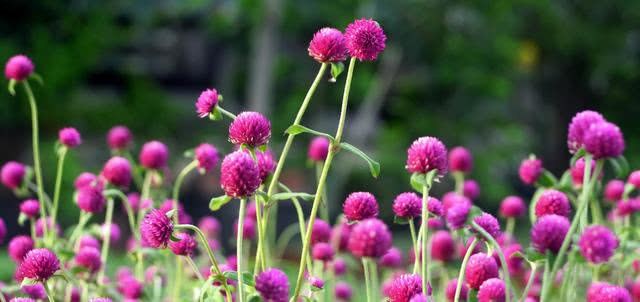
In some places globe amaranth is called hundred-day red or fireball flower. It is an upright ornamental commonly seen in subtropical and tropical regions, with long flower stems and flowers of excellent color and luster. After the flowering period, the dried flowers can remain undecayed for a long time, which is one of its major characteristics. Its uses are also fairly wide: it can be made into wreaths, flower baskets and other decorations. Today let us look at how this ever-lasting hundred-day red is grown.
I. Requirements of the growing environment
Hundred-day red is originally a tropical flower and can often be seen in southern China. It does not demand much from the environment for its growth; it likes sunny, dry and hot areas, and is only afraid of waterlogging. Well-aerated soil is a very good substrate. Its growing temperature is generally above 20 degrees, and even high temperatures of over 30 degrees have no effect on its growth, but a low-temperature winter may be rather hard for it to endure; excessively low temperatures easily cause poor growth and can also lead to frost damage.
II. Propagation methods
Seed collection can begin in September. The collected seeds must be stored properly, and by April they can be sown. Judging by the plant's growth rate, it can generally be transplanted after one month. The surface of hundred-day red seeds has a layer of fine fuzz, and this may be the reason its germination is somewhat slow. So to increase the germination rate of the seeds, the seeds can be pre-treated to force sprouting before sowing. The selection and preparation of the seedbed and the maintenance of humidity are all very important steps that directly affect the germination results of the seeds.
June and July before seed collection is a good time for cuttings. Generally, select a few healthy branches directly from the mother plant, about 10 cm or less in length. After cutting off all the leaves on the branches, insert them into the soil. Only in this way can water loss from the leaf surface be reduced and the branches root faster in the sand bed. The temperature must also be controlled well; if the temperature is below 20 degrees, rooting will be somewhat slower, a few days slower than in a high-temperature environment.
III. Tips for flowering
1. When globe amaranth is planted out, some farmyard manure can be used as a base fertilizer, which is of great help to the plant's later growth and has extremely strong fertilizer-retention capacity. But just because the base fertilizer is applied sufficiently does not mean no topdressing is needed. When the plant reaches maturity, the topdressing work should begin. A light fertilizer can be applied once every ten days or so, but do not dilute it too thinly.
2. July to October is the flowering period of hundred-day red. After the flowering period, the plant should be pruned so that it can sprout some new branches. It can also make the plant's shape look rounder and neater, giving globe amaranth higher ornamental value. When the plant has generally grown into shape, the terminal buds can be appropriately removed. The number of times pinching is done should be decided according to the specific growth conditions of the flower. This operation can increase the growth of the plant's side branches and also raise the plant's flowering quantity.
Globe amaranth has the characteristic of flowers that do not wither, so it can truly be called a natural dried-flower series. Combined with some scented sachets to make bundles of dried flowers, it also looks very nice, and the petals will not drop off everywhere. What is more, hundred-day red has very few pests and diseases, and its leaves and flowers are generally quite intact, so pruning can be done fairly freely, without deliberately watching out for damaged branches and leaves.