The powder on succulent leaves has many uses; can it regenerate after falling off?
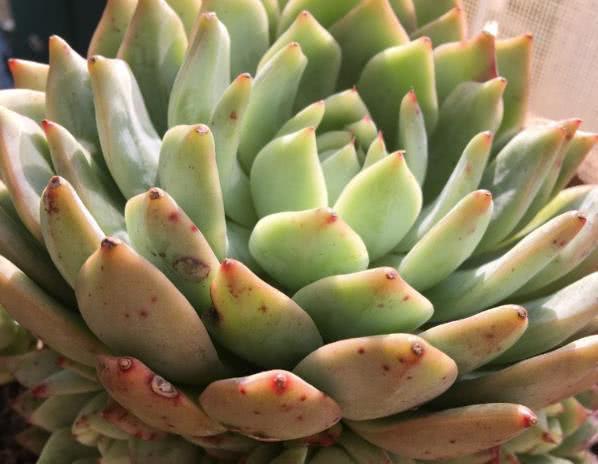
The powder on succulent leaves is very attractive and also plays a role in the growth of succulents. The white powder on succulents is a protective layer that can reduce light intensity. However, there is one thing to note about the powdery coating on succulent leaves: the white powder on the leaves is very easily rubbed off.
The powder on succulent leaves can reduce water loss from the leaves. Have you noticed that succulents that have lost their powder are more prone to sunburn and more likely to develop soft leaves from excessive water loss than those that have not? Sometimes we buy varieties that come with powder, so when removing soil or planting, try to support the outermost leaves to reduce powder loss. It does not matter if the powder on the bottom leaves is lost; they will be replaced through metabolism later.
The waxy layer is a standard feature when epidermal cells are newly formed. For an individual epidermal cell, the waxy layer cannot regenerate, but for the entire leaf, newly formed epidermal cells on the leaf will carry a new waxy layer. Therefore, newly grown succulent leaves will have white powder. If the leaf is very small, even if the white powder is wiped off, it can still regenerate (because there are many new cells, and each new cell carries white powder). For succulents with larger leaves, once the white powder is wiped off, it is not easy for it to regenerate, because the white powder brought by new cells is not enough to make up for the powder that was wiped off.
There is another kind of powder that is not normal. Improper daily care habits can cause succulents to become infected with pathogens and develop powdery mildew. At first, small yellow spots appear on the succulent leaves, which later become round or oval lesions with a white powdery mold layer on the surface. Powdery mildew is not a widespread disease, but it can seriously affect photosynthesis in succulents, disrupt normal metabolism, and cause premature aging.
Due to the plant variety itself, some varieties are more susceptible to powdery mildew, such as: Huoji (Firestick), Chiguicheng, Orostachys, etc. The peak season for powdery mildew in succulents generally occurs in early summer or late summer, in weather with high humidity that is neither cold nor hot. With more rainfall in summer and autumn, excessive water and overly moist soil breed mold, making powdery mildew more likely. There is also another situation: overly dry soil, no light for a long time, a habit of spraying and watering at night, water remaining on succulent leaf surfaces combined with poor ventilation, and excessive fertilization all favor the growth of powdery mildew.
When watering, do not pour water onto the leaves; water the root system as much as possible. Watering at night, especially spraying, means the water on the leaf surface cannot dry and evaporate quickly during the night. If the humidity is too high, fungal problems such as powdery mildew are very likely to occur. The most suitable time for watering is 7 or 8 in the morning, and no later than 9 at the latest, so that the daytime sunlight can quickly evaporate the water on the leaves. In addition, when watering, do not pour water onto the leaves; water the root system as much as possible.
This is a gathering place for succulent lovers, sharing succulent care tips. You are welcome to follow and exchange ideas.