A grand roundup of 11 common ivy varieties: which one do you like best?
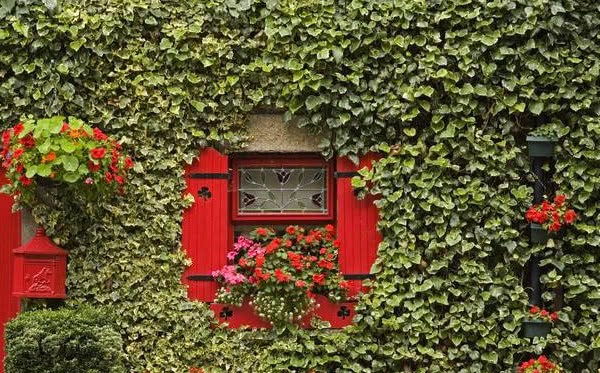
Roots and bones with endless strength, lush and green through all four seasons. Climbing trellises, carving colorful canopies; spreading over the ground, embroidering a velvet carpet. Bathed in rain, it surges like a dragon; facing the wind, it opens its musk-scented breast. On a thousand-fathom path of life it tosses, never fading in its heart to strive forward. -- "Common Ivy"
Common ivy has extremely strong vitality. It can climb walls and trellises, spread flat across the ground, and can also be grown in pots and allowed to trail, each creating a secluded, charming scene. It is an evergreen woody vine with smooth stems that can extend 20 to 30 m. The young branches have soft hairs like scales, and it climbs other objects by means of aerial roots. The leaves are dark green. It blooms in late autumn, with pale greenish-white, fragrant flowers. The fruit is spherical, red or yellow when ripe. The leaves, stems and fruit can all be used as medicine.
There are nearly 500 varieties of common ivy, each with its own characteristics and all very beautiful. Among the 11 common ivy varieties below, which one do you like best?
1. Irish ivy
This common ivy has large leaves and is easy to grow; it looks very nice climbing on fences and walls.
2. Variegated ivy
This common ivy variety originates from the Middle East. Its leaves are larger than those of common ivy, and it has many variants, all very beautiful.
3. Canary ivy
The leaves are relatively large, with a neat, emerald-green shape, full of vitality and very beautiful. This variety also has many variants.
4. Nepal ivy
Nepal ivy has narrow, elongated leaves that are wedge-shaped or even sword-shaped, glossy and lovely.
5. Japanese ivy
Japanese ivy has relatively hard leaf texture, and the leaf lobes are not obvious, usually three-lobed. The color is dark green and glossy. It also has variegated variants.
6. Cyprus ivy
Cyprus ivy has a leaf shape similar to Chinese ivy. The leaf color is blackish-green, and the veins are pale white, making it very distinctive compared with other varieties.
7. Woerner ivy
It should be the most cold-tolerant variety. The color is dark green, and the stems and leaves tend toward purplish-red, very beautiful.
8. Azores ivy
It has more leaf lobes, and a single leaf is not very distinctive, but the new and old leaves differ in shade, giving a special flavor when decorating walls.
9. English ivy
This common ivy is one of the most commonly seen common ivy varieties in our daily life. Its leaves are relatively small, and when well grown, the leaf surface is shiny.
10. Chinese ivy
Chinese ivy has indistinct leaf lobes; each leaf looks like a small triangle with a piece missing.
11. Curly ivy
This common ivy also varies a lot in leaf shape and color, and its wavy, undulating leaf edges are very beautiful.
Common ivy care methods:
1. Native common ivy all clings to shady, damp tree trunks or rock walls, so care should ensure the potting soil stays moist, with frequent misting to maintain humidity.
2. At temperatures between 18 and 25 degrees, it grows rapidly and is full of vitality. In winter, it is best not to go below 5 degrees. In summer, when it exceeds 35 degrees, increase ventilation and cooling.
3. Common ivy is relatively light-loving and very shade-tolerant. In daily care, indirect light is very good, and direct strong light must be avoided.
4. Common ivy roots very easily from cuttings. Note that when choosing branches, it is best to use healthy young branches from the current year. After cuttings, place them in a bright, indirectly lit spot, and water so that the soil dries and gets wet alternately; they will root in about one month.
5. To make common ivy look good, also pinch out the growing tips in time to encourage bushy branching and make the plant full and shapely. After it grows to a certain height, it is best to support it with a stake for it to climb on, and it will look very beautiful.