Why does Crescent Lake in the desert never dry up? It turns out the water source comes from here
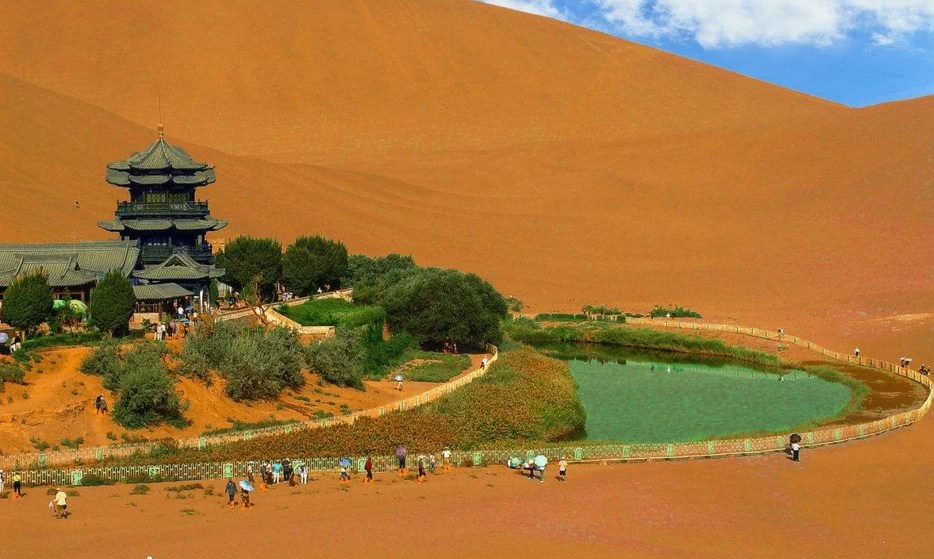
The very thought of a desert makes you feel thirsty. Deserts can bring disasters, and that is sandstorms. Over the centuries, sandstorms have struck many villages. Some of the stronger sandstorms tore the roofs off houses and sent yellow sand flying everywhere, bringing disaster to people's production and daily life. But some people are drawn to the desert; it is a paradise for adventure lovers. Today we are going to talk about Crescent Lake, located in the Mingsha Mountain desert in Dunhuang. After every sandstorm, this Crescent Lake has never been buried by windblown sand.
The Mingsha Mountain and Crescent Lake Scenic Area is located 5 km south of the urban area of Dunhuang, China, with a planned area of 212.86 sq km, a scenic and historic interest area of 76.82 sq km, and a core area of 12.79 sq km.
Mingsha Mountain and Crescent Lake are a pair of twin sisters in the vast desert and Gobi. "The mountain sings because of its spirit, the water is all the more beautiful because of its divinity." One truly has the feeling that "Mingsha Mountain pleases the mind, Crescent Lake cleanses the heart."
Crescent Lake has created a world wonder by not drying up for hundreds of years, and this has attracted many Chinese and foreign tourists to visit. So what exactly is the reason Crescent Lake does not dry up? Today we will talk about Crescent Lake. In ancient times, Crescent Lake was called Shajing. Crescent Lake is nearly 100 m long from north to south and about 25 m wide from east to west. The spring water is deep in the east and shallow in the west, with the deepest point about 5 m. The shape of Crescent Lake resembles a new moon, so the locals call it Crescent Lake, and it is named for this wonder. It also has the reputation of being the first spring of the desert. Crescent Lake is surrounded on all sides by yellow sand, and sandstorms often strike, but Crescent Lake has never been buried by sandstorms. From the Han Dynasty to modern times, Crescent Lake has always been famous in China as the first spring of the desert.
What exactly is the reason Crescent Lake does not dry up?
First:Crescent Lake contains pondweed and stonewort plants, and there are dense reeds on the south bank. It is surrounded by shifting sand, and even in strong winds the spring is not covered by sand. At the same time, Crescent Lake relies on the continuous replenishment of the groundwater system to keep the spring water welling up and form a water cycle.
Second:Because the dunes move and the water channels change, it has become a separate body of water. Because the terrain is low, water seeping underground continuously replenishes the spring, keeping it flowing without cease and preventing it from drying up even in drought.
The northeast is the air inlet. When the wind blows in carrying yellow sand, the wind force blows all the yellow sand to the other side, so Crescent Lake is not easily buried.
In the mid-1970s, local land reclamation, farmland creation, pumping for irrigation, and the destruction of surrounding vegetation and soil erosion caused the water level of Crescent Lake to drop rapidly. Now, multiple methods of artificial water replenishment are needed to maintain the flow. As the water continues to decrease, "will Crescent Lake disappear in the future" has become an issue of concern to us.