Four taboos for bonsai beginners to note, and five benefits to be gained
[Bonsai People Tell Stories]
Text | Zhou Yingzhi, Xiamen, Fujian
A president was taking a walk with his grandson when a beggar bowed and saluted him. The president immediately stopped to return the salute, and bowed even lower. The grandson was puzzled: "He is just a beggar!" The president replied: "I will never allow a beggar to be more courteous than a president! Do not think that others respect you because you are excellent. In fact, others respect you because they themselves are excellent, and excellent people respect everyone."
Courtesy and respect symbolize one's realm and cultivation. Do not overestimate yourself, and do not casually look down on others. Others giving you face does not mean you have face!
Beginners enjoying bonsai should note the "four taboos" and can gain the "five great benefits"
Recommended text | Penyi
Recommended images | Qiu Zheng
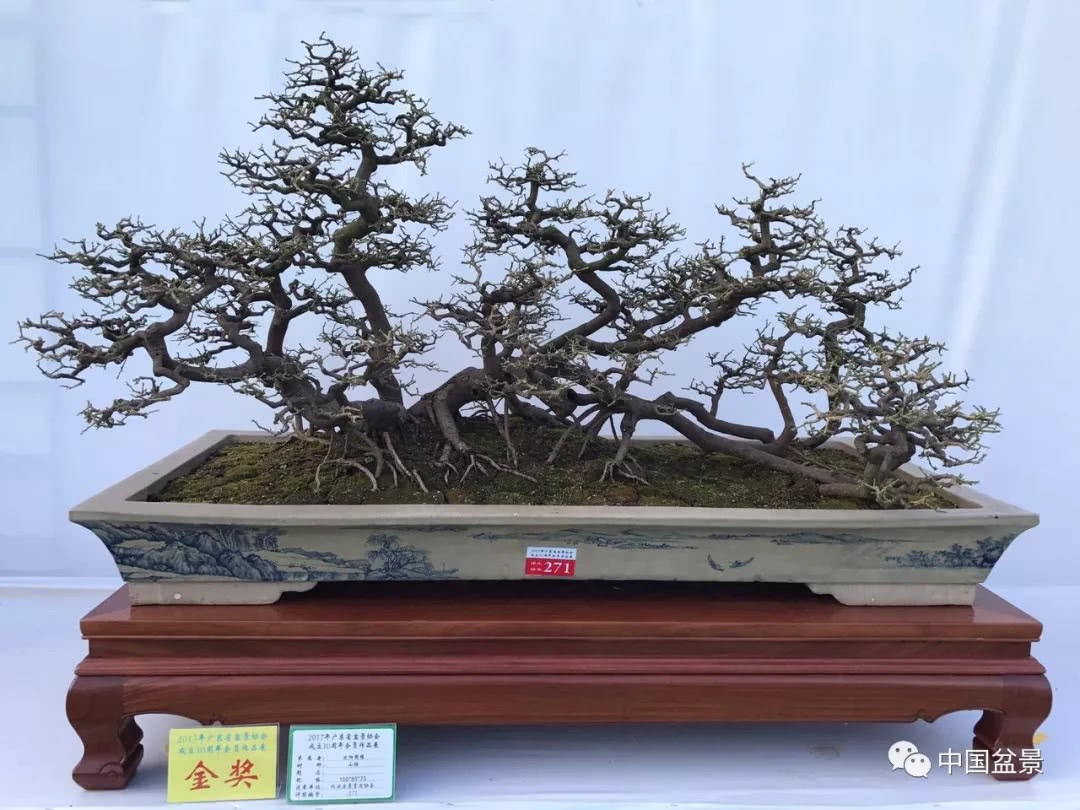
Bonsai captures the solitary tree and forest forms of nature, with varied shapes and countless postures; with profound artistic conception, feeling within the scene and scene within the feeling, a blending of scene and emotion, sturdy and twisting, branches and leaves layered in green like spring breeze, refreshingly green; the tree's form is quaint and vigorous, intoxicating in its striving, upward artistic shaping, and captivating in its artistic conception of "lively spirit and rhythm, both form and spirit, blending scene and emotion" - yearning to have such a few pots of beautiful scenery oneself, from that moment on it becomes unstoppable, pondering bonsai constantly, thinking of it day and night, nearly obsessed.
Four taboos
One taboo: blind passion
Seeking tree stumps, one must above all avoid blind passion. With bonsai, one always wants to own many varieties and styles, to enjoy and relieve one's "hunger" and "thirst" at any time, but when first playing with bonsai, because one's appreciation ability is insufficient and artistic level is not high, one ends up wanting every stump seen when collecting stumps in the wild, carrying out "carpet-style" digging, wasting resources and destroying the ecology; or when buying stumps at flower and bonsai markets, one does not distinguish good from bad or superior from inferior, and buys in large quantities. But the result is a waste of time, effort and money, because the survival rate of stumps is affected by maintenance and management as well as other factors. For ordinary stumps, "a stump without soil, and the stump dies after a hundred hardships." Considering the protection of the natural ecological environment, collecting stumps is not recommended. If bonsai friends buy stumps, they should observe whether the stump has a soil ball? Whether protective measures have been taken for the stump roots? The season when the stump was dug and the weather of the past few days? How long the stump has been left sitting? The condition of the cut surfaces of the stump's root fibers? Therefore, although beginners' eagerness to seek stumps is understandable, when buying one should comprehensively consider various factors and act cautiously. If guided by a professional in the bonsai industry, losses can be avoided and detours reduced, so that one will not be blind and will not get half the result with twice the effort.
Two taboo: carelessness
Caring for stumps, one must above all avoid carelessness. The ancients said: "Action succeeds through thought, and is ruined through carelessness." The same applies to caring for stumps. Stump care requires patience and carefulness, and even more requires understanding of plant growth habits, nutritional knowledge, soil structure knowledge, water and fertilizer application knowledge, and pest and disease control knowledge.
During maintenance and management:
First, avoid careless handling of stumps.
Each stump must, according to one's own shaping ideas, have its branches and roots carefully pruned and its wounds treated before it can be planted in soil, otherwise it is not conducive to the stump's survival, and even less conducive to future shaping.
Second, avoid careless soil preparation.
Soil is an important factor in whether a stump survives and grows well. If the soil is well prepared, the stump is already one-third alive. One must understand each plant's growth habits, prepare the soil in proportion, and provide the stump's growth with a good medium that is well aerated and easy for absorbing nutrients.
Third, avoid careless application of water and fertilizer.
Plant growth cannot be separated from water and fertilizer. Recommended fertilization: light fertilizer applied frequently. Watering principle: do not water if not dry, and when watering, water thoroughly. If watering frequently (water and soil are inseparable, and the stump dies all for nothing), water timely and in appropriate amounts. If there is too much water and too much fertilizer, the stump cannot absorb it, and its survival will be in danger.
Fourth, avoid careless handling of pests and diseases.
Many pests and diseases can endanger a plant's life within a few days, so they must not be treated lightly or with indifference. One must discover them promptly and control them promptly (do pest and disease control work well according to the season), otherwise the stump may have branches and trunks wither and die from pests and diseases, affecting its appearance, and in serious cases causing the stump's death, and all previous work will be wasted. This is not only an economic loss, but also causes oneself to feel deeply regretful over the stump's death, and may even severely damage one's confidence in playing with bonsai.
Fifth, avoid carelessly moving stumps around.
If a stump is planted in the ground or in a large pot, one must wait until its root system is well developed and it has completely survived before considering, in a suitable season and weather and taking into account factors such as pot size, putting it into a pot or repotting it. Do not ordinarily leave it buried in the ground and then, on a sudden whim, pot it up for display and move it here and there, turning a living stump into a dead one.
Three taboo: haste
Shaping, one must above all avoid haste. Personally creating a bonsai work with a unique style is undoubtedly the most exciting and passion-inspiring thing, but one must above all avoid haste.
First, avoid shaping hastily when maintenance is inadequate. The branches of a stump must grow to a certain robust degree and gradually form transition branches with the trunk before they can be pruned and shaped. One must never judge by length alone rather than by robustness, and once the branches reach a certain length, bind and wire them in a "twisted dough twist" style. On the surface it may appear to have a certain shape, but on closer inspection the "heat is insufficient," especially for deciduous plants, whose defects become obvious when viewed in winter (repotting is not recommended when the stump is in sub-health).
Second, avoid shaping casually when considerations are immature. A stump requires repeated pondering and repeated deliberation before a shaping plan can be determined. Beginners, because their shaping skills are only half-understood and they are eager to act, rush in blindly, and later constantly make drastic corrections, causing a stump to be moved and placed around, delaying the time and opportunity for it to take shape. Therefore, it is suggested that beginners, when shaping, had best first put forward their own views, and then find three to five bonsai enthusiasts and bonsai professionals for guidance (after a stump's branches and trunk are cut, the growth cycle is long and whether the later sprouting points grow in the ideal positions is hard to predict), to avoid unnecessary losses. This can both reduce detours and greatly help improve one's own artistic cultivation.
Third, in stump shaping, if the concept is not established first, with conception before and execution after, and further refinement of the conception during production, it is suggested that shaping can be carried out in stages, avoiding the "pulling up seedlings to help them grow" of shaping all at once, which affects the stump's later growth (this can be determined according to each stump's own condition).
Four taboo: imitation
Pursuing artistic conception, one must above all avoid imitation. Bonsai shaping is both an embodiment of art and an expression of the maker's profound artistic conception. When beginners pursue artistic conception in bonsai making, imitation can indeed quickly improve one's artistic quality and creative level, but if one creates works solely through imitation, then one's level can never be improved, and one's artistic realm can never be elevated. Therefore, in making bonsai, drawing on "stones from other mountains" is certainly important, but more important is that one earnestly study botany, actively delve into aesthetics, strive to explore literature, observe plant growth in nature, combine this with our Chinese nation's five-thousand-year cultural tradition, and combine it with one's own emotions for systematic creative processing, increasing one's overall qualities, constantly improving artistic cultivation, and constantly pursuing a beautiful realm and taste.
Because the survival rate of raw stumps is too low, and even if they survive, there are still uncertain factors affecting their survival in the future, and in addition to the later pruning, shaping, potting, maintenance and management of stumps, the waiting period is too long (for miniature bonsai, the day the scenery is achieved owes its merit to ten years, while for medium and large stump bonsai, taking shape takes more than ten years, or even several decades). Even if after all those years one produces a formed scene, how many pots of relatively high-grade bonsai can one bring out?
Five great benefits
By understanding and mastering the content of the above four taboos, earnestly studying plant habits, nutritional knowledge, soil structure knowledge, water and fertilizer application knowledge, pest and disease control knowledge, and production and shaping techniques, and buying some semi-finished or nearly finished bonsai that are easy to keep alive and easy to shape for practice, and making slight adjustments on the basis of their shaping, one brings bonsai friends five great benefits:
One, one can get started quickly and greatly shorten the time to achieve a scene.
Two, they are not easily killed and avoid causing economic losses.
Three, through theory plus practice, one explores and summarizes experience in bonsai maintenance and management.
Four, each pot one plays with looks good, market circulation is convenient, and one avoids economic losses from paying too much tuition
Five, one gains confidence in playing with bonsai and enjoys the joy brought by its changes through the four seasons.
The above content also applies to miniature bonsai. Miniature bonsai is an extremely small bonsai, with small pots, little soil, and a plant crown height of 15--20 cm from the pot surface. It is small in form, exquisite and unique in shaping, shrinking a dragon into an inch, with concise lines. It is a living, inheritable art piece. It reveals the great through the small, can be enjoyed directly, and also leaves rich imagination; therefore, although miniature bonsai is a thing held in the palm, it can also achieve superlative craftsmanship. To make miniature bonsai, one should first choose plant material with fine branches and small leaves, easy to keep alive after potting, and with peculiar roots and trunks, gorgeous flowers, and easy shaping.
For miniature bonsai, the day the scenery is achieved owes its merit to ten years, and compared with medium and large bonsai, the time to achieve a scene is greatly shortened. Its advantages are even more prominent, suiting future urbanization and indoor living, truly realizing bringing bonsai into the family. It is the mainstream of today's bonsai development (small in size, convenient to transport, smooth to exchange, showing an aged appearance, each pot is a unique piece, treasured as a gem; people of all ages, old, middle-aged, young and children, are all playing with miniature bonsai).
(This article was compiled and recommended by "Penyi," and the copyright belongs to the original author. Images were photographed by Qiu Zheng)
Wonderful replay:
Chinese bonsai welcomes you!
Enjoy at any timeViewBonsai exhibition hall
Promote bonsai culture, exchange bonsai skills!
Appreciate bonsai art, share a happy life!