Wang Yangming contemplated bamboo to gain insight; what I contemplate is you.
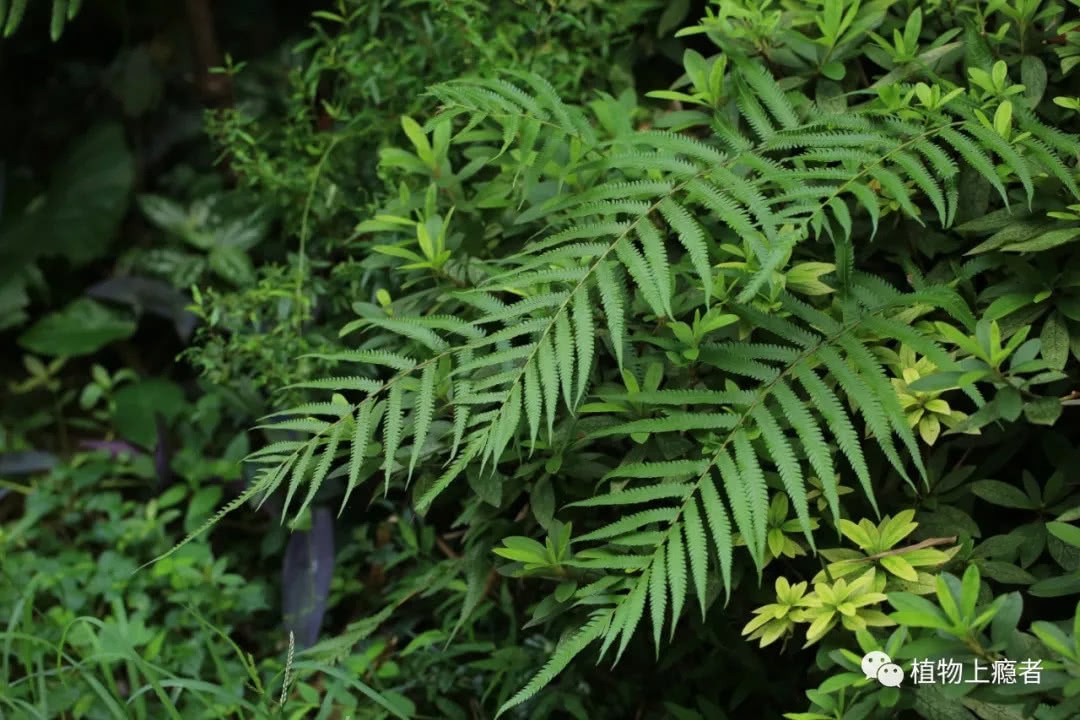
"Beautiful Ferns"
06
Cyclosorus acuminatus
Cyclosorus acuminatus
Aliases: Bizi Shujin Cao, Niuleiba
Thelypteridaceae, Cyclosorus
A medium-sized terrestrial understory plant
1
Enter laughing, leave crying
When I first became obsessed with ferns, a fern friend said, "Be careful, the fern pit is very deep. Usually you enter laughing and leave crying..." The first fern that made me want to cry was Cyclosorus acuminatus.
It is so common. In the grass, under big trees, in cracks between roadside stones, you meet it everywhere. Moreover, it is tall, about half a person's height, impossible to ignore. But for me, just entering the fern world, I was completely bewildered. What is its name, whose child is it?
Seeing it face to face every day, yet unable to name it. That feeling was extremely frustrating.
Fronds bipinnatifid; pinnae 13-18 pairs
Lobes numerous, arranged in a pectinate pattern
The pinnae edges are arranged with exceptional neatness, like fine brushwork painting, meticulous to a fault, slightly lacking in liveliness. This was my first impression of it. Turn a pinna over, and the spores are also arranged meticulously, uniform and neat, light yellow when immature, brown when mature.
Spores
With this little bit of knowledge, I used the dumbest method - taking out a plant illustrated guide to compare. The closest match was Thelypteridaceae, Cyclosorus. The fronds are bipinnatifid, and the basal pair of lobes tends to be longer, which also matches the characteristics of Cyclosorus.
The upper basal lobe is longer
2
An incomprehensible text
Cyclosorus, in the broad sense, has over 100 species; in the narrow sense, over 40 species. At first glance, they all look similar. "Lobes numerous, arranged in a pectinate pattern" is the hallmark of this genus.
Aliases Bizi Shujin Cao, Niuleiba - do they fit?
The description and key of Cyclosorus looked like an incomprehensible text. Knowing I did not yet have the ability to decipher it, I simply asked two fern friends directly. They both gave the same answer: Cyclosorus acuminatus.
Young fronds circinate
The frond apex is caudate-acuminate, hence the name
With this name in hand, I compared it directly against the description in the Flora, feature by feature, until the following passage blocked my way:
"The basal pair of lateral veins arises from the base of the midrib, their ends joining into a blunt triangular areole, from the intersection point extending outward small veins to the transparent membranous connecting line below the sinus, the upper 1 vein of the second and third pairs reaching the transparent membranous connecting line, below the sinus there are 2 1/2 pairs."
In the key, the most essential species-determining feature is also this passage.
Completely unintelligible. This is simply a coded telegram. When Guo Jing, the great hero Guo, first saw the "Nine Yin Manual," his feelings were probably about the same as mine at this moment - not understanding a single word.
So I put it down. Perhaps, when I have a bit more experience, I will deal with it again.
3
The master contemplated bamboo; I contemplate Cyclosorus
In the end, I was still unwilling to give up. In the days that followed, I played with other plants, but my heart still hung on this fern. Each time, I would casually pull up one or two stalks of Cyclosorus acuminatus and bring them home, and when free, I would look at it through a magnifying glass for a couple of glances. Haha, this is probably the "investigating things to extend knowledge" advocated by the legendary master of mind philosophy, Wang Yangming, right? Only, the master contemplated bamboo, while I contemplate Cyclosorus.
After looking many times, one day, a long, obliquely flattened triangular pattern suddenly emerged clearly from the handheld magnifying glass. What? After the surprise, I hurriedly pulled out the Flora description and checked it word by word:
"With the rachis as the base, the tips of the basal pair of lateral veins between adjacent lobes join each other to form a blunt or pointed triangular areole" - a perfect match!
The triangular areole was the first to be deciphered
This discovery greatly boosted my confidence. Pressing on, I looked at the next line of the code:
"And from the intersection point extends one or long or short outward small vein, connecting with the transparent membranous connecting line below the sinus."
Even macro shots cannot show it clearly; a hand-drawn diagram is as follows:
4
Within one delicate frond, silent secret words are hidden
Of the coded telegram of Cyclosorus acuminatus, only the last line remains:
"The upper 1 vein of the second and third pairs reaches the transparent membranous connecting line; below the sinus between adjacent lobes there are 2 1/2 pairs of lateral veins."
To understand this line, I still used the old method: look repeatedly. Guo Jing practiced martial arts the same way. What the master taught, if you do not understand it once, practice it again a hundred times. One day, "its meaning will reveal itself."
I do not know on which repetition it was, but suddenly inspiration struck, and I instantly understood what "the upper 1 vein of the third pair" meant, which had confused me for days. See the figure below:
To sum up in retrospect:
The sensitive points of Cyclosorus are exactly these points in the code.The connection status of the leaf veins is the core point for species determination, the presence or absence of outward small veins, the number of pairs of lateral veins below the sinus, combine to produce various different Cyclosorus species. As the saying goes: within one delicate frond, silent secret words are hidden. With Cyclosorus acuminatus as a foundation, next time I encounter other Cyclosorus species, recognizing them will be much easier.
At this point, the truth was fully found, and its identity was finally verified. And I really wanted to down a big glass of wine to celebrate having successfully cleared the level~
Name explanation:
The genus name Cyclosorus of Cyclosorus acuminatus is composed of the Greek roots cyklos, meaning circular, and sorus, meaning heap, referring to the round sori. The species epithet acuminatus means "acuminate," referring to the frond apex being acuminate, suddenly contracting into pinnatifid caudate pinnae. The aliases Bizi Shujin Cao and Niuleiba also vividly describe the characteristics of its fronds.
Distribution:
Chongqing, Sichuan, Yunnan, Guizhou, Hunan, Hubei, southern Shaanxi, Zhejiang, Jiangsu, Jiangxi, Anhui, Fujian, Guangdong, Guangxi, Hainan, Taiwan, China, Shandong, Henan. Also distributed in Japan, South Korea, and the Philippines.
The article and plant images (unless otherwise credited) are all original by the author
Your forwarding and appreciation are the greatest support for me
Plant Addict
WeChat: plantfiend
Discover the unique beauty of every plant