Reasons Why Cymbidium faberi Never Blooms and How to Fix It
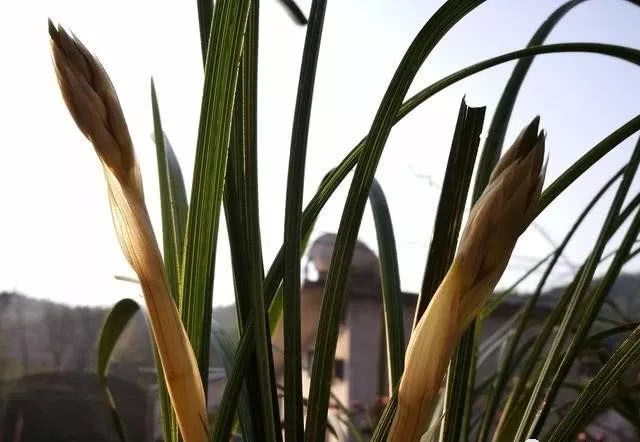
There are mainly three reasons why Cymbidium faberi does not bloom. These are the results of the Good Photography Farmer's own experiments, and today I will discuss these three aspects with the reader.
During the 2015 Spring Festival, I found a wild Cymbidium faberi on the mountain. It had more than 30 shoots, a very large clump. The leaves were nearly 80 cm long, dark green in color, and drooping in form. Such a robust Cymbidium faberi had no flower spikes. Even after the farmer introduced it back home, when Cymbidium faberi of the same period all bloomed, it still showed no sign of blooming. This Cymbidium faberi has still not bloomed to this day. So sometimes a Cymbidium faberi not blooming may be related to the variety.
Another factor is temperature. In the winter of 2016 (late December), a friend in Beijing wanted to take a pot of Cymbidium faberi from me. At that time I found two pots for him to choose from, and both had flower spikes that had just emerged from the soil. He chose one pot, and under Beijing's temperatures it bloomed before February. But the pot I kept at home did not bloom until late March, a full one and a half months later. However, his Cymbidium faberi did not bloom this year, possibly due to management issues. If the flower spikes of Cymbidium faberi do not receive enough low-temperature vernalization, it is very difficult for it to bloom, and even if it does bloom, the flower scape is very short, resulting in poor-quality flowers.
The third factor is fertilizer. Cymbidium faberi has large plants and many roots, so it naturally needs more fertilizer. If a Cymbidium faberi that has bloomed for two years is still not repotted with fresh soil, the nutrients in the growing medium will not be enough to sustain its bud formation, and it will not bloom. I suggest fertilizing Cymbidium faberi twice a year. The first time is after flowering, mainly with nitrogen fertilizer supplemented by phosphorus and potassium fertilizer; the second time is around White Dew, mainly with phosphorus and potassium fertilizer supplemented by nitrogen fertilizer. In between, foliar fertilizer should also be sprayed to ensure that Cymbidium faberi has enough nutrients to bloom.
Finally, there is one more point that is not the main focus but is still important: Cymbidium faberi needs a relatively large amount of light. Except for the midday sun in midsummer, it is best to give it sunlight most of the time, especially in late autumn and winter. More sunlight can make the flower spikes more robust and make it easier to produce many fine flowers.