What are the requirements for the branches of a stump bonsai?
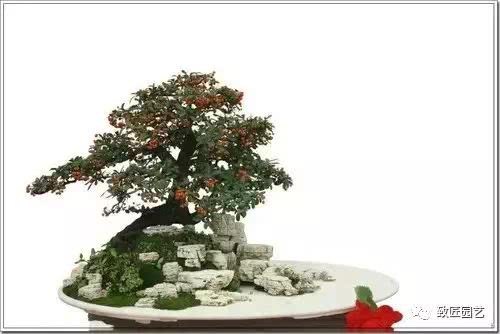
Branches are like a person's limbs; together with the trunk they form the skeleton of the plant. The arrangement of the branches determines the arrangement of the "leaf pads," so the layout of the branches is very important. In the composition of a stump bonsai, the branches are mainly made up of three parts: side branches, back branches and trunk-covering branches. Different branches play different artistic roles.
1. Side branches. Side branches are the branches on the left and right sides of the trunk; together with the trunk they form the "tree skeleton." If the side branches do not change, the tree shape will not undergo any fundamental change. Therefore, side branches hold an important position. From the perspective of artistic expression, side branches display an external, exposed kind of linear beauty.
2. Back branches. These are the branches behind the trunk, also called hidden back branches. They play a "concealing" role, exactly opposite to that of the side branches. They express an inner, reserved beauty.
3. Trunk-covering branches. Any branch that can cover the trunk on the viewing side of the tree, making the trunk "appear and disappear by turns," is called a trunk-covering branch. Trunk-covering branches mainly cover a certain part of the trunk, so that the trunk is partly hidden and partly visible, achieving an artistic effect of appearing and disappearing by turns. A trunk-covering branch can cover the trunk directly as a front branch, or it can achieve the purpose of covering the trunk by drawing back a side branch.
Side branches, back branches and trunk-covering branches form an organic whole. They interact and complement one another, together forming a graceful tree shape.
The various branches of a stump bonsai must be arranged in three dimensions along the whole trunk. One must not seek good looks from only one side, but require good looks from many sides, so as to form a graceful three-dimensional landscape. At the same time, one must consider the unity of the tree's own physiological needs and the artistry of the stump bonsai. Therefore, the layout of the branches must follow certain rules.
1. Side branches occupy favorable positions. In the branch layout of a stump bonsai, side branches are often placed in favorable positions, extending outward to form the tree shape; while back branches and trunk-covering branches are often placed in unfavorable positions, serving as embellishment and patching. Seen from the front of the tree, side branches are generally placed where they emerge at the top of a bend in the trunk, so that they are both vigorous and powerful and in keeping with the appearance of a natural tree; back branches and trunk-covering branches are placed partway along a bend, and must be arranged ingeniously and interwoven naturally in order to play their "concealing" and "hiding" role. This is because side branches are the "tree skeleton"; apart from the roots and trunk, they are the main viewing branches that are fully exposed. Therefore, side branches should occupy favorable positions on the trunk, so as to expose their outward-extending lines and their twisting, vigorous branch structure for people to admire. Back branches and trunk-covering branches, however, gather inward; their positions on the trunk cannot be seen from the front, and what people admire is only the branches and leaves revealed on the outside and the artistic expression of "concealing" and "hiding" that they produce.
2. Avoid overlapping positions. The layout stresses staggered front and back and distinct layers. One should try to avoid overlapping positions among side branches, back branches and trunk-covering branches, so as to embody the artistic form of expression in which "there is concealment within exposure." "Concealment" is a technique for giving depth to artistic expression; if something is "concealed without being revealed," there is no artistic expression or appreciation to speak of.
3. Crescent-shaped radial layout. Looking down at the whole tree, the positions of the side branches, back branches and trunk-covering branches are distributed radially with the trunk as the center. If the shaping of the "leaf pads" is added, a crescent-shaped layout is ultimately formed, in which the concave side is the front and the convex side is the back. This is because the crescent-shaped layout plays an important role in improving the viewing effect of a stump bonsai. With the concave side of the crescent facing forward, the viewer's line of sight is at the center point of the arc, which helps concentrate the line of sight and gives a feeling of being there in person, making the whole shape attractive. If the branches and leaves are laid out in a long strip, the line of sight cannot converge inward, the scenery is scattered, and the viewing effect is poor. If the convex side of the crescent faces forward, the scenery recedes and the viewer feels excluded from the scene. Therefore, according to the laws of vision, whether for a single tree or for multiple trees, the layout of branches and leaves must form a crescent-shaped layout.
4. The length of the branches must be natural. After the positions where the branches grow on the trunk are determined, one should also consider the length of the branches and the size of the "leaf pads" they form, and their effect on forming a graceful tree shape. Generally, side branches are the longest, back branches come next, and front branches that cover the trunk are the shortest. Vertically, the branches at the bottom are the longest, gradually becoming shorter from bottom to top. The size of the "leaf pads" formed by the branches must match the length of the branches, in order to bring out a natural appearance.
5. Large branches and trunks sparse, small branches and trunks dense. When the branches are placed overall, one should also achieve "large branches and trunks sparse, small branches and trunks dense." That is to say, in the tree shape of a stump bonsai, what is generally exposed are the mother branches, while the other branch divisions are covered by "leaf pads." Therefore, "large branches and trunks sparse" mainly refers to the mother branches, and "small branches and trunks dense" refers to the other branch divisions. So when arranging the layout, one must by no means use two mother branches growing from the trunk to form one "leaf pad," in order to prevent the "tree skeleton" from becoming chaotic. One must use one mother branch to form one "leaf pad" or several "leaf pads," so as to ensure that the "tree skeleton" is moderately sparse and dense, mottled and open, with graceful lines.
Wonderful content