What are some tips for growing sweet alyssum (Lobularia maritima) in pots?
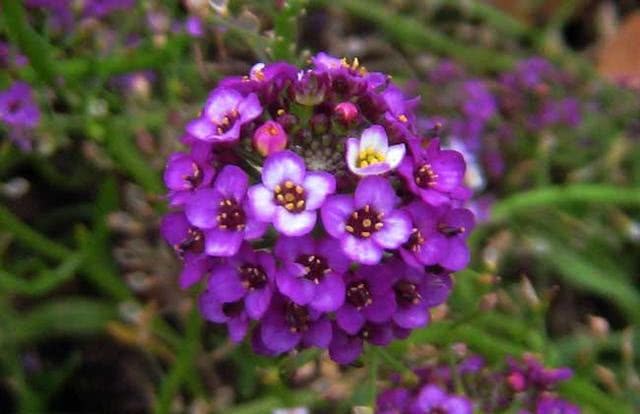
Sweet alyssum is also called "little white flower," but its flowers are by no means white, so don't be misled by the name. It is a perennial herbaceous flower, yet whether the planted specimen is annual or biennial, its base will not become woody. Its branches grow in a creeping manner, often clinging to rock walls to grow, and it can also be planted in flower pots or used as ground cover. Today let's see how this ball-shaped flower with its faint fragrance is grown.
I. Growth habits
Sweet alyssum originally grows in relatively cold regions, so its own cold resistance is fairly strong, but it may struggle to adapt to the hot environment of the south; it likes to stay in cold places with sunlight, fears too much water, and does not mind drought or even fertilizer-free soil, as long as it is not submerged in water, so it also dislikes places with high humidity.
II. Propagation methods
Both sowing and cuttings work for "little white flower," but sowing is generally used more often. In the north, sowing is usually done in spring, and seedling raising can begin in March. Its seeds grow very quickly, relatively fast compared with other flowers, and the uniformity of emergence is very good; under suitable ambient temperatures, new seedlings can grow in less than a week. For transplanted seedlings, the old rule still applies: three to five leaves counts as passing.
III. Growing tips
1. Soil. When growing "little white flower" at home, it is mostly potted, and there are many ways to mix the soil: garden soil plus furnace soil, garden soil plus clay pebbles plus coarse sand, grass ash plus furnace soil plus clay pebbles, and so on. Try to improve the soil's drainage performance without affecting the plant roots' ability to breathe. Once the nutrient soil is ready, the plant can go into the pot. Be sure to water immediately after potting and place it where there is no strong light, so the plant can adapt to the environment faster.
2. Potting. Sweet alyssum seedlings have particular requirements when being potted; you cannot just stick them in casually. First place the seedling into a flower pot with bottom soil, then cover the surroundings with a layer of coarse-grained soil, which can provide maximum drainage, then cover with a layer of soil prepared with base fertilizer. Its height should not cover the seedling's new leaves and should be a bit lower than the rim of the pot. The fertilizer must be thoroughly mixed with the soil to avoid the fertilizer concentrating in one place; if it directly touches the seedling's roots, it may burn the seedling and affect its growth.
3. Pinching. Before the flowering period arrives, there is one step that is very important, namely pinching off the leaf centers at the top. Generally it needs to be done twice: the first time is to make the plant grow more side branches, and the second time is to make the plant produce more flowers. About half a month after transplanting, the plant will have grown into a well-formed seedling. This is the best time for the first leaf pinching. How much of the top growth to remove depends on the plant's specific growth condition.
Generally, just leave three to five leaves and remove the rest; later you will find that the plant sprouts some side branches and its shape becomes rounder and fuller. But in order for the plant to bloom more profusely during the flowering period, at this point you need to stop the growth of the branches. The removal of branches is the same as the first operation, at least in method, only the purpose is different.