Taiwan's first circular building takes shape: Taiwan and the Netherlands join hands on whole-building material recycling, a world first
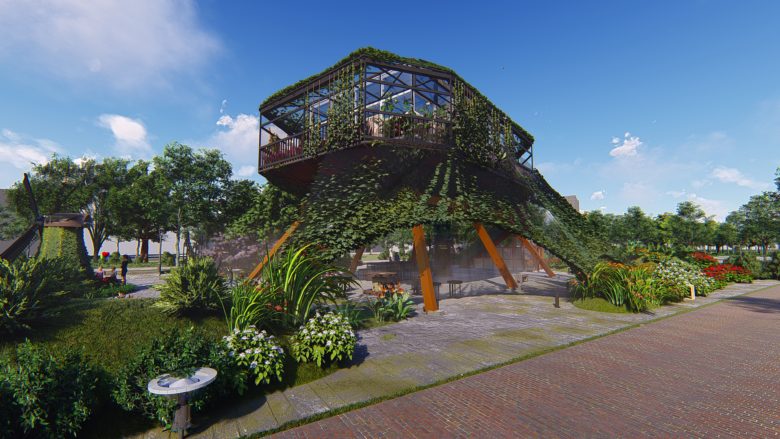
The Netherlands, a major flower-producing country, is taking part in the Taichung World Flora Exposition not only to show off its agricultural strength, but also to lay the foundation for Taiwan's circular future. Representing the Dutch government, the Netherlands Trade and Investment Office (NTIO), together with four leading Dutch enterprises and Taiwan Sugar Corporation, and in cooperation with industry, government and academia in both the Netherlands and Taiwan, is building Taiwan's first circular building in the International Garden Area of the Houli Forest Park at the Taichung World Flora Exposition. It will also be the world's first circular building slated for demolition, with the aim of putting the concept of "circular use of building materials" into practice.
Lai Ying-Ying, director of the Waste Management Division of the Environmental Protection Administration (EPA), said that the "circular economy" is one of the nation's 5+2 industrial innovation plans, and that the EPA has worked for many years to promote it. In June of this year (2018), the EPA, drawing on the spirit of the Netherlands' "Green Deal," encouraged businesses and alliances to sign a "Green Agreement," hoping to create a win-win for the economy and the environment through public-private cooperation. The EPA, the Circular Taiwan Foundation, the Taiwan Institute for Sustainable Energy, and the Taichung Architects Association were invited to serve as strategic advisors to the Netherlands Pavilion at the Taichung World Flora Exposition. Lai welcomed the cooperation on the Netherlands Pavilion, saying she believes all the public and private sectors involved will gain valuable experience and contribute to the development of circular building in Taiwan.
Heat-insulating paint cools effectively; powder coatings leave zero waste
At the same time, the four leading Dutch enterprises and Taiwan Sugar Corporation are also showcasing new technologies and new models of the circular economy at the Netherlands National Pavilion. AkzoNobel, the world's largest coatings company, has ranked first globally on the Dow Jones Sustainability Index five times in the past six years, and four of its technology products are being used in the Netherlands Pavilion.
Ho Chi-Ting, general manager of AkzoNobel Taiwan Ltd., said the roof of the Netherlands Pavilion uses "Bekelou," from AkzoNobel's well-known brand Dulux. Besides being waterproof, it uses highly reflective technology to insulate against heat, cooling the roof by 10 degrees and the interior by 5 degrees, reducing air-conditioning electricity use. In addition, the orange beams and columns of the Netherlands Pavilion use Interpon powder coatings. Besides protecting the building materials and extending their reusable lifespan, the coatings generate no wastewater or waste gas from production to spray application, and unused powder coatings are recovered and reused through a recovery system, achieving a utilization rate of at least 98% and greatly reducing waste.
World's only recyclable carpet makes its first appearance in Taiwan
Dutch materials company DSM has been named one of Fortune's "Change the World" companies for three consecutive years, and for two years running has been rated by Sustainalytics as the chemical company with the best environmental, social and governance performance. This time DSM is providing the Netherlands Pavilion with the world's first recyclable carpet, "Niaga," making its debut in Taiwan. Shao Chung-Yi, general manager of DSM Taiwan, said that for many years DSM has applied the highest technology to improve people's lives today and in the future, and that the "circular economy" theme of the Netherlands Pavilion at the Taichung World Flora Exposition fits perfectly with DSM's "3P policy": Planet, People and Profit.
Shao Chung-Yi pointed out that carpets are woven and bonded from multiple materials and are hard to recycle, so more than 95% of carpets worldwide are buried or incinerated, causing a major impact on the environment. DSM redesigned the product and the manufacturing process to make the carpet material uniform and the adhesive separable, so the carpet can be recycled and remanufactured into carpet material and made into carpet again. Read backwards, "Niaga" is "again," symbolizing the circular, reuse-based circular economy.
Selling light, not lamps: a century-old Dutch company's new business
Dutch company Signify, which provides Philips lighting products and has a 127-year history, is lending its lighting system free of charge this time, embodying the circular business model of "leasing instead of buying" and "selling light, not lamps."
Yu Yung-Tao, general manager of Signify Taiwan Ltd. and global vice president, said that Signify's circular lighting integrates three aspects of the business: modular product design that favors repair over disposal; smart connected systems that use sensors to enable better interaction between people and light; and leasing instead of selling, so that businesses need not consider long-term fixed-asset investment or complex technical systems, but simply buy lighting services from Signify to enjoy top-tier lighting with a light asset base.
In addition, Yu Yung-Tao noted that besides installing solar-powered street lamps outside the Netherlands Pavilion at the Taichung World Flora Exposition, Signify has also deployed the Interact City Philips smart road lighting system in the Taichung Precision Machinery Park, so both the government and the public can easily enjoy the benefits of connected lighting, which is not only convenient and energy-saving but also effectively managed.
Promoting a new economic model: a duty the Dutch bank "cannot shirk"
The Dutch bank ING was named the world's best bank by Global Finance last year (2017), and it has also joined the Netherlands Pavilion at the Taichung World Flora Exposition. Yang Shih-Ching, executive vice president of ING Bank Taipei Branch, pointed out: "No new economic model can ever flourish without the support of the banking and financial sector and an injection of capital"; therefore, in promoting the importance of the circular economy through the Netherlands Pavilion, the ING Group "cannot shirk its duty."
Yang Shih-Ching said that since 1996, ING Bank has been researching sustainable operations and the circular economy and actively cooperating with international institutions. This year (2018), it teamed up with two other Dutch banks to launch the world's first set of circular economy financing guidelines at the United Nations High-Level Political Forum, hoping to awaken the banking and financial sector's attention to the circular economy. By taking part in the Netherlands Pavilion, he hopes to show ING Bank's determination to promote the circular economy and, through professional assistance, to become the best partner for Taiwan's government and businesses as they move toward a circular economy.
Taiwan Sugar Corporation casts a brick to attract jade, leading a circular Taiwan
Taiwan Sugar Corporation, with a history of more than 70 years, has promoted the circular economy in Taiwan for many years and has also taken part in building the Netherlands Pavilion at the Taichung World Flora Exposition. Huang Yu-Cheng, chairman of Taiwan Sugar Corporation and the Circular Taiwan Foundation, said that the wood for the interior flooring, doors and furniture of the Netherlands Pavilion comes from the Dayong sugar warehouse at Pier-2 in Kaohsiung, built in 1949. The wood was originally the roof trusses, but the trusses later sagged, were difficult to repair and were dismantled and preserved; this time they are being reused, with the process avoiding damage to the mortise-and-tenon structure as much as possible, in the hope that they can continue to serve as building materials in the future.
Huang Yu-Cheng noted that he hopes this cooperation will let Taiwan's industry and government see that Taiwan Sugar Corporation has many resources, from timber to idle spaces, that can become important platforms for promoting the circular economy and for building a forward-looking circular Taiwan. After the flora exposition ends, the Netherlands Pavilion will be recreated at the Yuehmei Sugar Factory, which Taiwan Sugar Corporation is transforming, and it is hoped it will stand out in the Yuehmei "Taiwan Circular Design Park" as a model of circular building.
Putting circular building into practiceExperts will draft recommendations
The Taiwan Construction Research Institute will use Building Information Modeling to create a building material passport for the Netherlands Pavilion at the Taichung World Flora Exposition, recording and disclosing all building material information, which will make reuse easier in the future and turn the building into a building material bank that temporarily stores building materials. In addition, they will record the challenges and opportunities encountered in putting circular building into practice in Taiwan, and plan to publish "Implementing Circular Construction White Paper: The Case of the Netherlands National Pavilion."
Professor Lu Liang-Cheng, president of the Taiwan Construction Research Institute, said that a 16-member delegation of Dutch industry, government and academia representatives submitted the Dutch construction industry's transformation agenda earlier this year, detailing the schedule and recommended changes for the Netherlands' move toward circular building. When the Netherlands Pavilion at the Taichung World Flora Exposition is demolished next year, it will be the world's first circular building to be dismantled, and it is worth documenting for reference.
At present, Lu Liang-Cheng offers three observations worth considering as Taiwan promotes circular building. First, in designing circular buildings, Taiwan must take earthquakes and typhoons into account and consider what approaches can ensure safety while also solving the problems of insufficient natural resources and waste disposal. Second, when Taiwan's government subsidizes the renovation of dangerous and old buildings, circular design should also be taken into consideration, so as to expand the relevant market demand. Third, Taiwan's current procurement system does not include cases of buying or leasing used building materials, and indicators should be established to quantify circularity, so as to calculate the benefits that the circular economy brings each year.