Potted mandevilla grows vigorously, easily covering an entire pink flower wall
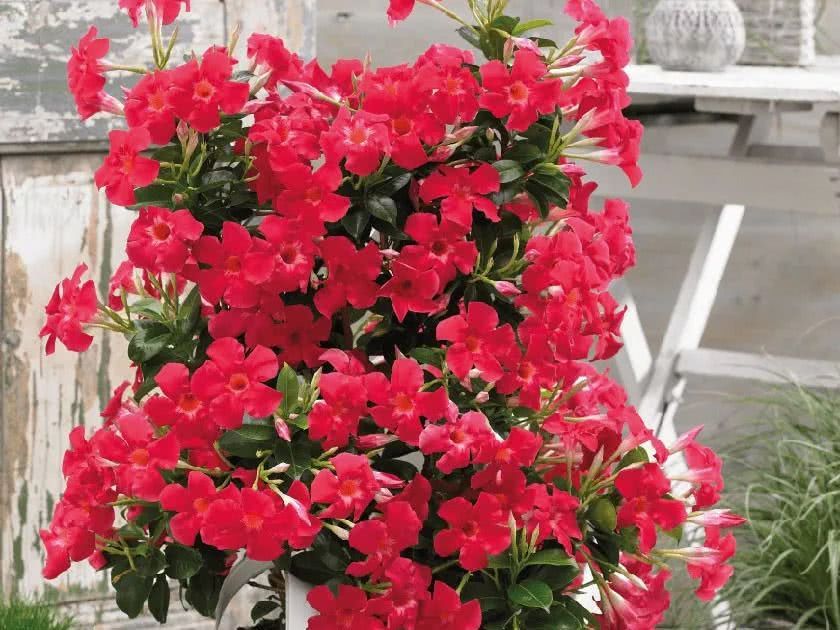
Mandevilla is a very charming tropical climbing flowering plant. It likes to grow in a warm and humid environment all year round, and the growing location must have as much light as possible for it to bloom well. It can not only be planted in the yard, but is also very suitable for pot cultivation. You can even grow it indoors.
Some people also like to grow mandevilla as a climbing flowering plant, or hang it on a windowsill to turn it into a charming hanging basket plant. If you want mandevilla to stay in bloom all year round, you need to pay attention to the following points.
1. As much light as possible
It can also grow vigorously in partial shade, but then its leaves will grow excessively and the flowers will become fewer and fewer, or it may even fail to bloom.
The advantage of growing mandevilla in a pot is that it can be moved around freely, and you can move it to the sunniest spot.
For potted mandevilla, if the summer temperature is too high and the sunlight is too intense, it should be properly shaded at noon.
2. Watering precautions
Mandevilla has a slight tolerance for drought, but this does not mean that potted mandevilla can be left with dry soil all the time.
The soil for growing mandevilla must have good drainage. In spring and summer, the soil can be kept moist, but waterlogging should be avoided. If the soil becomes waterlogged, it can easily cause root rot. Before watering mandevilla, be sure the soil has dried out completely, and the growing location should be well ventilated and have light.
When watering, try not to pour water on the leaves. Be sure to water slowly so the soil absorbs enough water.
3. Choosing pots and soil
When growing mandevilla, be sure to choose a flower pot and soil with good drainage. The container should not be too large, otherwise it can easily cause waterlogging and root rot. The flower pot chosen should not be too deep either; you can choose a slightly wider and shallower pot for growing it.
For growing mandevilla, choose slightly acidic, fertile, loose sandy soil. You can appropriately add some slow-release organic fertilizer to the soil, and properly mix in river sand or perlite to maintain good drainage.
4. Proper fertilizing
When caring for mandevilla, pay attention to regularly replenishing fertilizer. In spring and summer, you can add a slow-release organic liquid fertilizer once every 1 to 2 weeks, and the concentration must not be too high. After the weather starts to turn cool in autumn, gradually reduce the frequency of fertilizing, and stop fertilizing in winter.
5. Overwintering care
Mandevilla is a tropical flower. If the minimum temperature where you are is below 5 degrees, you need to move it indoors for the winter. Avoid keeping it below 4 degrees, otherwise it is prone to cold damage. Mandevilla moved indoors can be grown beside a windowsill with more light.
Mandevilla grown indoors should be protected from cold damage. In late autumn, you can properly prune the branches and leaves, stop fertilizing, and appropriately control watering.
If the air is relatively dry, you can spray water around it to maintain a certain level of air humidity.