Exploring the Origins of Mono no Aware in The Tale of Genji (Part 2)
By: DaDa
"Mono no aware" originated in the aristocratic culture of the Heian period and is an important concept running through traditional Japanese culture and aesthetic consciousness. The Japanese scholar Motoori Norinaga pointed out in his Genji Monogatari Tama no Ogushi: "The way of waka can be summed up in the single phrase 'mono no aware.' From the age of the gods down to the present, and on into the endless ages to come, all waka can be encompassed by this one phrase."
Starting from the artistic expression of literature and the reader's aesthetic reception, and combining this with an appreciation of the thought and art of The Tale of Genji, Motoori Norinaga put forward a relatively systematic theory of "mono no aware."
First, he gave a fairly precise explanation of the literal meaning of the term "mono no aware." "Mono" refers to the things spoken of, the things told of in the tale, the things seen in life; it is a general term. "Aware" refers to the sigh of emotion uttered when what one sees and hears stirs the heart. Second, he clarified the diversity and subjectivity of the emotion of "mono no aware." "Aware" is not limited to sorrow; it also includes other emotions, "grief, melancholy, longing, moving one to the depths."
Third, he emphasized that the core emotional expression of "mono no aware" should be love. "The many circumstances of human life are all revealed in love: bitterness, sadness, resentment, anger, delight, joy, and so on are all present. If love were cast aside, then the many subtle and profound aspects of human feeling, and the true essence of mono no aware, would all be difficult to reveal." Fourth, he further proposed the theory of "knowing mono no aware": "As for things, what is good is good, what is bad is bad; what is sad one feels as sad, what is sorrowful one feels as sorrowful. To understand and savor these things is called knowing mono no aware."
From then on, "mono no aware," as a special aesthetic mode and literary-artistic characteristic within Japanese aesthetic thought, was largely fixed and has been used ever since.
In Shibun Yoryo, Motoori Norinaga held that among all human feelings, the most unforgettable is the love between man and woman. Within love, what most enables people to feel "mono no aware" and to "know mono no aware" is transgressive, illicit love, that is, "irogonomi" (amorousness). "Nothing better embodies human feeling than 'irogonomi.' Thus those who are 'amorous' are the most deeply moved and know 'mono no aware' best." The vast majority of the main characters in The Tale of Genji are "amorous" people, all involved in illicit love, including incest, seduction, adultery, rape, and promiscuous affection, and the longing, yearning, excitement, anxiety, self-reproach, worry, sorrow, and pain that arise from these are all precious human feelings. So long as they come from true feeling, they are beyond reproach, all belong to "mono no aware," and can all enable the reader to "know mono no aware."
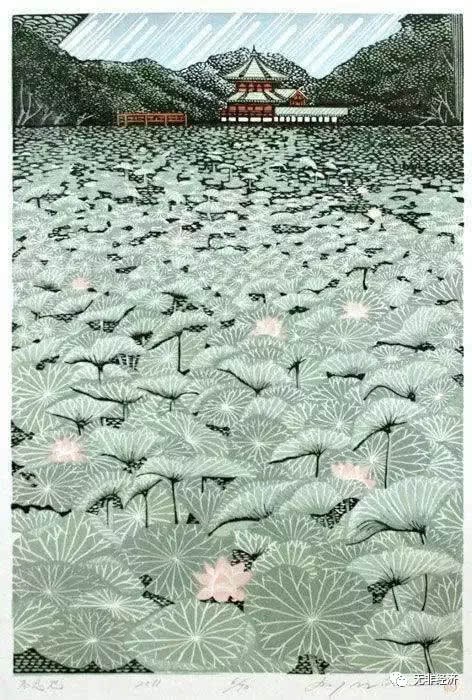
It may appear that The Tale of Genji takes delight in talking about transgressive love, but that is not an appreciation or exaltation of transgression; it is for the sake of expressing "mono no aware." He gives an example: accumulating mud and dirty water is not for the sake of appreciating that mud and dirty water, but for the sake of planting lotuses. If one wishes to appreciate the beauty of the lotus, one cannot do without mud and dirty water. Writing of transgressive, illicit love is like accumulating mud and dirty water, in order to obtain the beautiful "flower of mono no aware."
Therefore, in The Tale of Genji, those morally flawed, guilty, heterodox "amorous" people are all good people who "know mono no aware." For example, Genji is amorous by nature all his life, repeatedly defying convention, yet enjoys wealth and honor throughout his life and receives the honorific title of "Retired Emperor." By contrast, those moral guardians are written as villains who "do not know mono no aware." So-called rewarding good and punishing evil means writing that good has good reward and evil has evil punishment, so as to rouse a sense of warning in the reader, and The Tale of Genji could never become a warning against amorousness. If one reads The Tale of Genji with a mind to admonition, then the feeling of "mono no aware" will be obscured; thus didactic theories are the "demon obstacle" to understanding The Tale of Genji.
We can see that the fate of the women in The Tale of Genji offers only three choices: either enter the grave and have done with it, or take the tonsure and become a nun, severing all worldly ties, or keep watch alone in an empty chamber, alive yet as if dead. The calamity-laden fates of these women, like the life experiences of Genji, reflect Murasaki Shikibu's aesthetic characteristic of feeling things and grieving.
The tragedies of the women in The Tale of Genji are sometimes caused by the marriage system, and sometimes imposed upon themselves by women bound by feudal ethics; their tragedies move one to sympathy, and also make one angry at their failure to resist and their failure to awaken. The criminal marriage system, women's self-enslavement... these all caused the tragedies of vast numbers of women in the feudal era. Although the causes of these women's unhappy fates differ in emphasis, their tragedies also share a common root. Not only the women under Murasaki Shikibu's pen, but even Murasaki Shikibu herself, could not escape the tragic fate imposed on them by the times and social tradition.
The seventeen-year-old Hikaru Genji's stunning dance "Seigaiha" at the flower banquet. With red leaves adorning his head, he danced brilliantly in all directions, and red leaves fell amid the graceful song. So extreme was the beauty that it even made one shudder. Radiant as that, resplendent as this, the dancing figure of the Shining Prince made one dizzy and ready to weep. In an instant, the reader's heart too cannot help but feel a sense of loss. Mapped onto the reality of the Heian period, this is just as Ienaga Saburo evaluates Hikaru Genji in A History of Japanese Culture: "Even a superhuman figure like Hikaru Genji, whose appearance, birth, status, and talent all far surpassed ordinary people, in the face of unchangeable fate ultimately appears pale and powerless." That Fujiwara no Michinaga, once called the "model for Hikaru Genji," that triumphant court noble who once recited at a banquet, "This world is my world, like the full and flawless moon," when his daughter was about to give birth, could do nothing but pray desperately for a boy to be born. This is the sorrow of that society. It is also the "mono no aware" of that era.