Soaring Momentum and Proud Bones with a Striking Framework: An Exploration of the Unique Formative Aesthetic of Jing-Chu Pine Bonsai
High Mountains and Flowing Water
Yuefu
Instrumental
00:00/03:31
Soaring Momentum and Proud Bones with a Striking Framework
-- An Exploration of the Unique Formative Aesthetic of Jing-Chu Pine Bonsai
Original Author | Zhu Liangzheng, Jingzhou, Hubei
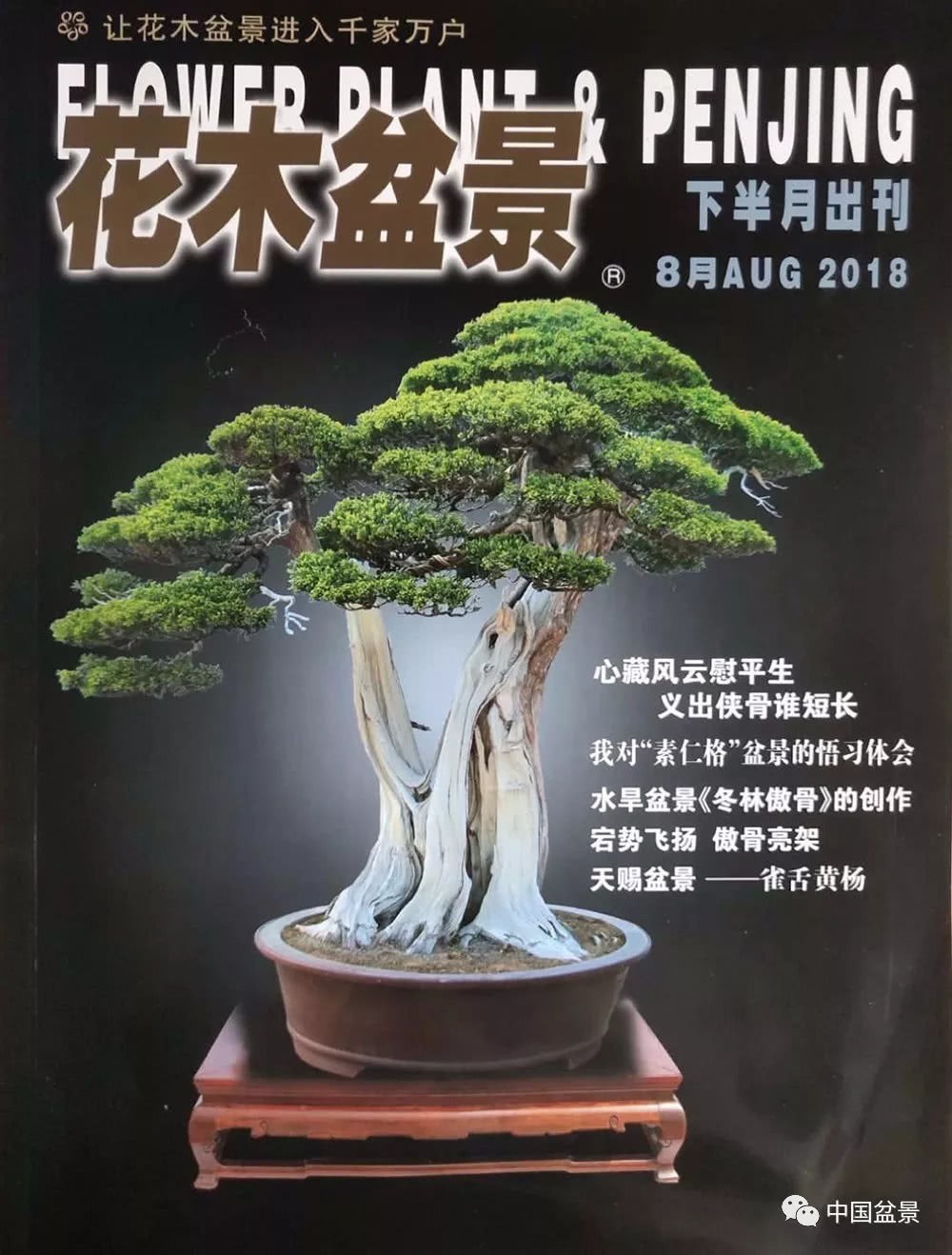
This article is an original submission by Mr. Zhu Liangzheng, first published in the August 2018 second half-monthly issue of "Flowers, Trees and Bonsai" magazine
Pine trees have always held powerful influence and extremely high ornamental value in our country. The qualities of the pine -- majestic and vigorous, ancient and singularly refined, elegant and graceful, ethereal and towering -- have been revered and worshipped by people of every generation. The anthropomorphized personal charisma of the pine occupies a very high position in the spiritual realm, to the extent that scholars appreciate the pine, poets chant of the pine, painters depict the pine, and bonsai enthusiasts cultivate the pine.
Title: Soul of Chu-Heaven Pine
Species: Black Pine
Specifications: Height 90CM
Author: Zhu Liangzheng
Because the pine has coiled roots like dragon claws gripping the earth, a vigorous and ancient trunk that twists and turns with change, rigid branches like deer antlers and crab claws with cadenced rhythm that defy frost and snow, and especially tough needles unlike the leaves of other trees, it is deeply favored by bonsai practitioners and has become one of the flagship species of bonsai. As a result, enthusiasts are growing ever more numerous. I have visited bonsai gardens such as Tangyuan in Xi'an, Suiyuan in Suzhou, and Shanmao Caotang in Wuhan, and every one of them has no shortage of fine pines. It is worth noting that each region has explored and established a unique local style based on its own historical and cultural origins and local characteristics. For example, in Guangdong, Han Xuenian dissolved the concept of wild cursive calligraphy into pine tree styling -- like wielding a wolf-hair brush on raw xuan paper, with startled cliffs and ancient vines beneath the brush, coiling and transforming into dragons, leaving one absolutely amazed. In Anhui, Fan Shunli's pine-crafting techniques are profound and refined, his artistry subtle and penetrating, the finished pine conceived in his mind yet unified in form and spirit, his excellent works rewarding careful and repeated appreciation. In Zhejiang, Wang Haiping selects material that is solitary, lofty and upright, brimming with ancient spirit; his pines have tall trunks with swept branches, their momentum like a feathered arm dragging a blade, possessing an awe-inspiring, unassailable presence -- his works are transcendent and extraordinary, full of true pine flavor...
Title: Dragon Boat Racing on the Chu River Bank at Duanwu
Species: Red Pine
Specifications: Height 40CM, cascade length 100CM
Author: Zhu Liangzheng
On our Jing-Chu land, those who love pines and create pine bonsai are everywhere. The Jing-Chu region is where north and south converge, and various styles and schools exchange and collide here -- stars in multitudes, impossible to distinguish one from another. Consider the State of Chu through the Spring and Autumn period, vast and mighty for eight hundred years -- Chu ci poetry, bianzhong bells, silk and lacquerware, broad and profound, with brilliant ancient relics. Then look at today's Jing-Chu: great Wuhan, thoroughfare of nine provinces, a flourishing metropolis; great Jingzhou, ancient city of the fire phoenix, pearl of the Jianghan Plain. With such historical prominence and present-day brilliance, among the hundred arts of many schools, every artistic category should march to the rhythm of the Jing-Chu era and bear the imprint of Jing-Chu civilization. Therefore, among the many pine styles and schools of Chinese bonsai, there cannot fail to be a unique style of Jing-Chu pine. Today's Jing-Chu lovers and creators of pine bonsai cannot but take this as their own mission. As one of them, I must practice it personally -- it is an inescapable duty.
Title: Jing Song and the Graceful Chu Waist
Species: Red Pine
Specifications: Height 85CM
Author: Zhu Liangzheng
"Jing has tall pines, ornamental catalpa, yellowtooth oak, nanmu, and camphor, while Song has no tall trees -- this is like brocade and embroidery compared to short coarse cloth." (Mozi, Gongshu). "The person in the mountains, fragrant with pollia, drinks from the stone spring and rests in the shade of pines and cypresses." (Qu Yuan, Nine Songs). The Jing-Chu land has had luxuriant pine forests since ancient times. I was born here and grew up here. I grew up in the mountains and fields -- open the door and see the mountains, raise your head and see the pines. In my youth I spent my days and nights in the company of mountain pines, drinking pine dew at dawn, admiring pine shadows at dusk, listening to the wind in the pines, watching the pine's bones in the snow. My family had East Woods and South Mountain, both primeval forests of ancient pines. By the roadside of Pangu Village on the border with Yichang, there was a great pine that five people with arms outstretched could barely encircle. Every time I came home and saw this pine, so vigorous and towering, with the air of a sovereign ruling all under heaven, I was deeply shaken. Unfortunately, at the end of the last century, a restaurant opened beneath that tree, and this pine was destroyed by smoke and fire. "Long have I known that painting is no ordinary matter; everywhere, clouds and mountains are my teacher." (Yuan dynasty, Zhao Mengfu, "Layered Mountains in a Verdant Forest"). Learning from creation, learning from nature -- the precious land of Mount Jing where I was born and raised, and its richly endowed pine resources, are the natural foundation for our creation of a unique Jing-Chu pine style.
Title: Flying Clouds over Mount Jing
Species: Red Pine
Specifications: Height 90CM
Author: Zhu Liangzheng
"In human history, painting has always developed along with the development of society. The development of society as a whole drives and determines the general trend of painting's development -- this is an objective law of painting's development. In addition, painting also has its own tradition and the historical continuity of its development -- this is the internal law of painting's development." (Zhou Jiyin, "Chinese Painting Theory: The Chapter on Inheritance"). Therefore, inheriting the cultural tradition of Jing-Chu, taking the traditional artistic aesthetic principles of Jing-Chu as our foundation, absorbing the essence, and making the ancient serve the present -- this is the focus of our creation of a unique Jing-Chu pine style. Today, as we study the cultural origins of Jing-Chu and summarize its many cultural characteristics, among them "pursuing novelty and chasing the extraordinary," "incorporating all and accommodating everything," and "soaring momentum" are the three important principles we must inherit today.
Title: Misty Rain over the Chu Gorge
Species: Red Pine
Specifications: Height 95CM
Author: Zhu Liangzheng
"Whimsical, strange, and bizarre" (Zhuangzi, On the Equality of Things), "startling splendor and unmatched beauty" (Wenxin Diaolong, Discriminating Sao) -- this is the mainstream style of Chu art: first, it is new; second, it is strange. So new as to be inconceivable, so strange as to be nearly indescribable, leaving people astonished. In my many years of pine bonsai styling, I have continually reflected on and explored the principles of forming a pine, and have understood and applied these principles in an accessible way, arriving at the following insights: the roots and trunk of a pine depend on selection, while the branches and foliage depend on cultivation. This is because the roots and trunk are mostly innate and can only be chosen with a discerning eye, while the branches and foliage are acquired and must be brought into being through the rules and skills of styling. The pine's own law is that old branches must droop and an old crown must be round -- this natural law must be followed. Furthermore, coiled roots must grip the earth, and an upright trunk must follow the momentum. In actual practice, one first selects the stock: the trunk must be vigorous and forceful, with variation and rhythm; it must bend without being vulgar, be straight without being dull, be tall without being precarious; when it changes, it follows the momentum. As described in "Chu Ci: Great Summons," "a small waist and graceful neck" -- the beauty of curves in Chu aesthetics, reflected in the styling form, gives a nimble and vivid visual effect.
Title: Qu Zi's Heavenly Questions
Species: Red Pine
Specifications: Height 70CM, cascade length 85CM
Author: Zhu Liangzheng
Now to discuss "incorporating all and accommodating everything." Because of its own position, Jing-Chu is easily influenced by both north and south, and among these influences there is both artistic essence and vulgar dross. As mentioned earlier, a group of Chinese pine bonsai creators have produced works with a style both ancient and singularly refined, combining ancient spirit and painterly quality, which can be borrowed for bonsai composition. The modern aesthetics master Zong Baihua pointed out: "Chinese painting takes line composition as its primary form of expression, while Western painting takes mass structure as its primary form of expression." Some Japanese pines flood our pine circles. A whole tree with only a few green masses, layered and bloated, stiff and clumsy, with trunk and branches entirely hidden, a lump of fog -- there is no pine flavor to speak of. Japanese pines and our style are utterly different and do not conform to our country's aesthetic tradition. Moreover, although there are many mature artistic styles across the country worth learning from, due to the constraints of regional environment, local customs, and cultural tradition, they cannot be copied wholesale. Our method of learning can only take the form of sketching, not the form of photographic reproduction. Dynamically selecting and discarding, removing the dross and keeping the essence -- this is the magic weapon by which Jing-Chu pine establishes itself in the bonsai world.
Title: Chu-Heaven Frosty Dawn
Species: Black Pine
Specifications: Height 90CM
Author: Zhu Liangzheng
"Soaring momentum, proud bones, striking framework" -- the framework is an extremely crucial link in styling, for it tests the author's compositional method and artistic conception, and must be mastered conscientiously. "Wangshu ahead as my vanguard, Feilian behind as my follower; the luan and phoenix as my outriders, the Thunder God telling me nothing is ready. I bid the phoenix bird fly and soar, following on with the sun and moon." (Qu Yuan, Li Sao). The artistic conception of the Chu people is wild, free-spirited, and untrammeled -- they could "drive flying dragons," "mix with jade and ivory," "raise clouds and rainbows," and "sound jade luan bells." In creating Jing-Chu pine, this must be given concentrated expression. First, handle the drooping of the main branch -- it must have a soaring, vigorous force, distinct rhythm, soaring spirit, and strong sense of motion. Ascending branches like deer antlers, drooping branches like crab claws. In arranging branches, one must have the formed pine in mind: lengths must differ, thicknesses must be distinguished, density must be ordered, every branch must vary, and they must echo one another. The needles must be short, sparse, and tough, revealing the branch and fork framework and bringing out the dynamic framework. Through such framing and momentum, "one shifts the 'truth' of depicting realistic form to the 'truth' of seeking the spirit of the object through qi-yun and brush-and-ink." (Luo Yiping, "Creation and the Mind's Source"). Then, the qi-yun and spiritual transmission that the Jing-Chu style must shift to is this: using the pine's qualities of vigor, proud bones, and grandeur to express the spirit of the Jing-Chu people -- "blazing a trail through wild lands to open up the mountains and forests."
Title: Jing-Chu Fire Phoenix
Species: Red Pine
Specifications: Cascade length 130CM
Author: Zhu Liangzheng
"Pine is most easily made craftsmanlike, and most difficult to imbue with scholarly spirit." (Yuan dynasty, Ni Zan, "Yunlin Painting Manual"). In the text, "craftsmanlike" means artisan air, while "scholarly spirit" refers to the bearing of the educated person of that time. "Craftsmanlike" and "scholarly spirit" are two opposing sides. Here I reason that "scholarly spirit" corresponds to three aesthetic theories: qi-yun, spiritual transmission, and rhythm. In my understanding, qi-yun, spiritual transmission, and rhythm are a trinity whole -- they are interrelated yet each has its own emphasis. Qi-yun mainly emphasizes the dynamic momentum of the object; spiritual transmission mainly emphasizes the spiritual dimension of the subject; rhythm emphasizes the sudden transformation of things. When the sudden transformation of the composition occurs, rhythm organically integrates the three, combining the abstract momentum and spirit into a rhythm most easily accepted, thereby transforming into a wondrous dynamism and emotional core. If pine styling can fuse qi-yun, spiritual transmission, and rhythm into one tree -- as Su Shi evaluated Wang Wei, "there is painting within poetry, and poetry within painting" -- then our Jing-Chu pine style will reach the height of perfect mastery and consummate excellence. This is precisely the Jing-Chu pine dream that Jing-Chu pine creators tirelessly pursue. I am searching high and low in this direction, seeking extraordinary pines everywhere, and have built my own "Hundred Pine Garden." After more than ten years of effort, the pine garden has taken modest shape -- one can already see pine bones and catch glimpses of pine wind. Just look at "Soul of Chu-Heaven Pine" in the Hundred Pine Garden, with soaring momentum and ancient proud bones; "Jing-Chu Fire Phoenix," spreading wings and calling long, touching the heavens with celestial music; "Flying Clouds over Mount Jing," with wild brushstrokes piercing clouds and breaking mist; "Qu Zi's Heavenly Questions," daring to question Jing-Chu and behold its elegance... There are also a batch of pine bonsai with Jing-Chu cultural characteristics as their background, such as "Misty Rain over the Chu Gorge," "Jing Song and the Graceful Chu Waist," "Dragon Boat Racing on the Chu River Bank at Duanwu," "Chu-Heaven Frosty Dawn," "Wind's Pass," and "Xi." Some express the enterprising spirit of the Jing-Chu people through the pine's vigor, proud bones, and grandeur; some celebrate the splendor of Jing-Chu traditional culture; some showcase the magnificent mountains and rivers and the outstanding people of the Jing-Chu land. In 2017, I participated in the "Sixth Bonsai Exhibition of the Famous City of Jingzhou" and won first prize.
Title: Wind's Pass
Species: Red Pine
Specifications: Height 70CM, cascade length 100CM
Author | Zhu Liangzheng
An old steed in the stable still aspires to gallop a thousand li. I am still busy in the pine garden, further perfecting the crafting of Jing-Chu pine bonsai and promoting local culture. This is a work of reflection by an elderly man of Jing-Chu; the text inevitably contains errors, and I respectfully ask for your kind correction.
Title: Xi
Species: Black Pine
Specifications: Height 80CM
Author: Zhu Liangzheng
About the Author:
Highlights Replay:
Chinese Bonsai Welcomes You!
Enjoyanytimethe bonsai exhibition hall
Promote bonsai culture, exchange bonsai techniques!
Appreciate bonsai art, share a happy life!