The Beauty of Rust: Landscape Designs That Get More Beautiful the More They Rust
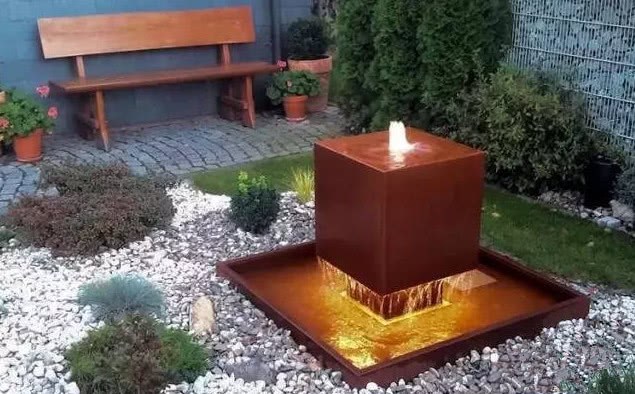
In landscape design, you can often see a material whose surface is a layer of rust-red substance, very rough to the touch, with a very distinctive texture. It does not look out of place, and even combines perfectly with plants. In the contrasting combination of rough and delicate, cold and warm, soft and hard, it condenses into a rich design context. Its name is weathering steel!
Weathering steel, also known as corrosion-resistant steel, originated from Corten steel in North America. It is a series of low-alloy steels between ordinary steel and stainless steel. Weathering steel is made by adding a small amount of corrosion-resistant elements such as copper and nickel to plain carbon steel. It has the toughness, ductility, formability, weldability and cuttability, corrosion resistance, high-temperature resistance, fatigue resistance and other properties of high-quality steel.
As early as the beginning of the 20th century, some avant-garde artists abroad used steel for sculpture creation. Since steel rusting is a natural state of the material itself, it fits very well with the principle of truthfulness in artistic expression. Over time, steel became one of the materials in modern landscape sculptural art design. After ordinary steel rusts, it will gradually corrode and age until it breaks down. The emergence of weathering steel has given designers the opportunity to make full use of the rusted form of steel for expression in sculptural art creation.
Weathering principle:
Rusting under natural climate conditions causes the steel material to form a dense oxide layer between the rust layer and the substrate. Because of the presence of this dense oxide film, oxygen and water in the atmosphere are prevented from penetrating into the steel substrate, thereby improving resistance to atmospheric corrosion.
Features of weathering steel:
1. Rust-resistant and corrosion-resistant, with atmospheric corrosion resistance 4-8 times higher than that of ordinary steel.
2. Steel components have corrosion resistance and extended service life, reduced thickness and consumption, saved labor and energy (weathering resistance is 2-8 times that of plain carbon steel).
3. Green and environmentally friendly. No initial coating is needed (in severely polluted atmospheres or areas that are not especially humid); it can reduce the use of fireproof coatings and fireproof cladding, thereby reducing pollution, shortening the construction period, lowering costs and reducing maintenance. It is an economical type of steel with "green environmental protection" and sustainable development.
4. The material can be recycled and reused, making it very low-carbon and environmentally friendly.
Design applications of weathering steel in landscapes:
1. Outstanding visual expressiveness. Rusted steel plates change over time. Their color brightness and saturation are higher than those of ordinary structural materials, so they stand out easily against the background of garden plants. In addition, the rough surface produced by steel plate rusting gives structures a greater sense of volume and mass.
2. Distinct spatial definition capability. Because steel plates have great strength and toughness, they are not subject to as much thickness limitation caused by structure as brick and stone materials. Therefore, very thin steel plates can be used to divide space very clearly and accurately, making the site concise and lively while full of power.
3. Strong form-shaping capability. Like other metal materials, rusted steel plates are relatively easy to shape into richly varied forms and can maintain excellent integrity, something that wood, stone and concrete all find very difficult to achieve.
4. A language of changing time. Rusted steel plates change over time, and their color is greatly affected by the environment and climate. After being placed for a long time, they easily change from bright reddish-brown to dim dark blue-gray. As they age with time, the aesthetically rich unique color and texture of weathering steel can express a distinctive artistic charm. It can trace the historical sense of a site, record the instantaneous sense of time, extend the vitality of the site, allow limited materials to "coexist" with one another, and reflect a sustainable design view.
In addition to being applied to building structures and building facades, weathering steel can also be seen in landscape architecture, retaining walls, landscape bridges, steps, sculptures, wayfinding signs, planting beds and other landscape features.