A Random Talk on the Appreciation and Creation Experience of Penjing
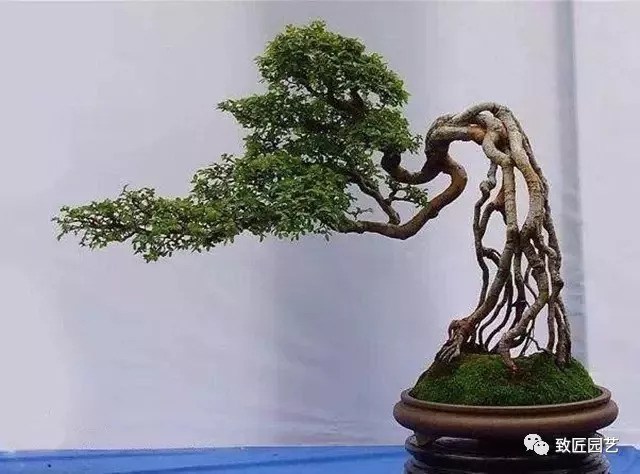
Appreciation can extend and develop the artistic conception of a work, and conversely it can also enrich and enhance one's capacity for appreciative insight. Therefore it can be said: without appreciation, how can there be creation? In view of this, this article discusses a few observations on some phenomena in the appreciation and creation of tree-stump penjing.
Phenomenon one: "An inch of branch grows over several years; a fine scene is only completed after ten autumns." This shows how arduous penjing creation is. Yet in this long creative process, even a master who has conceived the idea first and has a fully formed plan in mind finds it hard to get it right in one step, and "reworking" is unavoidable. Even the great Japanese penjing master Masahiko Kimura was no exception; otherwise, why would one of his fine Chinese junipers (Juniperus chinensis) have been 80cm tall in 1984 and yet have dropped to 68cm in height by 1994?
Appreciation and creation advance each other, complement each other and bring out the best in each other. In fact, there is no creation without appreciation, and still less any appreciation without creative practice; there is only a difference in the level of appreciative insight, a difference between conscious and unconscious discernment and enjoyment, quietly influencing the whole of creation. On the one hand, through appreciation one perceives the workings of nature, draws on tradition, and absorbs the creative methods and stylistic traits of predecessors or peers, so that one moves from the exploratory stage of imitation and production to creative practice that proceeds category by category and step by step; on the other hand, as creative practice is explored and studied and as experience deepens and accumulates, one's appreciative insight is enhanced. Alternating again and again in this way and advancing layer by layer, the two gradually move toward high taste and a high realm. In other words, their development is a process of continual adjustment and ascent. If we think calmly, we will find that the process from the first stirring of interest in stump penjing--imitation and production--creative conception--the birth of an outstanding work generally follows this pattern: people first begin with the appreciation of flowers and trees in nature and develop a liking for growing and enjoying them in pots; next they follow what others say, imitating step by step in competition with one another; then they select a certain school's style, methods and modeling traits that suit their own interests as a model for production; then they make horizontal choices and dig vertically deep, broadly adopting the strengths of many, and working according to the material to create works that express artistic individuality; finally they grasp the connotations and aesthetic implications of outstanding works and, with a discerning eye and original ingenuity, achieve the highest artistic conception of the work.
Phenomenon two: in penjing appreciation, some viewers linger and forget to leave, while others glance at the flowers while riding past; in penjing creation, some creators advance day by day, seeking artistic individuality as they break free of the self, while others stagnate, trapped in a strange loop set by the "self" until their artistic creativity dries up.
The mindset of the appreciator constrains artistic creativity. For the stump-penjing creator, appreciation is not merely a noble spiritual activity that entertains body and mind and purifies the soul; more importantly, through such activity one broadly adopts the strengths of many, fosters strengths and avoids weaknesses, and continually raises one's artistic cultivation, hoping to accumulate deeply and then release it to create outstanding works. In fact, however, not everyone can do this. In appreciation we often, consciously or unconsciously, "divide into two": on one side our own works; on the other side the works of others beyond ourselves. This leads to different thoughts and feelings and to a bias in appreciative mindset, giving rise to different appreciative behaviors and their effects. The first manifests as "promoting the many and suppressing oneself," placing one's own works "behind," and, with sincerity toward art and the pursuit of it, adopting a mode of observation, imitation and appreciation characterized by seeking, exploring and exchanging. Such a mindset undoubtedly breeds utter sincerity and objectivity; facing the object of appreciation, one inevitably stops and lingers, gazing in concentrated appreciation, and whether partial or whole, composition or rules, technique or artistic conception, all are comprehensively and synthetically brought into the scope of appreciation--such things as imagery and conception, tree form and structure, modeling proportions, execution of technique, stylistic traits, implications and mood, and so on--while striving to seek meaning beyond the pot and images beyond the scene, so that one can understand inwardly, find a source for what is excellent and a reason for what is poor, and thus fulfill the original purpose of appreciation. The second is the opposite, "promoting oneself and suppressing the many": only my own is beautiful, only my own is best, and toward others' works one shows carelessness, "glancing at the flowers while riding past," calling it appreciation while in fact going against it. The former is healthy and upward, and its latent artistic creativity is fully mobilized, full of vitality, able to bring into play appreciation's capacity for re-creation; while the latter is rigid in thought, stagnant, treating the practice of the exploratory stage as an eternal law. Or one travels the familiar road, becoming urbanized, formulaic and conceptualized; over time this will ultimately lead to the drying up of artistic creativity, so the emergence of two utterly different phenomena is not surprising.
Phenomenon three: in the appreciation of works, although some tree species and stump material are of superior quality, the works they yield give the impression of being completely transparent at a glance; while some stump blanks, though unremarkable, produce works whose artistic effect leaves one with endless aftertaste. Grasping the artistic component can stimulate the awakening of creativity in the appreciator. In reality, there are many appreciators whose scrutinizing gaze focuses on the merits of the stump blank and neglects the artistic effect. They little realize that the artistic value of a stump penjing lies not in whether the variety is rare and precious, nor in the merits of the stump blank or the size of the potted tree, but in the level of the author's artistic attainment. Obtaining a good stump is 50% of success; adding 50% of later craftsmanship makes this 100% ideal, of course, but an ordinary stump blank that can become a fine work is even more commendable. Making an outstanding work from mediocre material depends on discovery and on creation. For example: the elegance, clarity and spareness, the proud aloofness of the late Su Ren, setting out a plain and simple "life"; the well-measured density and soaring dynamism of Master He Gansun, opening up a "world" of life; the sparse grove and fine water, the tranquil freshness of Master Zhao Qingquan, creating a quiet "world." Looking across the stump blanks in the masters' works, they are not necessarily what we ordinary people would regard as superior material. Yet the works are of the highest grade. The key lies in bringing forth the new from the ordinary, seeking the extraordinary in the ordinary, displaying skill in the ordinary, and lending charm in the ordinary, truly embodying something uniquely one's own, with the eye reaching, the skill reaching, the heart reaching, the feeling reaching, the meaning reaching and the charm reaching. Whether in form or in content, all is determined by the accumulation of deep-level artistic cultivation. Therefore, we hold that in appreciation one should not keep one's gaze fixed on the merits of the stump blank and fall into the mistaken zone of a narrow, one-sided view. Instead one should base oneself on the unity of the object of contemplation, that is, on the consistency between the work and the stump blank itself. In this respect, penjing art differs from fine art, calligraphy and other arts in the basis of their creative materials; because of differences in the merits of stump blanks, stump-penjing authors cannot all start from the same starting line. From this angle, the artistic standards for stump-penjing works are relatively vaguer, and this also gives rise to muddled understanding. Obtaining an excellent stump blank, one assumes it is a fine piece, not realizing that this good stump is bestowed by nature and not the achievement of the author's artistic cultivation and skill. Any fine piece has both a natural aspect and an artistic aspect. From the standpoint of artistry, limitations of conditions can better manifest the artist's creativity. Therefore one should see the essence through the phenomena and base oneself on the artistry of the work itself rather than the stump blank; that is, the appreciator can only discern and enjoy that particular work, giving play to appreciative creativity, and, according to the aesthetic constitutive factors of stump penjing, unfold a re-conception of the ideal aesthetic image and compare it with the object of appreciation. As the saying goes, only with discernment is there enjoyment; while stimulating and enhancing the re-creative capacity of the appreciating subject, one also understands that the emergence of the above phenomena is no accident.
Phenomenon four: works by authors of the same era leave utterly different impressions on later generations, as in literature, where some images are vivid, lofty and enduring, while others are blurred and dim, like passing clouds. Penjing art is no exception. The author's appreciative psychological orientation determines the level of creative taste. The above relationship between appreciation and creation and a healthy appreciative mindset are merely the conscious initiative and optimization of a good beginning in the structure of appreciative psychology, not appreciative aesthetic psychology itself; aesthetic psychology is a process of deduction accumulated day by day, gradually tending toward perfection in the course of that deduction. As far as stump penjing is concerned, its appreciative aesthetics carries the supra-sensory realization found in Chinese painting and calligraphy art. Besides the aesthetic power of the stump-penjing work itself, which can induce and purify, the appreciator also needs a combined force formed jointly by aesthetic perception, emotional affinity, imagination and understanding. How strong these abilities are means how deep the appreciation is; how deep the appreciation is means what taste creation pursues. Although stump penjing is akin to painting and calligraphy art and linked by a single thread to garden art, each art has its own limitations and aesthetic requirements, so one must begin from the essential characteristics, composition and rules of penjing and master the factors that constitute its aesthetic category: technique--modeling--artistic conception--spirit and charm, and so on, unfolding gradually and penetrating layer by layer. Such things as: the posture type of the main trunk, the positioning and composition of branch supports, the distribution and direction of the root base, the transition and finish of the treetop, the layered combination of foliage, the overall form of the outer silhouette, the configuration of the pot and stand, the embellishing and laying of rocks and moss, the sense of movement and force in the tree's momentum, modeling proportions and rhythm, as well as density and dispersion, gathering and scattering, looking and responding, the mutual generation of emptiness and solidity, the blending of scene and feeling, implication and spirit and charm, and so on. In short, one seeks a harmonious communication between the mind and the object of appreciation, achieving the forgetting of both object and self. Of course this aesthetic realization is not completed in one go; we have all had this experience: some works can be savored endlessly, each viewing bringing new feelings; others are completely transparent, with nothing to recall. On the one hand this shows the quality of the work itself; on the other hand it reflects that the more mature and perfected the appreciator's aesthetic psychology becomes, the closer one draws to the work's implications. While gaining infinite aesthetic feeling, we also acquire the decoding skills of appreciation and quietly influence our creation, so that artistic creativity is potentially vigorous, ready to erupt when opportunity coincides. Therefore, as far as its artistry is concerned, besides external skills such as modeling technique, stump penjing certainly also contains certain deep-level factors peculiar to the artist, such as inner spiritual temperament, quality and cultivation, and aesthetic implication. In view of this, the existence of the above artistic phenomena is not hard to understand.
A journey of a thousand li begins with a single step. Whether creation and appreciation can develop in harmony and advance side by side so that stump penjing truly enters the hall of art requires us to keep learning, practicing, accumulating and improving. Here, we borrow a saying from a Beida person as the closing words of this article, to encourage fellow travelers: "Not knowing that you don't know, knowing that you don't know, not knowing that you know, knowing that you know." (Huang Xiang)
Featured Content