Worried about your checked luggage getting damaged? Here's a Japanese packing method to share
Mid-September has passed,
and the Golden Week holiday is a little closer.
If you're going traveling,
the biggest headache besides planning your itinerary
is probably packing all that luggage.
Generally, for a 7-day trip,
you need to bring 3-7 different kinds of clothing.
(Fox brings 7 pieces, really too lazy to do laundry.)
If you take into account the need for photos at different spots like the beach or ancient towns,
if your clothes aren't packed well,
then on the day you arrive, whether they're wrinkled or scattered all over the place,
it will greatly reduce your travel experience.
Not to mention digital devices getting damaged from rough baggage handling.
Fox's home has 3 suitcases,
20-inch, 24-inch and 30-inch,
of which the 20-inch is the largest carry-on size,
and the 30-inch is the largest free checked size.
But for the amount two people carry on a 7-day holiday,
a single 24-inch suitcase is actually enough.
Today Fox uses the 24-inch as an example.
By the way,
this Japanese ACE suitcase
is the lightest Fox has ever seen.
As for how to fold clothes,
it's easy to find online.
But as for how to organize and arrange a suitcase, there's not much said.
In the past, Fox would often spend ages packing a suitcase,
and when arriving at the destination and opening it, everything would spill out with a whoosh.
Part of this is the rough baggage handling,
and part is the tilting and pulling of the suitcase.
Later Fox learned that a scientific layout can solve this,
in fact a suitcase can be divided into four zones,
and heavy items should all be supported by the part "close to the bottom of the case and the wheels."
"The bottom is the part that takes the most impact when luggage is checked and unloaded,
so fragile or sharp items cannot be placed there."
Generally the lid part of a suitcase has a mesh pocket,
while the bottom part generally has elastic straps.
How do you pack soft clothing?
First is the bottom zone of the suitcase,
because there are only elastic straps,
it's not suitable for storing odds and ends,
so this time Fox uses it to store dresses and jeans.
Besides dresses and jeans, the heaviest zone
can also store coats, books, shoes, hair dryers, folding umbrellas and so on.
This way, when dragging or carrying the luggage,
"scattering and damage due to gravity" won't happen.
Here there are only shoe bags,
and the shoes haven't been packed in yet.
(Won't bring ones that are too big.)
The popular clothes-folding methods online,
include the three-point folding method, the sock folding method and so on,
Fox uses the roll-up folding method,
on one hand it saves space,
on the other hand rolling is less prone to wrinkles than folding.
Won't go into detail about the folding methods here,
what to note is that "for T-shirts it's best to first fold a layer of the hem,"
so that when rolled up it can be flipped over the hem and tucked in.
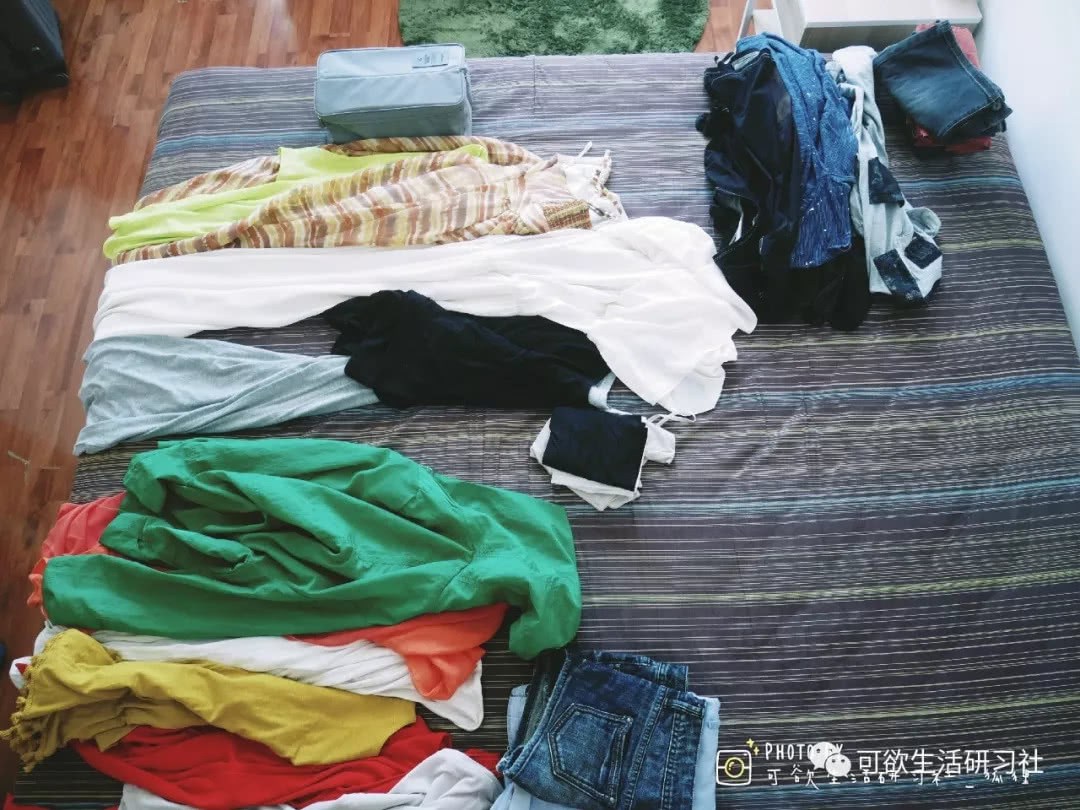
Like Mrs. Fox, who needs to bring lots of dresses, chiffon dresses essential for the beach, etc.,
although they can't be tucked into the hem,
they can still be "arranged upright" in the clothing storage bag.
In the past Mrs. Fox would fold them in order,
for example if on the third day she was going to the beach,
she'd schedule that outfit for the third day,
then fold them and take them out layer by layer.
But once something unexpected happens like rain or not being able to fit it in,
it still easily gets messy.
Straight men's clothes are easy to deal with,
all T-shirts...
But they still can't just be stuffed under the heavy items,
because they're lighter than jeans, dresses, etc.
The amount of pants is much less than clothes,
and they can also be rolled up the same way and tucked into the waistband.
Some people might not understand,
why is it said that rolling into a long strip saves more space?
Actually the benefit is that when the suitcase really can't fit anything more,
you can use the edges and corners, especially the dead space, to store clothes.
After adjusting this way, half the space can be freed up.
via ta-bi.net
Another benefit is that, like an egg white wrapping an egg yolk,
you can turn the clothing into a buffer layer,
to protect cosmetics and electronic devices.
But Fox doesn't really like clothing being exposed,
so didn't do it this way.
How do you pack electronic devices and toiletries?
There are quite a lot of toiletries and odds and ends.
Although not as heavy as dresses or coats,
they're still much heavier than T-shirts,
so they should be packed close to the wheels,
otherwise "heavy items squeezing and damaging clothing" can happen.
Next to the toiletry bag there are also electronics like chargers.
Cameras, e-readers and other digital devices are all carried on you,
so there's no particular need to pack them in the suitcase.
If you need to bring a laptop, please pack it in the upper layer as much as possible.
An article a few days ago mentioned that Mrs. Fox brings lots of disposable items when going out,
like disposable bath towels, sleeping bags, underwear, toilet seat covers and so on,
all of which can be placed in this zone.
Disposable face towels and bath towels,
along with toothbrushes, cosmetic samples and so on,
are stored in the toiletry bag.
When you get to the hotel, just hang it up with a suction cup hook.
Although they're all disposable items,
by sorting them by usage scenario in advance,
you won't be in a rush when using them.
Considering Mrs. Fox likes to do her makeup in the bedroom,
this time Fox specially chose a toiletry bag that can stand on a desk.
Last are the folding slippers mentioned before.
Although since it's not time yet there are still some things that can't be put in,
the basic framework is just this simple.
When you arrive at the destination and put on the slippers,
you can grab whatever you want right away,
with not a single item pressed underneath.
This article is original by Keyu Life Study Group,
please indicate the source when reposting.
Follow Keyu Life Study Group
to learn more about desirable goods and Japanese-style life proposals.