After a succulent leaf cutting sprouts, how should the old leaf be handled so the new sprout can grow healthily?
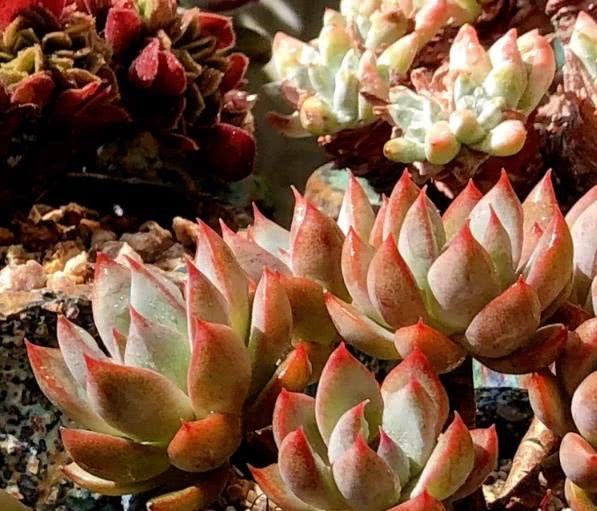
A gardening enthusiast asked: after a succulent plant's leaf cutting sprouts, how should the old leaf be handled so the new sprout can grow healthily? After a succulent leaf cutting sprouts, the old leaf does not need to be handled, because the new leaf will slowly absorb the water and nutrients from the old leaf, and the old leaf will mostly gradually shrivel and dry up until it is completely withered. If the new sprout has already grown but the old leaf is still plump, then you can gently twist the old leaf off and use it for a second round of cuttings.
Should a succulent plant's leaf cutting be put in the sun after it sprouts? After a succulent plant's leaf cutting sprouts, it is best not to put it in the sun, for fear that sun exposure will cause dehydration and death; placing it indoors in a sunny, ventilated spot is enough, and after one month it can be moved outdoors to get half an hour of morning or evening sun, which is better.
After a succulent leaf cutting sprouts, can water be sprayed on the leaves? After a succulent leaf cutting sprouts, spraying water on the leaves is not recommended. Because at this time the young sprout's absorption of water is still very weak, it basically still relies on the old leaf to take in water and nutrients; spraying water will, due to excessive moisture, cause rot and black rot, and if the potting soil is too dry, you can use a spray bottle to moisten the surface soil, and that is enough.
Why does a succulent leaf cutting only sprout without growing roots? In cases where leaf cuttings only grow roots and no leaves, or only grow leaves and no roots, it easily leads to a multi-headed condition; besides, growing roots first and then sprouting seedlings also easily gives a single head. Generally speaking, as long as the leaf piece has not dried up, it will sprout, so rest assured. You might as well gently bury it with soil, water it a little appropriately, and in a bright, indirectly lit, ventilated environment keep the soil slightly moist; this way the leaf will grow before long. For the case of only growing leaves and no roots, some gardening enthusiasts say you can sprinkle some rooting powder, and this way the roots will grow within a few days.
For this kind of situation, actually you still follow the solutions for the previous two situations: regardless of whether the leaf has grown roots, first bury the growth point into the soil, but do not bury it too deep, just 2~3 mm from the soil surface. If you let the leaf grow like this, it will consume a great deal of the mother leaf's nutrients, and you should promptly find a way to let the neck of the newly emerged small sprout touch the soil to encourage it to grow roots.
What is a "whole-leaf cutting"? It uses a complete leaf as the cutting. According to the insertion position, it is divided into two kinds. The flat-lay method: cut off the petiole, lay the leaf flat on the surface of the sand, fix it on the sand surface with an iron needle or bamboo needle, with its underside in close contact with the sand surface; for example, Bryophyllum pinnatum (air plant) produces young plantlets from the leaf margin; begonias produce plantlets from the leaf base or veins; for Begonia rex, whose leaves are relatively large, you can use a small knife to cut at each strong vein, and young plantlets will form at the cut. The other method is the upright insertion method, also called the petiole insertion method: insert the petiole into the sand, with the leaf standing on the sand surface, and adventitious buds will form at the base of the petiole. When Gloxinia (Sinningia speciosa) is leaf-propagated, a small corm first forms at the base of the petiole, and then roots and buds form.
This is a gathering place for succulent plant enthusiasts, sharing succulent care tips; you are welcome to follow and exchange ideas.