Detailed Explanation of the Tree Form Design and Making Methods of Cascade Bonsai
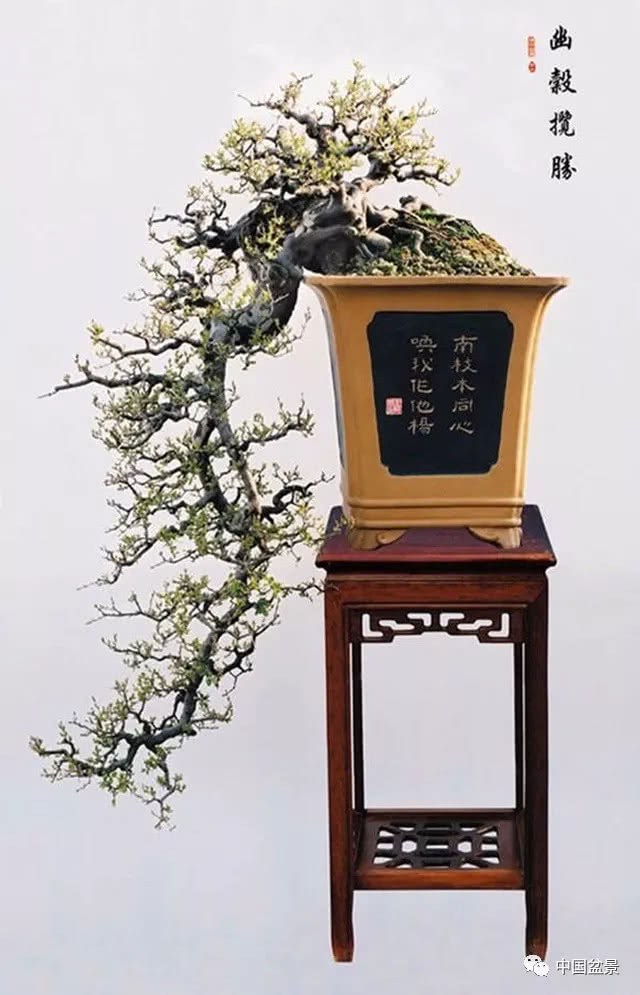
Cascade Bonsai Tree Form Design and Making
Pictures and Text | Hongye Bonsai
(This article is selected from "Hongye Bonsai", copyright belongs to the original author)
Cascade bonsai originated from the inverted pine hanging on sheer cliffs. With its roots exposed and claws bared, battered by fierce winds and scoured by torrential rain, it always clings tightly to the cliff, giving people a feeling of unyielding strength and power reaching the clouds. Therefore, as a typical dynamic-form bonsai, cascade bonsai must emphasize "natural charm, lively rhythm, soaring dynamism, and expressive effect." Its styling essentials are: it should have dramatic momentum, the trunk hanging downward, roots exposed and claws bared, tightly gripping the rim of the pot, fearless in the face of danger, the trunk extending smoothly, with natural proportions, clear pauses and transitions in the curves, and a sense of rhythm. The tree tip should be full of vitality, the branch pads appropriately positioned, with proper give and take, and well-balanced density. The styling steps are as follows:
Step One: The raw tree material should be planted at an angle or laid flat,This avoids the problem of uncoordinated bending at the base of the trunk. Shaping should be carried out promptly; once the trunk thickens, it will be very difficult to meet the requirements of the tree form design.
Step Two: Wrap with wire or palm fiber,If the trunk is too hard, the trunk-splitting method can be used (i.e., use a sharp small knife to make a deep vertical cut at the part of the thick trunk that needs bending, penetrating through the trunk; the direction of the cut should be perpendicular to the direction of bending, then line with hemp fiber or plastic film for protection). During the wrapping process, the requirements are: have the landscape in mind, establish the concept first, let the form follow the idea, and let the scene emerge from the feeling.
Step Three: Select and retain branch supports, keep backup branches, cut off excess branches, and after the form is established, cut off the backup branches.
Cascade style stump bonsai emphasizes raising the roots. Raising the roots not only displays the aged tree appearance but also can somewhat ease the dynamic momentum of the bonsai, creating visual balance. If relying only on root shaping, it cannot satisfy the balance requirements of the bonsai, so decorative stones can be used to achieve this purpose.
Step Four: Pot selection.Generally, a tall cylindrical pot or a bucket-shaped pot is suitable; a shallow pot is not suitable. The position of the pot should highlight the root crown of the tree, as close to the corner of the pot as possible, paying attention to seeking stillness within movement, balancing light and heavy, and stones should be added where stones are appropriate.
Cascade bonsai can be divided into three basic forms based on the length and angle of the trunk hanging downward: large cascade, small cascade, and semi-cascade. If viewed from the perspective of the layout changes of roots, trunk, and branches, cascade style also has many different artistic forms. Examples are as follows:
"Hook Style"Artistic form in which the trunk entirely hangs down and out of the pot rim, with only the roots remaining in the pot, the whole tree appearing as if hung on the pot rim by a hook.
"Probing Branch Style"Cascade artistic form in which the trunk does not hang downward, but rather a branch droops down to form the cascade artistic form. The trunk can be straight, slanting, or lying flat, but should not be too tall, to avoid diluting the artistic expression of the cascade. These three expression forms can respectively be called straight-trunk probing-branch cascade, slanting-trunk probing-branch cascade, and lying-trunk probing-branch cascade.
"Bald Top Style"Cascade artistic form in which a section of the trunk above the pot has no branches or leaves, forming a bald top, with foliage distributed on the downward-hanging trunk outside the pot. Although the bald top is plain, the overall form is rustic and elegant. Suitable for pairing with stones.
When pruning cascade bonsai, one of the most important techniques is pinching. That is, pruning the tender branches and leaves at the top of the cascade to suppress overly fast growth in one direction of the cascade bonsai, allowing the cascade tree to grow evenly. Another use is to control the growth direction of the cascade tree: whichever direction you want the cascade tree bonsai to grow in, simply retain the tender branches in that direction.
For cascade bonsai, on one hand we need to set up and prune the form well, and to ensure it grows according to the designed style, we need to continuously cut off newly grown tender buds and so on in the later stages, so that it grows into a reasonable form. There are also some branches that must be cut off. These are dead branches, poorly growing branches, crossing branches, and branches whose curvature affects the form. These must definitely be removed. First, for healthy growth; second, for greater beauty.
Link 1: Several cascade forms for reference
Fearless in the Face of Danger:This is a single-trunk full cascade form. The trunk tilts at a right angle and gradually extends downward and outward. The curvature angle is relatively large. The exposed roots and bared claws tightly grip the pot soil, and the center of gravity of the tree is outside the pot. This form gives a feeling of upright integrity and power reaching the clouds.
Dragon Probing the Sea:This is a full cascade form commonly given this name. After the vigorous and rugged trunk extends horizontally out of the pot, it does not curve straight downward, but after drooping, turns back and rises upward, then twists and extends outward along vertical and horizontal directions, like a giant dragon soaring.
Hanging Golden Hook:This is another form of single-trunk full cascade. The trunk emerges from the pot surface and sharply forms an S shape hanging to the left or right, with the center of gravity outside the pot. The first main branch slants downward, turns back and rises upward. The trunk extends beyond the bottom of the pot and gently raises its head. The branch tips all rise slightly to coordinate and echo with it, forming a posture of tenacious perseverance and fearless struggle against adversity.
Clear Stream Scooping the Moon:This is a single-trunk cascade form, which can be made into a full cascade landscape or a semi-cascade landscape. The above is the full cascade form. The trunk emerges from the pot surface, droops in a half-moon shape, folds back and extends horizontally. The tail end extends gradually after going beyond the bottom of the pot, with the tail tip pointing upward, graceful in appearance.
Life-and-Death Struggle:This is a wind-blown cascade form. The trunk presses at an angle and extends horizontally from the pot surface, then droops and curves gently inward. The branch supports drift in the same direction as the tail end. All branches and leaves flutter in the wind, elegant and graceful. The form should emphasize dynamism; the branches should be soft and flowing, and must not be stiff.
Clear Spring Watering the Horse:This is a semi-cascade form. The trunk slants downward and grows outward, with a relatively small curvature angle. The hanging tip does not exceed the bottom of the pot. The thick roots are exposed. The first branch curves back and rises upward, forming the entire crown top, shifting the center of gravity toward the roots to achieve overall balance of the center of gravity.
Twin Dragons Bathing in the Sun:This is a double-trunk cascade form. It is best to select a tree with a naturally curved base and two trunks where the upper is small and the lower is large. The lower trunk is the main trunk, styled as a full cascade; the upper trunk is the secondary trunk, styled as a semi-cascade. The two trunks should have variation in form, and attention should be paid to the emotional resonance between the two trunks, striving for mutual pursuit and interest, with branch supports giving and taking appropriately.
Peering into the Valley and Probing the Ravine:This is a falling-branch cascade form. The trunk stands slanting upward, leaning to one side. The first main branch is styled as a falling branch hanging downward, with the branch tip rising upward, elegant and flowing. Although this form goes against the conventional rules of cascade bonsai styling, the trunk slants and the main branch droops and hangs, with a beautiful appearance, making it unique among cascade bonsai.
Valley Ravine Hanging Pine:This is a pine-type turning-back falling-branch cascade form. The trunk slants out from the pot surface and then droops, folding upward in an O shape halfway, with the tail end winding back toward the base. This form has a strong personality, giving a sense of dragon-coiled scenic interest.
Link 2: Example of Making a Large Cascade Bonsai
A stump bonsai whose main trunk's hanging length exceeds the bottom of the pot is called a large cascade bonsai. The large cascade stump bonsai is the most difficult creative form in styling. First, selecting the stump is difficult. In addition to meeting all the conditions for creating a cascade body, the large cascade stump bonsai still has several specific factors:
1. After the stump head rises above the pot surface, there must be a branch support at the sharply bending and drooping part to serve as the key branch of the crown.
2. The trunk's bending and drooping should have dramatic ups and downs, with obvious rhythm and strong three-dimensional spatial variation; avoid soft large arcs and snake-like movement.
3. There must be sufficient hanging length.
4. Branch supports should be distributed reasonably, without obscuring each other.
Large cascade styling focuses on the styling of the first and second branch supports at the part where the stump head rises and then curls and droops. It requires that the main veins of the thick branches should be basically the same as the direction of the drooping trunk, playing a following role. The secondary veins can occasionally reverse to gain momentum, seeking variation and enhancing dynamism. The curvature variation of the newly cultivated trunk and the original trunk should preferably not be on the same vertical plane, but should have three-dimensional spatial variation in front, back, left, right, up, and down directions, in order to achieve reasonable distribution among branch supports and space for light.
The ending of a large cascade stump bonsai is flexible and varied. Due to the phototropism of plants, when the tail tip hangs to a certain length, it will turn upward, which conforms to the growth pattern and also strengthens the changes in rigidity and softness of the drooping trunk. To increase the weightiness of the tail tip, a double-branch ending can also be used, one main and one secondary, one strong and one weak, each with its own appeal. After the work is completed, the tail tip is generally pruned little, to strengthen the tree spirit of the drooping tail tip, while the branch supports in the middle part of the head should be reasonably suppressed to avoid excessive tree vigor, achieving balance with the tail tip.
The large cascade tree form is majestic, lively, with strong trunk variation, full of rhythmic beauty and strength beauty. When styling, one should grasp the overall trend and take the big picture into account. One should reasonably handle the give-and-take relationship among branch supports, and not favor one over another. One should fully exert the author's subjective effort, have pursuits, have personality, and gradually cultivate the form according to the established plan.
Figure 1 is a large cascade form of a mountain pine.
The trunk form combines rigidity and softness, with soft bends combined with hard angles. The two consecutive acute angles at the tail tip are the essence of the trunk form of the entire stump, which can be achieved by cutting off the main bud and using lateral buds. The top support and tail tip are the styling focal points of the entire stump. The top support should mainly use pruning, striving for twisting variation; the tail tip should mainly use wiring, with a long rhythmic transition, so that the timing of formation can be consistent.
Figure 2 is a large cascade form with a double-branch ending. The stump bonsai, through the mutual interweaving of the main and secondary veins at the tail tip, makes the tail tip weighty and becomes the focal point of appreciation. Relatively speaking, the top support and other side supports are all appropriately relaxed, making the stump form properly tight and loose, with the focal point highlighted.
Figure 3 is the original stump form of a mountain orange, with a hanging length of 120 cm and a maximum trunk diameter of 8 cm. This stump is a top-grade choice for a large cascade stump. The trunk rolls and twists with strong spatial variation, natural transitions, sufficient hanging length, high utilization rate of original supports, and strong roots. All of this is enough to make it a rare good stump material.
Figure 4 is the stump form after cutting, rotated 90° according to the characteristics of the large cascade, intended to become a large cascade form.
Figure 5 is the styling design drawing. The characteristic of this styling design is to use the tail tip extending straight up with a horizontal support as the ending main tip vein. Two right-angle sharp bends are newly cultivated, forming a linked 7-shaped branch form, contrasting with the rolling curves of the trunk. The styling seeks contrast and distinctive features within danger.
Wonderful replay:
Chinese bonsai welcomes you!
Enjoy at any timeAppreciation's bonsai exhibition hall
Promote bonsai culture, exchange bonsai techniques!
Appreciate bonsai art, share a happy life!