Why do succulent leaves go soft after being moved outside into the sun?
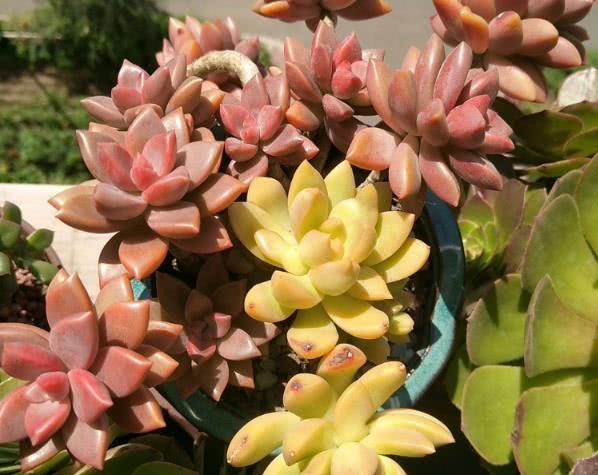
If it is the gentle morning or evening sun, and you have not watered the succulent in the past few days, this is probably normal and means the succulent is short of water. Once the soil temperature in the pot drops, you can give the succulent a little water. Note, however, that right after watering it is best not to put the succulent back out in the blazing sun. At that point there is a lot of water in the pot, and exposing it to strong sun again, especially if the pot has poor airflow, is like putting the succulent in a steamer, and the roots can easily rot.
So in the other case, if the pot is fairly wet and the succulent was still exposed to the blazing midday sun, then soft leaves mean there may be a problem with the roots. Also check whether the leaves have turned transparent. Transparency means the leaves have turned to water. With some succulents, even within the same sun-tolerant species, different individual plants need different amounts of sunlight, and some do not need very strong sun, for example Haworthia cooperi and similar types.
Why do succulent leaves turn red after being in the sun? If you regularly give succulents sun and place them in an open, airy spot where they get full sunlight, their leaves will change colour just like the leaves of trees in a forest in autumn. Of course, this does not mean sun in the high heat of summer, which will sunburn the succulent or even kill it. After being outside for a while, the colour at the leaf tips of the Sempervivum tectorum began to change.
During the period of leaf-cutting propagation, succulents do not need much light, and strong midday light in particular should be avoided, otherwise it will use up the nutrients for growing new shoots. Usually placing them in a shady spot or under diffused light is enough. Keep the soil slightly moist, which helps encourage rooting, and also ensure good airflow, since a ventilated environment is essential. Generally after two or three weeks you will see many roots and the beginnings of a succulent, and at that point it can get some sun. Also, the nutrients in the mother leaf will gradually be used up, which is normal.
The regions where succulents grow range from the edges of deserts to mountainous areas, so some varieties, such as Saussurea involucrata, can withstand hot weather better than most Echeveria, while other varieties native to mountainous areas can withstand low temperatures of 4°C. The differences are considerable, and ordinary Echeveria is still best suited to growing between 15°C and 30°C. Echeveria is a summer-type succulent, meaning the warm season is its peak growing period. In winter, below 12°C it has a short dormant period during which growth pauses, and below 10°C it is best moved indoors to a bright spot to keep it warm. At all times, try to keep Echeveria in a cool, airy place.
Drought-tolerant succulents like dry conditions and easily rot in damp environments. Because humidity in Southeast Asia is relatively high, growing succulents requires care. Normally it is enough to pour a small amount of water on the soil around the roots of the plant, the aim being to keep the potting soil moist. If it rains, move the succulent to a sheltered, airy spot under the eaves to avoid the rain, and stop watering for several days, until the soil begins to dry out before watering again. Watering should also be reduced during the winter and summer dormant periods.
This is a gathering place for succulent lovers, sharing succulent care tips, and you are welcome to follow and join the discussion.