This tiny insect actually learned to dive in order to find food
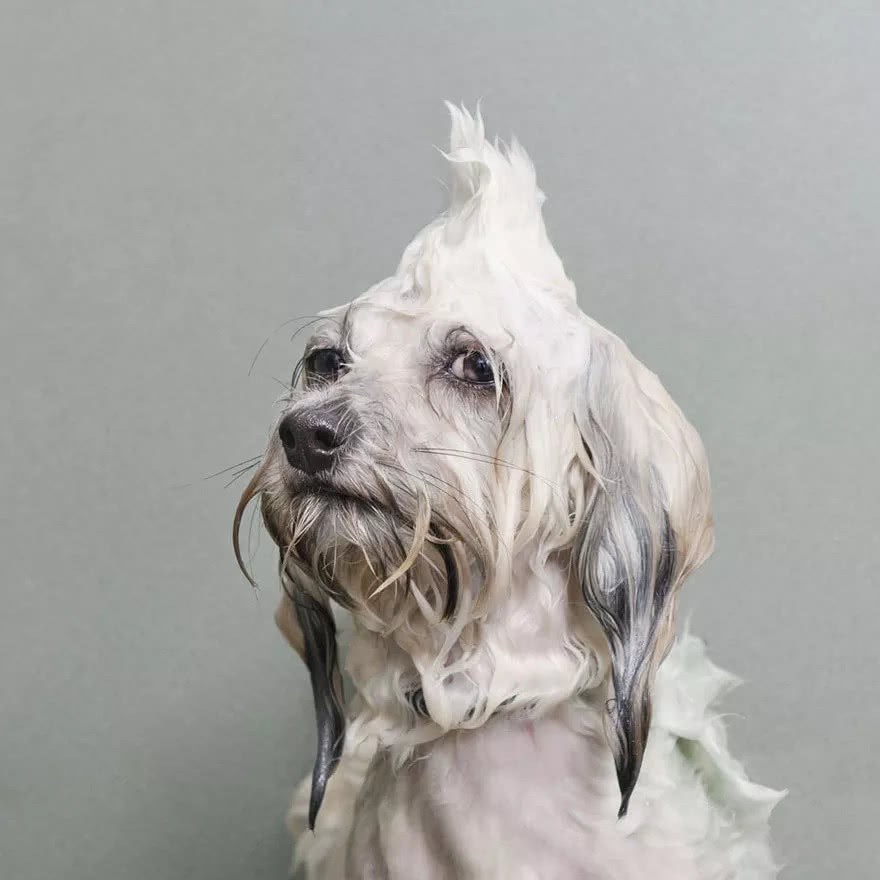
For many small land animals, "diving" is an extremely challenging endeavor. Never mind actually diving - just getting wet is enough to make them look utterly bedraggled.
For instance, for a dog, the effect is something like this
hello, who are you? Image: Sophie Gamand
And for a cat, it turns into this
hello, do you guys need something? Image: bored panda
So then, what is the situation like for small insects?
Bug alert! Bug alert! Bug alert!
Massive insect outbreak, all personnel please evacuate the area immediately!
At first glance, insects seem able to calmly "skim across the water's surface" without getting wet. However, if you force them underwater, you will discover thatmost insects---still get soaking wet, trapped in the water, unable to break free, no better off than your dog or cat.
Of course, those insects with built-in paddling skills don't count. Image: Pixabay
But! This is not the case for the tiny insect that lives by Mono Lakewith its "special skills" - the alkali fly(Ephydra hians).
An alkali fly at Mono Lake. Image: Judy Gallagher / Flickr
Even the great writer Mark Twain, 150 years ago by Mono Lake, marveled: "You can put them in the water as long as you like, and they don't mind at all, they are only proud of it," and "the moment you let them go in the water, they float easily to the surface, and when they emerge they are drier than a freshly printed patent office document."
An alkali fly casually floating back to the surface after diving. Image: Van, F. B. et al./Proceedings of the National Academy of Sciences (2017)
The secret of the "air diving suit"
So how exactly do these alkali flies transform into instant "submarines," entering the water without getting wet?
Careful observation reveals that when alkali flies crawl along the limestone into the water, theyform an air bubble around their body and wings, as if putting on a self-service "air diving suit" at the moment of entering the water. Most of their body is enveloped within it, leaving only the mouthparts exposed for eating.
An alkali fly wearing its "air diving suit." Image: Van, F. B. et al./Proceedings of the National Academy of Sciences (2017)
After eating and drinking its fill at the bottom, it releases its tiny claws from the limestone, letting itself float upward. At the instant it reaches the surface, the "diving suit" automatically bursts, and the alkali fly takes the opportunity to fly off the water's surface.
The alkali fly's amazing diving ability is truly enviable, and how this unassuming little creature acquired its "air diving suit" has long been a mystery.
An alkali fly diving in Mono Lake. Image: Van, F. B. et al./Proceedings of the National Academy of Sciences (2017)
To solve this mystery, Professor Michael Dickinson of Caltech led a team, following in Mark Twain's footsteps, to visit Mono Lake once again, hoping to uncover the secret of the alkali fly's "air diving suit."
Mono Lake, beautiful but hiding deadly perils. Image: Vezoy / Wikipedia
Is it all the lake water's fault?
When they arrived at Mono Lake, they found that although the scenery is stunning, the lake water is highly alkaline, and only a very few algae can survive in it. Yet the alkali flies seem to live there carefree (truly worthy of the name "alkali" fly!). After some surveying, they decided to approach the research fromthe lake water's compositionandthe alkali fly's bodythese two angles.
Before the formal experiments began, they needed quantifiable metrics and apparatus to measure the "wetness level" of the test subjects. One can imagine that the "wetter" the test subject in water, the more "dragging" it would be when leaving the water, and the more work would be required.
To this end, Michael's team designed an ingenious device: after fixing the insect to a small rod, they "pushed" the insect into the water, then pulled it back out (the insect: how tragic). During this process, optical sensing equipment was used to measure the work required for the insect to enter and exit the water surface, thereby reflecting the test subject's wetness level.
Diagram of the device for measuring the force required to enter and exit water, with sample data. Image: Van, F. B. et al./Proceedings of the National Academy of Sciences (2017)
Michael's team first wanted to see what was special about Mono Lake's water, and whether some component was keeping the alkali flies dry. However, they unexpectedly discovered thatthe lake water contains large amounts of Na2CO3, making it even easier to get "wet" than other ordinary lake water. In experiments, various fly species of similar body length to the alkali fly all became very "wet" in this lake water, and once they entered the water, they could hardly escape.
Wetness levels of various fly species. The smaller the Recovered Work, the "wetter" (the alkali fly is in the red box). Image: Van, F. B. et al./Proceedings of the National Academy of Sciences (2017)
The seaweed fly also capsized in the water. Image: Van, F. B. et al./Proceedings of the National Academy of Sciences (2017)
It seems the lake water can only "make things worse" and has no real effect. The core technology must still be controlled by the alkali fly itself.
More bristles means more waterproof?
If you can't see any difference with the naked eye, then magnify and observe again?
So the researchers used a scanning electron microscope to take high-definition images of other fly species, including the alkali fly. They found thatcompared to other flies, the alkali fly's surface is covered with the densest bristles。
Could "good hair volume" be the reason alkali flies don't fear getting wet?
Subsequent analysis found that fly species with more bristles had lower wetness levels. However, this seems to beonly one of the factors that keeps the alkali fly "dry". Although the alkali fly has the greatest bristle density, it is only 15% more than the seaweed fly (Fucellia rufitibia), yet its waterproofing effect is far better than the seaweed fly's.
Microstructure of various fly surfaces (the alkali fly in the red box has dense bristles on its surface). Image: Van, F. B. et al./Proceedings of the National Academy of Sciences (2017)
So, is there any other reason?
The research team next became interested inthe glossy, close-fitting "armor" on the surface of the alkali fly's bristles- they used gas chromatography-mass spectrometry (GCMS) to analyze the chemical composition of this armor, and found thatmost of it consists of two types of long straight-chain alkanes: pentacosane and heptacosane, which differs from all other fly species.
Could this be the real answer to why alkali flies don't get wet?
Eager to crack the case, the research team gave these alkali flies a bath in hexane, washing off all these long straight-chain alkanes, then conducted the experiment again. Sure enough, without their armor, the alkali flies instantly lost their usual swagger in Mono Lake's water, getting wet just like other flies after entering the water.
The alkali fly's surface is mainly covered with straight-chain pentacosane and heptacosane. Image: Van, F. B. et al./Proceedings of the National Academy of Sciences (2017)
Thanks to the alkane armor!
Why can the long straight-chain alkane "armor" help the alkali fly waterproof itself?
Actually, when liquid contacts a rough surface, there are mainly two states: The first state is the Wenzel state: the surface gaps are filled with liquid, making the entire solid surface very wet (similar to your pet). The second state is the Cassie-Baxter state: the gaps in the rough surface are filled with gas, similar to the alkali fly's layer of "gas diving suit."
The alkali fly's surface is mainly covered with straight-chain pentacosane and heptacosane. Image: Van, F. B. et al./Proceedings of the National Academy of Sciences (2017)
Which state specifically appears after solid-liquid contact depends on factors such as charge interactions at the contact surface. For example, in lake water with high concentrations of sodium carbonate, the electrostatic attraction between most insects' body surfaces and the lake water is strong, presenting the first state, thus causing wetness; while the alkali fly's dense bristles and long straight-chain alkane armor effectively reduce the electrostatic attraction between the alkali fly's surface and the lake water, thus presenting the second state, giving the alkali fly its layer of "air diving suit."
This cool diving method is actuallythe result of the alkali fly evolving to adapt to an extreme environment. If its mechanism is fully understood, it could also provide ideas for developing new hydrophobic materials.
Nothing can stop the alkali fly's determination to go into the water to find food!
The power of a food lover is infinite! Image: Floris van Breugel / NPL
Research anecdotes
During their survey at Mono Lake, the researchers accidentally discovered a strange phenomenon - whenever they stood close to the lakeshore, some alkali flies on the nearby lake surface would lose their ability to "stay dry," becoming trapped after entering the water.
At first they were quite puzzled. Could the alkali flies be scared of people? It was only after seeing the effect of the hexane bath on the alkali flies that they realized it might have beentheoil-based sunscreenon their bodies causing the trouble!
Because of the heat, sunscreen would drip with sweat into the nearby lake water, bringing some oily substances into the lake, dissolving the straight-chain alkanes on the alkali flies' bodies, and ultimately causing these alkali flies to unfortunately get wet.
The alkali fly pleads innocence. Image: Floris van Breugel / NPL
This article is authorized for republication from I Am a Scientist iScientist.
I Am a Scientist
iScientist
id: IamaScientist
"I am a scientist, and I do science communication."
Calendar Girl's today's avatar
Shore fly family Hydrellia griseola
This article was first published on Guokr.com I Am a Scientist iScientist