This too shall pass, just like life, the universe, and everything
Mammoth's New Story
In 2018,
Teacher Ye Mammoth brought us a brand-new story.
On that tiny blue planet far out on the Orion Arm of the Milky Way,
How do the plants and animals think, and how do they survive?
Every weekend at midnight, we take you on a tour.
Blue Star Survey Notes
This too shall pass
This is the final fate
[Fragment of thought activity record0103792】
(translated into local language)
Lately I have been exploring ruins.
At first I found it a bit strange, since no ruins had ever been discovered before. But I soon figured it out. These ruins do not take up a large proportion of the Blue Star's surface, and most of them are covered in lush plants, so if you do not look closely, they really are not easy to spot.
But once you are familiar with the patterns of these ruins, finding them is a piece of cake. Sometimes I can find several in a single day. After all, they are just sitting there, and they are even connected by flat roads - though these are often covered, cut off, or broken by plants.
Exploring ruins is fun. This kind of fun is different from interviewing organisms. This kind of fun is like exploring and solving a puzzle, discovering clues one by one and then piecing them together into the truth of what happened.
And the truths hidden in these ruins are so many that I feel I cannot comprehend them.
Let me first record a few of my guesses.
First, the organisms that built these ruins once spread across the entire Blue Star, except for the oceans and places that were too cold. This is what I am most certain about. It does not take much effort to see that although the ruins in different places are divided into many areas, the structure and function of each smallest unit within them are similar. This shows that the species that once lived here were all very similar. I was originally confident that I could infer the living habits and physical characteristics of this organism, but some later discoveries made me a little hesitant.
Second, these organisms needed light. Whether it is the large holes opened in the walls of their dwellings or the devices suspended from the ceiling in every room, both prove this. In some ruins, the devices on the ceilings can still work, and they really do emit light. They may, like Blue Star plants, be able to obtain energy from light.
Third, I think their body sizes may have varied greatly. In almost every ruin, some buildings can be found, often in the central area of the ruin, and the distance between each floor is very large. Perhaps some taller organisms lived here, but I have not found the corresponding living facilities. Perhaps these were only places where those tall organisms attended activities, while their living areas were elsewhere. In addition, I found some statues, which are very likely depictions of this kind of tall organism.
Also, I believe this species may have domesticated some other organisms and driven those organisms extinct in the wild. This is because I often see the remains of a strange organism. They have metal shells, possess four limbs or more, and the end of each limb is wheel-shaped. It can be seen that this shape is very suitable for running quickly on flat ground. Considering the ruins where these organisms are found, as well as the flat roads connecting these ruins, I think this was designed for this wheel-limbed organism. This also shows that the wheel-limbed organisms and the organisms that built these ruins once lived together.
Outside the ruins, I occasionally also find this wheel-limbed organism. But every one of these organisms found on the Blue Star is already dead and can no longer move. I have dissected several of these organisms of different appearances and found that their internal structures are basically the same.
Although the appearance and material of this organism are quite different from other organisms on the Blue Star, considering the huge number of remains they left behind, I think it is still more appropriate to classify them as organisms.
I am still fairly confident about these guesses.
[Fragment of thought activity record0104136】
(translated into local language)
Today I found an interesting building in the ruins. Interesting is not enough to describe it... perhaps I should say it is a very important building.
In this building, many older things are stored. Although I cannot tell what most of them are for, there are still some that can be understood at a glance - they are the remains of some ancient organisms.
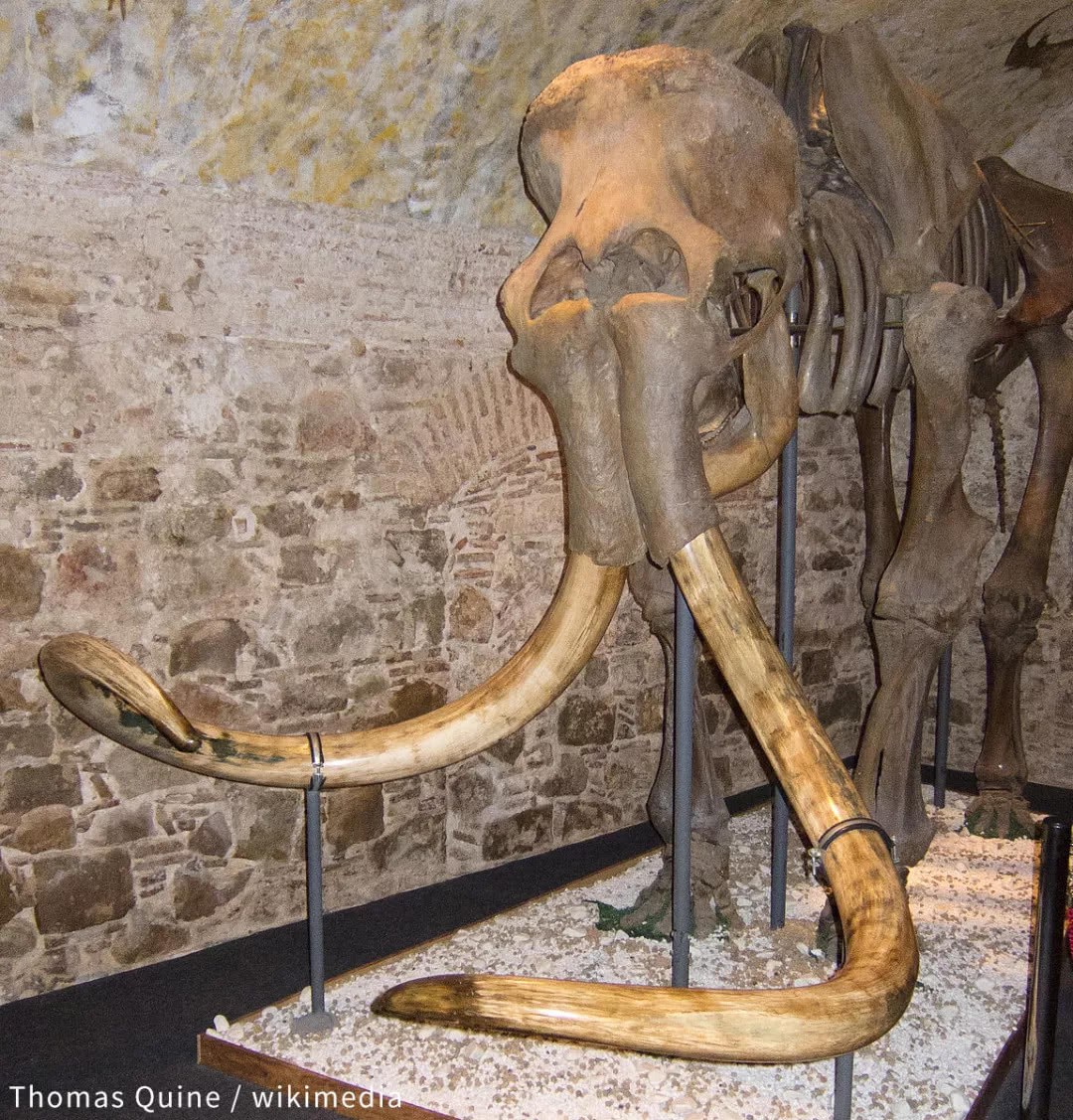
Among them, what concerns me most is the remains of a four-legged animal. Just by looking at their strong leg bones, one can imagine their astonishing weight; looking at the long ribs, one can imagine how broad their chest cavities once were; but as for the two huge bones extending from the skull, I do not know what their function was.
On the wall beside this set of bones, there is also a restoration drawing of this organism (editing authorized. Hereafter replaced with "true mammoth"). Although it has already cracked and faded somewhat, and some climbing vines have grown over it, the original appearance can still roughly be made out.
Huge, steady, gentle. I can even feel their gaze. It is as if they have seen through time, looking toward me, and also looking past me. As if they had already seen the ending.
And they are already extinct. (severe emotional fluctuation)
[Fragment of thought activity record0104298】
(translated into local language)
Before coming to the Blue Star, I had once seen some materials about the Blue Star. The records say that some huge animals once lived on the Blue Star, and whether in the sky, on land, or in the sea, all were their hunting grounds. But about 65 million Earth years ago, these animals went extinct.
And in the long ages before that, countless species appeared, reproduced, grew strong, and then went extinct.
Even on the Blue Star today, organisms are still constantly appearing and going extinct.
The species that once built this building has now also disappeared. Perhaps it also went extinct.
Even though they once built so many structures, leveled mountains, cut into the oceans, and perhaps even scarred the sky. They left so many traces, marking that they had once lived here, and perhaps they were once proud of this.
But they still went extinct, like trilobites, like dinosaurs, like true mammoths.
The tree of life puts out branches, grows leaves, and then lets them wither and fall.
The universe watches galaxies be born from nothingness, spinning and scattering energy, ultimately expanding, exploding, or collapsing, until everything returns to nothingness. The universe merely watches coldly.
I rarely consider problems from this angle. Although I have long known that everything will disappear. The Blue Star, the galaxy where the Blue Star is located, my home planet, and even life, the universe, and everything.
But none of this felt real until the moment I saw the true mammoth bones.
Everything will be born. Everything will ultimately be destroyed.
This is the final fate.
[Fragment of thought activity record0104299】
Recorder, do I have emotional fluctuations?
[Thought recorder feedback]
No.
Want to see more of the "Blue Star Survey Notes" series? The portal is here:
Calendar Girl's avatar today
Elephantidae African elephant
This account is a signed account of NetEase News and NetEase Hao "Each Has an Attitude"